Critics’ reviews

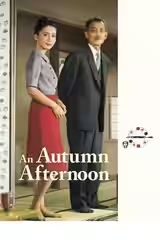
An Autumn Afternoon (1962)

11 reviews from 11 publications. Critics’ score 85: 9 positive, 2 mixed, 0 negative.

Back to our review of An Autumn Afternoon

85
Positive
9
Mixed
2
Negative
0

Most critics receive Ozu’s final film with something close to reverence. The reviews describe it as mellow, tender and sad, with the familiar story of a widower marrying off his daughter carrying extra weight for being the last time Ozu told it. The praise clusters on tone: melancholy cut with dry, ironic humour, and a family drama in which father and daughter each give something up for the other. The colour also draws notice, a muted palette broken by careful splashes of red.

The spread is narrow, with no outright dissent. Slant Magazine is the coolest, finding a work of bemused resignation rather than tragedy, though it admires the hard-edged visual style. Eye for Film calls it touching but not among Ozu’s most memorable. The Evening Standard, at the other end, ranks it alongside Tokyo Story, and The New Yorker adds a note others pass over: that beneath the melancholy sits pointed social criticism of postwar nostalgia.

Time Out
★★★★★ · TJ
100

The review calls Ozu’s final film a movingly valedictory affair. It says the familiar story of a widower marrying off his daughter carries added poignancy.

Read the full review →
Total Film
12 May 2014 · ★★★★★ · Philip Kemp
100

Kemp describes the film as mellow, rich in ironic humour, and gently melancholy. He praises its variations on Ozu’s themes of marriage and inter-generational tension, while noting its view of loneliness as universal.

Read the full review →
The AV Club
1 October 2008 · A · Keith Phipps
95

Phipps regards Ozu’s final film as an affecting, bittersweet meditation on change. He praises Ozu’s ability to make everyday images and family transitions newly resonant.

Read the full review →
Evening Standard
16 May 2014 · Derek Malcolm
90*

Malcolm regards Ozu’s final film as the work of a master and equal to Tokyo Story. He praises its poignant, humorous portrayal of family life and its universal resonance.

Read the full review →
The Guardian
15 May 2014 · Peter Bradshaw
90*

Bradshaw regards Ozu’s final film as exquisitely tender and sad, a superbly composed family drama. He especially praises its delicate depiction of family burdens and the father and daughter’s painful mutual sacrifices.

Read the full review →
Sight and Sound
85*

The critic regards Ozu’s final film as one of his most moving works, balancing emotional force with wry humour. They single out its subtly muted palette and occasional splashes of red for particular praise.

Read the full review →
The New Yorker
22 June 2010 · Richard Brody
85*

Brody presents the film as humane and politically incisive, with a tender understanding of its characters. He singles out its blend of melancholy and social criticism, especially in its treatment of postwar nostalgia.

Read the full review →
The New York Times
8 May 1973 · Vincent Canby
85*

Canby presents the film as a profound work and a fitting final film from Ozu. The accessible headline offers no further detail about what the review singles out.

Read the full review →
RogerEbert.com
64*

The page could not be accessed, so the critic’s verdict and any specific praise or complaint cannot be verified. The available page text provides no review details.

Read the full review →
Slant Magazine
28 September 2008 · ★★★ · Eric Henderson
60

Henderson sees Ozu’s final film as a quietly affecting work of bemused resignation rather than a tragedy. He especially praises the increasingly precise, hard-edged visual style and its carefully balanced use of color.

Read the full review →
Eye for Film
28 February 2007 · Merlin Harries
75*

The critic finds the film touching and thought-provoking, though not among Ozu’s most memorable works. They praise its warmth and poignant depiction of the bond between father and daughter amid social change.

Read the full review →

Ordered by the weight we give each publication, then by score. Scores are normalised to 100; * means inferred from an unrated review. Summaries are ours, not quotations; follow the links for the reviews themselves. How we rate