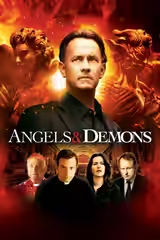
Most critics find Angels & Demons a brisker, more energetic film than The Da Vinci Code, and most of them still do not much like it. The praise clusters on the look of the thing: the reconstructions of Baroque Rome, the production design and the cinematography are mentioned approvingly even by reviewers who are otherwise unimpressed. Ewan McGregor’s performance as the pope’s secretary is singled out more than once, and Hans Zimmer’s score gets a nod.
The reservations are about the plot. Reviewers call the film overstuffed, heavy on exposition and rushed in its puzzle-solving, with leaps of logic that undercut the pace it is praised for, and several say its ideas about science and religion go nowhere. The spread is wide. The Hollywood Reporter is alone in calling it thrilling and warm-hearted; NME finds it formulaic and without a point of view; The New Yorker goes further and calls it exploitative, religious ritual turned into a creep show.
H
The Hollywood Reporter
4 May 2009 · The Associated Press
75*
The critic finds the sequel more thrilling and briskly paced than its predecessor, with a warm-hearted finish. They praise the simplified story and the spectacular reconstructions of Baroque Rome.
Read the full review →R
RogerEbert.com
13 May 2009 · Roger Ebert
64*
The page could not be read, so its verdict and any specific praise or complaint cannot be verified. The available text contains only a browser-check message.
Read the full review →S
Screen Daily
5 May 2009 · Mike Goodridge
64*
The review's verdict cannot be determined from the accessible page. No praised or criticized element is visible.
Read the full review →N
The New York Times
15 May 2009 · A.O. Scott
64*
The page did not provide the review text, so its verdict cannot be established. No specific praise or complaint can be verified from the accessible content.
Read the full review →T
Total Film
6 May 2009 · ★★★ · Neil Smith
60
The critic finds the sequel a kinetic but mechanical improvement on its predecessor, though it remains overstuffed and pompous. Hans Zimmer’s dynamic score and the busy set-pieces are singled out for praise.
Read the full review →A
The AV Club
14 May 2009 · C · Tasha Robinson
57
Robinson finds the film an exhausting, overlong thriller whose clue-solving and implausible leaps of logic undermine its pace. She praises the sumptuous production design, cinematography, and beauty of Rome, but says they become oppressive over the film’s length.
Read the full review →R
Radio Times
★★ · Sue Robinson
40
Robinson calls the film disappointing. The review criticizes the adaptation for failing to match the original novel’s murder, betrayal and religious conspiracies.
Read the full review →G
The Guardian
10 September 2009 · Rob Mackie
40*
Mackie finds the film overblown and weighed down by exposition, though he enjoys its denouement. He singles out the big twist as a payoff after the lengthy explanations.
Read the full review →T
Time Out
12 May 2009 · ★★ · Trevor Johnston
40
The 2/5 rating signals a negative verdict, and the description frames the film as relying on faith that it will repeat the first film’s commercial success. The available text singles out that box-office expectation, rather than a creative strength, as the guiding principle.
Read the full review →V
Variety
5 May 2009 · Todd McCarthy
40*
McCarthy finds the film more energetic and less aggravating than its predecessor, but says its contrived plotting and rushed timeline hold it back. He praises the visually spectacular climax and the convincing Roman atmosphere.
Read the full review →E
Empire
23 May 2006 · Kim Newman
35*
Newman finds the film more entertaining than The Da Vinci Code, but ultimately still tosh. He faults the implausible supporting characters and Ron Howard’s plodding direction despite the more urgent pace.
Read the full review →L
Los Angeles Times
15 May 2009 · Betsy Sharkey
30*
Sharkey finds the film an overstuffed action thriller that fails to give its ideas meaningful direction. She praises its visual design and breakneck pace, while criticizing its dialogue and reverence for Dan Brown’s hackneyed vision.
Read the full review →N
The New Yorker
17 May 2009 · David Denby
30*
Denby finds the film hollow, exploitative conspiracy-minded entertainment rather than a meaningful inquiry into religion. He singles out its relish for religious ritual turned into a creep show of sadism and self-mutilation.
Read the full review →E
Evening Standard
10 April 2012
25*
The critic finds the film noisy, overplotted and short on the guilty pleasures that made its predecessor entertaining. Ewan McGregor’s portrayal of the pope’s secretary is singled out as a welcome display of genuine acting.
Read the full review →S
Slant Magazine
13 May 2009 · ★/4 · Nick Schager
25
Schager pans the film as a dull, geriatric adventure that substitutes the appearance of action for excitement. He particularly criticizes how its elaborate historical puzzles are rushed through and reduced to afterthoughts.
Read the full review →P
Paste
15 May 2009 · Robert Davis
65*
Davis calls it a decent, more exciting thriller than The Da Vinci Code, though it does not turn its ideas into genuine suspense. He praises the film’s sustained science-versus-religion theme and its playful plot twists, while criticizing its heavy-handed symbolism and thin characterization.
Read the full review →D
Den of Geek
10 May 2009 · ★★★ · Doralba Picerno
60
Picerno finds the film an enjoyable, tightly paced thriller, though its crowded plot leaves the characters underdeveloped. She singles out Rome’s striking visuals and production design as the film’s real strength.
Read the full review →E
Eye for Film
14 May 2009 · Jennie Kermode
55*
Kermode finds the film effective as light entertainment but criticizes its implausible science and predictable plot. She praises the smooth direction and engaging performances, especially those of Tom Hanks and Ewan McGregor.
Read the full review →N
NME
13 May 2009 · Owen Nicholls
10*
Nicholls gives the film a harshly negative verdict, finding it formulaic and lacking a point of view. He singles out the screenplay for prioritizing plot over character, theme and engaging dialogue.
Read the full review →Ordered by the weight we give each publication, then by score. Scores are normalised to 100; * means inferred from an unrated review. Summaries are ours, not quotations; follow the links for the reviews themselves. How we rate