Critics’ reviews

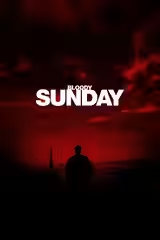
Bloody Sunday (2002)

8 reviews from 8 publications. Critics’ score 75: 6 positive, 2 mixed, 0 negative.

Back to our review of Bloody Sunday

75
Positive
6
Mixed
2
Negative
0

Most critics come away shaken and persuaded. Six of the eight reviews are positive, none negative, and the praise falls in two places. The first is the camerawork: the jittery handheld style is credited with making the day feel immediate while keeping the chaos clear, and the Los Angeles Times calls the result exceptional advocacy cinema. The second is James Nesbitt as Ivan Cooper, the harassed idealist leading the march, whose frazzled, naturalistic performance is singled out by nearly every reviewer as the film’s emotional centre; Empire calls it his best work.

The reservations are modest and scattered. The AV Club thinks the attempt to humanise the British soldiers is unnecessary; Slant notes how little historical context the film supplies; IndieWire finds the visual approach sometimes slows the momentum rather than driving it. The spread is narrow, running from approving to enthusiastic, and the two more muted reviews offer description rather than complaint.

Los Angeles Times
18 October 2002 · Kenneth Turan
90*

Turan calls the film compelling, exceptional advocacy cinema that does full justice to the day’s tragedy. He especially praises the jittery handheld camerawork for making the events feel immediate while keeping the chaos dramatically clear.

Read the full review →
The Guardian
25 January 2002 · Peter Bradshaw
88*

Bradshaw finds the film visceral and compelling, and says it demands to be seen. He singles out James Nesbitt’s performance as the harassed idealist leading the march.

Read the full review →
Slant Magazine
5 September 2002 · ★★★/4 · Ed Gonzalez
75

Gonzalez finds the film gripping and overwhelmingly dread-filled, while noting its limited historical context. He praises James Nesbitt’s naturalistic, frazzled performance as Ivan Cooper.

Read the full review →
The AV Club
11 October 2002 · Scott Tobias
75*

Tobias finds the film powerful and immediate, while faulting it for an unnecessary attempt to humanize the British soldiers. He especially praises its documentary-style camera work and the emotional center provided by James Nesbitt’s performance.

Read the full review →
Empire
1 January 2000 · Alan Morrison
70*

Morrison finds the film emotionally effective as a human tragedy that transcends sectarian divisions. He singles out James Nesbitt’s career-best performance for grounding the story in a personal response.

Read the full review →
IndieWire
8 February 2002 · festival review · Eddie Cockrell
70*

Cockrell finds the film a vivid, timely and even-handed account of a tragic confrontation, though its visual approach sometimes undercuts the conflict’s momentum. He praises its urgent, eye-opening portrayal of regional history and its effort to convey competing perspectives.

Read the full review →
Time Out
· TJ
65*

The available page metadata identifies this as a review but does not reveal the critic’s verdict. Its description singles out the eyewitness-based reconstruction and 24-hour timeframe.

Read the full review →
Screen Daily
22 January 2002 · Colin Brown
64*

The page is a review of the 2002 film, but its verdict is not visible. The accessible text provides no specific praise or criticism.

Read the full review →

Ordered by the weight we give each publication, then by score. Scores are normalised to 100; * means inferred from an unrated review. Summaries are ours, not quotations; follow the links for the reviews themselves. How we rate