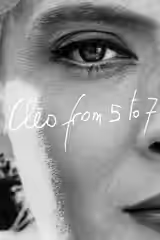
The reviews are almost uniformly warm. Most critics place the film among the key works of the French New Wave and praise Varda’s Paris above everything else: the streetscapes shot in natural light, the overheard fragments of city life, and the way one woman’s anxious two-hour wait becomes a way of looking at everything around her. Jean Rabier’s photography is singled out more than once, and several notices admire how freely Varda handles time, space, colour and genre, including the playful film-within-a-film.
Reservations are thin and the spread is narrow, with most scores clustered in the eighties and nineties. The Evening Standard is the coolest of the modern notices, valuing the film chiefly as a record of a vanished era, while Slant notes that it resists being claimed as either a feminist or an anti-feminist work. The single mixed review, Bosley Crowther’s for The New York Times in 1962, is the only one from the film’s first release, and its reasoning is not available to us.