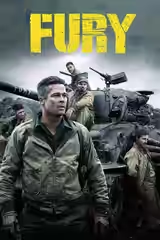
The reviews lean cautiously favourable on Fury, with praise clustering around the tank battles, convincing military detail and performances. Critics repeatedly single out the cramped conditions inside the tank and the physical force of combat, finding the action persuasive even when the writing disappoints. Brad Pitt draws particular praise for his charisma and restraint, while several reviews credit the crew’s performances with giving familiar wartime roles some human weight.
The spread is wide, and the central disagreement concerns what the brutality achieves. The Wrap sees a thoughtful, humane account of war; Slant Magazine argues that the film glorifies warriors while presenting its violence as an anti-war message. Reservations elsewhere cluster around thin characterisation, heavy-handed themes and a climactic battle that strains credibility. Even some admirers find the storytelling conventional, while the harsher reviews see technical accomplishment offering little insight into the suffering depicted.
L
Los Angeles Times
16 October 2014 · Kenneth Turan
90*
Turan calls Fury a memorable addition to the war-movie canon, praising how it refreshes traditional expectations with a modern sensibility. He singles out its painstaking physical realism and unflinching depiction of violence.
Denby calls Fury one of the great war movies and praises its visceral, coherent action staging. He also singles out the tank crew’s performances, while criticizing Norman’s clichéd character and the scene that forces him to kill a prisoner.
Sexton calls the film extraordinarily intense and unmissable, while noting it is less overwhelming than Come and See and less ambitious than Saving Private Ryan. He praises its graphic violence and unsparing detail in depicting tank warfare.
The critic finds the film soulful but unoriginal, with a problematic jingoistic subtext. He praises the visceral battle scenes, especially the Sherman’s clash with a German Tiger.
Papamichael presents the film as a heart-pounding war drama. She singles out Logan Lerman’s replacement driver as the perspective through which the reality of conflict becomes clear.
The review regards the film’s brutal ugliness as an appropriate way to tell a war story. It singles out the graphic violence and the damage war has done to the characters.
McCarthy calls it a good, solid World War II movie, praising Brad Pitt’s performance while faulting the climactic stretch for feeling grandiose. He singles out the apartment encounter as the film’s strongest passage for its portrayal of war’s damage beyond the battlefield.
The available standfirst frames the film as a revival of Greatest Generation tropes, but does not disclose the critic’s full verdict. It singles out the film’s suggestion that hell lies somewhere other than other people.
Kermode finds the film stirring but overly macho, with character and spiritual themes taking a back seat to action. He praises Steven Price’s boisterous score, while noting that the tank setting is used less effectively than in Lebanon.
The critic finds the film’s violence shocking but ultimately shallow, with its bleak view of war failing to add up to a meaningful argument. He praises the convincing gore while faulting the film for treating ugliness as an end in itself.
Clarke gives the film a mixed-to-positive review, describing it as a gutsy, old-fashioned war epic. She singles out Brad Pitt’s charisma as the force that pulls it along.
Kohn finds the film visually striking and viscerally effective, but says its blunt writing and themes leave it shallow. He singles out Roman Vasyonov’s cinematography for creating a compelling, hyperreal atmosphere.
Nathan finds the film persuasive in its depiction of tank warfare but undermined by an overwrought, familiar story. He praises the grim, convincing battlefield atmosphere, while faulting the crew’s contrived characterization.
Cataldo finds the film too solemn and unimaginative, faulting it for dressing up violence as an anti-war message while glorifying warriors. He singles out its reliance on faceless villains and tired clichés instead of examining how conflicts begin and continue.
Edelstein finds the film powerful in places but ultimately undermined by a return to conventional, morally muddled action. He praises Pitt’s stillness and the unsettling scenes that expose the soldiers’ brutality, while criticizing the formulaic climax.
Scott’s verdict is largely negative, finding the film technically accomplished but intellectually uncurious. He criticizes its gore-heavy approach for offering little insight into war.
Debruge finds the film disappointingly bland, with cardboard characters and an implausible climactic battle. He praises its researched military detail and the tense atmosphere inside the tank.
Hammond calls the film one of the year’s best and perhaps the best war film in decades. He praises Brad Pitt’s performance and the gripping, human drama, while noting its violence.
The critic finds the film unflinching and powerfully humane, with its brutality serving a thoughtful vision of war. Brad Pitt’s willingness to play an unlikable character is singled out for praise.
Goble finds the film a sturdy, riveting war actioner that refuses to idealize battle. He praises its unsettling portrayal of war’s persistence and Brad Pitt’s quietly expressive performance.
Kaye calls the film a pretty good but ultimately flawed war movie, held back by thin characters and heavy-handed moments. He praises its visceral tank battles and haunting depictions of combat’s aftermath.
The review finds the film a harrowing, effective account of war that avoids gung-ho heroics. It especially praises the tank crew’s believable camaraderie and performances, while noting that some scenes stray into war overload.
The review finds Fury a solid but uneven war film, with Brad Pitt’s performance standing out. It also praises the practical tank combat for giving the action a convincing, tactile quality.
10 October 2014 · festival review · Simon Reynolds
65*
Reynolds finds the film a tough, testosterone-fuelled throwback, though not a war-movie classic. He praises the cast and sustained battlefield tension, but says a mid-film interlude slows the pace.
Chen finds Fury solid, though its character work and brotherhood theme do not fully land. He praises the performances and thrilling tank battles, while noting unsettling imagery that conveys war’s horrors.
The review finds the film bluntly intense but ultimately weakened by thin characterization and an unfocused second half. It praises the effectively staged tank battles and the performances of Brad Pitt and Logan Lerman.
McIndoe criticizes the film for turning its depiction of war into masochistic machismo, obscuring its insights into trauma. He singles out the graphic violence and the chest-pounding tone as complaints.
The critic finds the film muddled, with a weak script and a final battle that undermines its realism. He praises the visceral tank combat and the convincing, detailed depiction of life inside the tank.
Ordered by the weight we give each publication, then by score. Scores are normalised to 100; * means inferred from an unrated review. Summaries are ours, not quotations; follow the links for the reviews themselves. How we rate