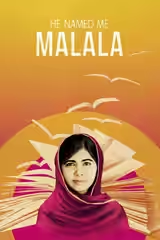
Most critics agree that Malala Yousafzai’s story is stronger than the film built around it, and the reviews lean mixed rather than warm. The praise gathers almost entirely in one place: the intimate footage of Malala at home, teasing her brothers, arguing with her father and behaving like an ordinary teenager rather than a public figure. Several critics also like the hand-drawn animation Guggenheim uses for her childhood in the Swat Valley, finding it the film’s most distinctive visual choice.
The reservations gather just as tightly. Critics repeatedly call the film hagiographic, short on political context and content to settle for uplift instead of examining what Malala’s activism actually involves. The spread is wide: the Los Angeles Times and Empire find it inspiring, while Slant Magazine argues the animation keeps viewers at a distance from the horrors it depicts, and Consequence says the disjointed structure cuts short the moments when Malala speaks for herself.