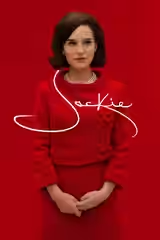
Most critics admire Jackie, and the praise centres almost entirely on Natalie Portman. Critics call her performance layered, controlled and physically precise, with particular attention to the voice and to the way she holds Jackie Kennedy’s steel and fragility in the same frame. Mica Levi’s score is the other constant, singled out for tying the public image-making to the private grief. Several critics also welcome Pablo Larraín’s decision to abandon the conventional biopic for something fractured and intimate.
The disagreement is about whether that fracturing works. The dissenters call the film erratic, incoherent or rudderless, and fault the jumbled timeline for creating distance; Sight and Sound finds it remote and small-scaled, The New Yorker intrusive and often absurd, The Ringer unable to make its ideas cohere. The spread is wide, from full marks to the low thirties. Even the harshest reviews keep praising Portman and Levi; the quarrel is with the film around them.
L
Little White Lies
20 January 2017 · 3/5/4 · Sophie Monks Kaufman
100
Kaufman finds the film a gorgeous, layered portrait of Jackie, praising its intelligence and emotional restraint. She singles out Portman’s performance and the striking images that capture Jackie’s carefully managed public image.
Rooney finds the film an emotionally shattering, perceptive portrait of grief, legacy and political maneuvering. He particularly praises Natalie Portman’s layered, incandescent performance as Jackie Kennedy.
13 September 2016 · festival review · David Sexton
90*
Sexton calls the film an astonishing and unexpected achievement. He singles out Natalie Portman’s riveting performance and Mica Levi’s score for praise.
Croll calls the film a bracing, distinctive triumph, though it falters somewhat toward the end. He especially praises Natalie Portman’s layered, physically expressive performance as Jackie.
Turan finds the film transporting and transfixing, praising its bold, emotionally effective approach to a familiar tragedy. He singles out Natalie Portman’s convincing, nuanced performance as Jackie and her collaboration with Pablo Larraín.
13 September 2016 · festival review · Nigel M Smith
90*
The critic calls the film a singular, uncompromising work and concludes that it is great cinema. Portman’s intimate, vivid portrayal of Jackie Kennedy is singled out for praise, especially her voice and emotional vulnerability.
Tallerico gives the film a positive review, praising Natalie Portman’s performance. He also singles out Larraín’s intimate, fractured portrait of Jackie Kennedy.
Lodge finds the film a daring, richly constructed portrait of grief and legacy, though its intimate approach may unsettle viewers expecting a conventional biopic. He particularly praises Natalie Portman’s layered, technically precise performance.
Richards finds Jackie an insightful biopic that brings its subject vividly to life. He especially praises Natalie Portman’s nuanced performance, which conveys Jackie’s steel and fragility.
The review praises the film as an unconventional, moving portrait, crowned by Natalie Portman’s performance. It also singles out Mica Levi’s sublime score, while noting that a conversation with a priest slows the pace.
The page could not be accessed, so the critic’s verdict and specific praise or complaint are unavailable. The URL identifies a New York Times review of the matching film.
7 September 2016 · festival review · Jonathan Romney
64*
The page identifies this as a Venice review, but the critic’s verdict is not visible. No praise or complaint can be determined from the accessible text.
Edelstein finds the film hard to love but admires its brittle, ambivalent quality. He praises Natalie Portman’s portrayal of Jackie’s mix of shyness and slyness, while finding her voice unnatural in some scenes.
Gray calls the film striking but ultimately erratic and rudderless. He praises Mica Levi’s score for bridging the gap between Jackie’s self-conscious image-making and her raw grief.
Charity finds the film interesting but emotionally remote and disappointingly small-scaled. He praises Mica Levi’s tremulous score for expressing Jackie’s inner turmoil in vivid White House sequences.
Lane finds the film intrusive, presumptuous, and often absurd, though it may gratify viewers drawn to the breaking of formal façades. He praises Natalie Portman’s watchful, tremulous performance and her precise capture of Jackie Kennedy’s voice.
The critic calls the film a stunning, unsentimental reinvention of the biopic. She especially praises Natalie Portman’s complex, raw performance as Jackie Kennedy.
Hammond finds the film haunting and calls Portman’s performance transformative and unforgettable. He also praises the production and costume design for vividly recreating the Camelot era.
The critic finds the film an exceptional, artistically ambitious portrait of grief and history. He especially praises Natalie Portman’s performance, alongside the screenplay, visuals, and Mica Levi’s score.
Goldberg finds the film an engaging, complicated portrait of Jackie Kennedy, though its succession of endings blunts the finale. He especially praises Natalie Portman’s layered performance, which balances Jackie’s strength and vulnerability.
Sinacola finds the film disorienting and monumentally surreal, though its script’s explanations of myth-making feel overly obvious. He praises Natalie Portman’s finely controlled performance and the sumptuous, tactile imagery that makes Jackie’s grief feel immediate.
The headline signals a positive view of the film as a deeply human portrait. The page content is blocked, so no specific element of the review can be confirmed as singled out for praise.
The critic finds the film impressionistic but ultimately incoherent, with Portman’s portrayal only intermittently convincing. The funeral-planning sequences are singled out as especially illuminating, while the fractured timeline is faulted for creating emotional distance.
Kermode finds the film more gloss than substance, though its cultivated emptiness may be deliberate. She praises Larraín’s precise framing and elegant sets for reinforcing its theme of artificiality.
Collins finds the film disappointing, arguing that its competing ideas about Jackie’s public persona and private self never come together. He praises the White House tour sequences for showing her carefully constructing her public image, but faults the film’s fussy structure and melodramatic portrayal.
Ordered by the weight we give each publication, then by score. Scores are normalised to 100; * means inferred from an unrated review. Summaries are ours, not quotations; follow the links for the reviews themselves. How we rate