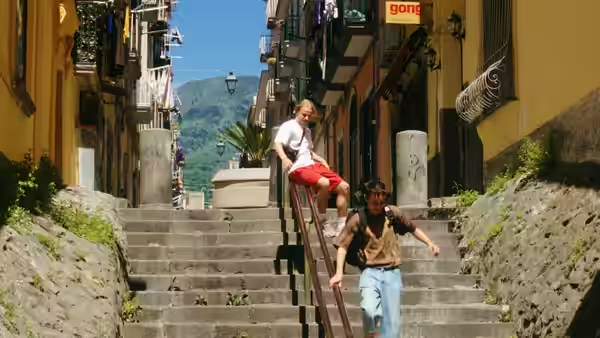
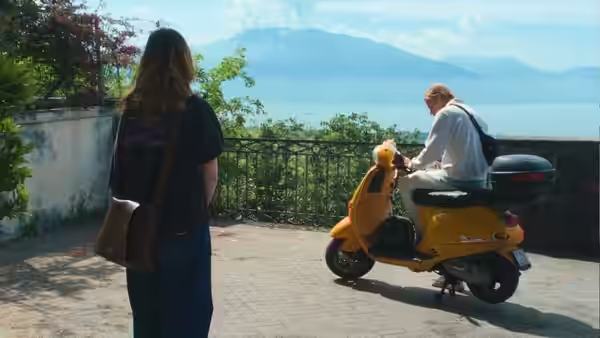
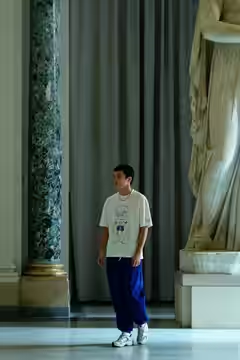
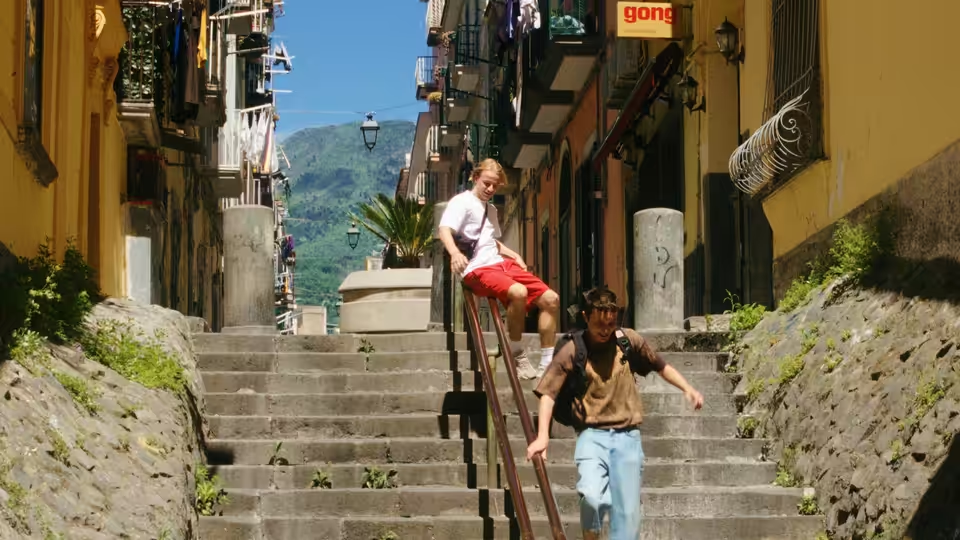
A young man descends a steep stone staircase as another sits on the railing above
Film review

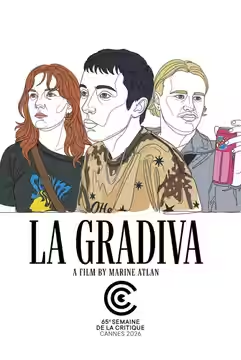
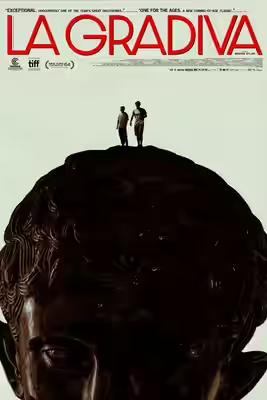
La Gradiva

2026 · Directed by Marine Atlan · 2h 25m

In a sentenceAncient ruins, teenage embarrassment, and a teacher with rather more to manage than the itinerary

An Italian school trip takes a group of teenagers to Naples and Pompeii, bringing their changing relationships into contact with places marked by the distant past. Toni (Colas Quignard) is among the young people at the centre of the story, alongside James (Mitia Capellier-Audat), while Madame Mercier (Antonia Buresi) is the teacher struggling to manage her pupils. Classroom exchanges and the journey give the group different settings in which to negotiate desire, embarrassment and their uncertain understanding of one another. The trip supplies a shared itinerary, but the teenagers bring private concerns that their teacher cannot easily follow or resolve.

Plays from YouTube when you press play; nothing loads from them until then.

Fi1m review

Marine Atlan’s adolescent drama earns our recommendation through its attentive ensemble and Colas Quignard’s quietly affecting Toni. The symbolism sometimes presses too hard, but the young people remain complicated enough to resist being reduced to a lesson.

La Gradiva is a good, patient film about teenagers whose feelings exceed their ability to explain them. Marine Atlan gives their embarrassment and confusion serious attention without treating every youthful mistake as a revelation. An Italian school trip provides the occasion, with Naples and Pompeii bringing a long historical perspective to immediate personal worries. We recommend it for the performances, with a reservation about symbolism that sometimes makes those worries carry more significance than they need.

Colas Quignard’s Toni gives the film its most persuasive reason to keep watching. His body language conveys heartbreak without demanding that every feeling be put into words, and the restraint leaves room for uncertainty about what another person can understand. We found Toni’s hurt affecting because Quignard lets physical awkwardness communicate what speech cannot comfortably accommodate. The performance also avoids the precocious self-knowledge that can make screen teenagers sound as though they have already spent years discussing their childhoods.

Antonia Buresi brings sympathy to Madame Mercier, the teacher overwhelmed by the young people in her charge. Her performance matters because an adult in this sort of story can so easily become a convenient obstacle, present chiefly to misunderstand everyone. Buresi allows the difficulty of looking after the group to register alongside the pupils’ own difficulties. The classroom scenes give Atlan a useful setting for observing how little people understand about one another even when they spend time together, and the ensemble keeps that uncertainty alive.

The cinematography, credited to Pierre W. Mazoyer and Marine Atlan, gives the images grain and a tangible sense of surfaces. That approach suits a film interested in the physical discomfort of adolescence: bodies matter here, as does the effort of occupying them in company. The detailed imagery also gives the historical surroundings a presence beyond their usefulness as a destination. Guillaume Lillo is the editor and Anna Le Mouël the production designer; the film’s strongest visual achievement is the sustained attention given to the young people within those surroundings.

The reservation concerns how insistently the ancient places are asked to illuminate the teenagers’ lives. Connecting adolescent desire and anxiety to Naples and Pompeii offers plenty to consider, but some of the symbolism feels too emphatic. We need little encouragement to take these young people seriously once the actors have established their vulnerability. At 145 minutes, the film asks for considerable patience, and the moments that underline its themes are less rewarding than the quieter work of watching someone struggle to make themselves understood.

Within the coming-of-age drama, Atlan’s particular strength is her willingness to let several people remain difficult to read at once. Anne Brouillet and Marine Atlan’s writing gives the ensemble room for conflicting feelings, while the performances prevent adolescent shame from becoming a general condition without individual faces. The film is sombre enough to require the right evening, and its length deserves consideration before settling down. Choose it when there is time to pay attention to an actor who is saying little.

Critical consensus AI synthesised

85
Positive
11
Mixed
0
Negative
0

The reviews agree that Marine Atlan’s debut offers a perceptive, affecting account of adolescence, with praise clustering around its young ensemble and its sensitivity to feelings the characters cannot fully explain. Critics repeatedly commend the naturalistic performances, observant direction and attention to teenage uncertainty. IndieWire singles out Colas Quignard’s quiet body language as Toni, while The Guardian highlights Antonia Buresi’s sympathetic portrayal of an overwhelmed teacher and the subtlety of the classroom scenes. The detailed imagery also draws praise, alongside the connections between adolescent anxieties and the history of Naples and Pompeii.

The differences concern the strength of the enthusiasm rather than basic approval: all eleven reviews are positive. Reservations are scarce in the supplied accounts, though Eye for Film finds the symbolism occasionally emphatic despite admiring the grainy imagery and sensitivity to adolescent shame. The consensus is clear, but the most enthusiastic notices go considerably further in their praise than the more measured responses.

IndieWire
21 May 2026 · A · Marya E. Gates
95

Gates finds the film wholly transporting, praising its empathetic, layered portrayal of teenagers and their inner lives. She especially singles out Colas Quignard’s performance, whose quiet body language makes Toni’s heartbreak deeply affecting.

Read the full review →
The New Yorker
26 May 2026 · festival review · Justin Chang
95*

Chang calls La Gradiva an exceptional debut and one of the year’s great discoveries. He particularly praises Marine Atlan’s lively, perceptive filmmaking and the film’s vividly drawn young characters.

Read the full review →
Variety
14 September 2026 · festival review · Jessica Kiang
95*

Kiang praises the film as a deeply moving, perceptive portrait of adolescence and calls it an extraordinary debut. She singles out its vivid ensemble and Atlan’s compassionate attention to the characters’ partial understanding of one another.

Read the full review →
The Hollywood Reporter
21 May 2026 · festival review · Jordan Mintzer
90*

Mintzer calls the film a stunning debut and says it announces a formidable new talent. He particularly praises the candid performances and Atlan’s fluid, observant portrayal of teenage moods and turmoil.

Read the full review →
Slant Magazine
11 September 2026 · ★★★½/4 · William Repass
88

The review finds the film’s coming-of-age story unusually resonant and thoughtful. It praises how Atlan connects the teenagers’ desires and anxieties to the deep history of Naples and Pompeii.

Read the full review →
The Guardian
16 May 2026 · festival review · Peter Bradshaw
86*

Bradshaw praises the film as a beautifully directed, superbly acted coming-of-age story, while noting its increasingly sombre emotional force. He particularly singles out Antonia Buresi’s sympathetic performance as the overwhelmed teacher and the film’s nuanced classroom scenes.

Read the full review →

Straight answers AI written, from our review

Is La Gradiva worth watching?
La Gradiva is worth watching for its attentive ensemble and Colas Quignard’s quietly affecting Toni, and we score it 83 out of 100. We recommend it to viewers who enjoy patient, sombre coming-of-age dramas, though its 145 minutes require concentration and the symbolism surrounding Naples and Pompeii sometimes presses harder than the performances need.
How long is La Gradiva, and what is it rated?
La Gradiva runs 2h 25m. It is a drama film.
Where can I watch La Gradiva in Türkiye?
La Gradiva is not on any streaming or rental service in Türkiye at the moment. Availability is checked daily.
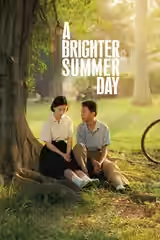
How does La Gradiva compare to A Brighter Summer Day?
La Gradiva is a more contained school-trip drama than A Brighter Summer Day, which we recommend more strongly for its densely observed schoolboy, family and gang life. Both place adolescent attachments against historical pressures; we favour La Gradiva for an evening focused on awkward, private feelings, while Edward Yang’s 237-minute film asks for greater commitment to a larger community.

Cast

Awards

Bright Horizons Award, 2026

Won
Bright Horizons Award

If you liked this, try…

  1. The Green Ray (1986) · not reviewed yetFor another holiday shaped by awkward encounters and feelings that resist explanation.

  2. The Wonders (2014) · not reviewed yetAn Italian coming-of-age story attentive to family work, embarrassment and competing desires.

  3. A Brighter Summer Day (1991, Fi1m 90)Adolescent attachments unfold within a densely observed community and its historical pressures.

  4. Rocks (2019) · not reviewed yetA lively young ensemble makes friendship, responsibility and private distress feel immediate.

  5. Goodbye First Love (2011) · not reviewed yetFor the patient attention to youthful heartbreak and its stubborn persistence.

Free account

Know what to watch tonight

Two lists that know where things are streaming, collections you can share, your own score beside ours, and Discover that remembers what you have seen.

  • Want to see, sorted by what is streaming now
  • Seen, with your score out of ten
  • No adverts, ever