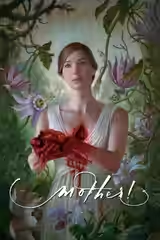
Most critics come out in favour, and their praise gathers around Jennifer Lawrence. Review after review calls her performance the thing that holds the film together, and several note that the camera scarcely leaves her face, which they count as Aronofsky’s best decision. The close handheld photography and the oppressive sound design are named repeatedly as the source of the dread. Michelle Pfeiffer’s cruel house guest gets a steady supply of admiring mentions, and most agree the controlled first half is the film at its best.
The reservations are about what comes after. A good number of the positive reviews concede that the second half tips into excess and that the allegory is too plainly signposted to reward decoding. The spread of opinion is wide. Variety finds the spectacle dazzling but empty, and Vulture objects that the film puts Lawrence through suffering that serves the director rather than the story. /Film goes further and thinks her miscast.
E
Evening Standard
15 November 2017 · ★★★★★ · David Sexton
100
Sexton finds the film scary and arty, with its oppressive style casting a spell. He especially praises Jennifer Lawrence’s emotional honesty and expressive face.
Turner calls the film an unmissable, nightmarish experience that is both shocking and intense. He especially praises the technical direction and Jennifer Lawrence’s captivating performance.
The critic calls the film bold, barmy and brilliant, an instant landmark of boundary-pushing cinema. The review singles out its in-your-face psychological horror as far more than a haunted-house movie.
Croll finds the film daring and effective, building from a slow burn into an audacious cinematic blaze. He especially praises the close, handheld camerawork that keeps viewers with Jennifer Lawrence as the house and its horrors spiral out of control.
Chang finds the film feverishly inspired, experimentally ambitious, and beautifully coherent despite its escalating chaos. He especially praises Jennifer Lawrence’s extraordinary, expressive performance and the film’s commitment to her perspective.
Bradshaw finds the film an outrageous, exhilarating horror-comedy, though its chaos is deliberately excessive. He praises Jennifer Lawrence’s compelling central performance and Michelle Pfeiffer’s cruel supporting turn.
Vishnevetsky finds the film a brilliantly deranged, skillfully made work that delivers horror despite its elaborate allegory. He especially praises Aronofsky’s claustrophobic focus on Jennifer Lawrence’s disoriented perspective.
Mottram finds the film audacious and wildly watchable, though its second half never matches the brilliance of its first. He praises the unsettling control of the early scenes and Michelle Pfeiffer’s performance as a provocative house guest.
Brody finds the film initially dull but ultimately thrilling, horrifying, and audacious. He praises Aronofsky’s cataclysmic imagination and the film’s forceful satire of fame, artistic vanity, and destructive fandom.
Jolin finds the film difficult and disorienting but vivid, ambitious, and far from forgettable. He praises Jennifer Lawrence’s intense central performance and the film’s striking dreamlike imagery, while noting that its excesses and brutal climax may alienate viewers.
5 September 2017 · festival review · Fionnuala Halligan
70*
Halligan presents the film as an expressionistic ode to contemporary life, suggesting a positive verdict. The standfirst singles out its expressionistic approach, though the review’s further praise or criticisms are not visible.
The review describes the film as entertaining but muddled. It notes echoes of Rosemary’s Baby and Get Out but the available text gives no further detail about what it praises or criticizes.
Pinkerton finds the film crass and overblown but ultimately impressed by its forceful filmmaking. He singles out the escalating claustrophobia and masterfully orchestrated final chaos.
The page content is unavailable, so the critic’s verdict cannot be established. No specific praise or complaint can be verified from the accessible text.
Jenkins describes the film as an ordeal and leaves its enjoyability unresolved. He singles out its bewildering, visceral conceptual imagery, likening it to a Rorschach blot made of menstrual blood.
Gray finds the film ambitious but overburdened by references, with its escalating drama often feeling inert. He singles out its oppressive sound design as an effective source of atmosphere.
5 September 2017 · festival review · Todd McCarthy
50*
McCarthy finds the film gripping but ultimately excessive, with plot contrivances that weaken its dramatic impact. He praises Jennifer Lawrence’s performance and the unsettling cinematography and production design.
Sragow’s verdict is negative, saying Aronofsky’s mystical thriller flounders. He singles out the film’s unsuccessful attempt to work as a mystical thriller.
5 September 2017 · festival review · Owen Gleiberman
30*
Gleiberman finds the film dazzling and entertaining as horror spectacle, but ultimately empty and lacking meaningful resonance. He particularly criticizes its thin characterization and escalating torments, which he says offer little beyond shock and showmanship.
Edelstein finds the film grandiose and self-aggrandizing, despite calling it a tour de force on its own terms. He complains that it puts Jennifer Lawrence through needless suffering, reducing her to a director’s object of torment.
The critic calls the film a glorious piece of cinematic insanity, praising its ambition and audacity. They single out Jennifer Lawrence’s committed performance at the center of Aronofsky’s singular vision.
Burt finds the film an effectively disturbing, challenging experience despite flaws in its exploration of womanhood and race. She praises Lawrence’s grounding performance and Aronofsky’s modern reworking of biblical material.
The critic calls it an unusually wild and effective horror film, though its symbolism and treatment of its protagonist may put some viewers off. He praises the claustrophobic technical craft, especially the close camera work and unnerving sound design.
Walsh calls the film a shocking delight whose strangeness rewards repeated interpretation. He praises its layered mystery, horror, and sharp critiques of art and celebrity culture.
The critic finds the film a potent, harrowing provocation, though its blunt metaphors and excesses can verge on indulgence. Jennifer Lawrence’s performance is singled out as a towering achievement and the story’s essential human anchor.
Formo finds the film audacious and thrilling, though its metaphors are obvious and its chaotic second half goes too far. He singles out Aronofsky’s camerawork and sound design as revelatory.
The critic finds the film wildly ambitious and potentially divisive, but ultimately worth celebrating. They single out Aronofsky’s precise control of its escalating chaos, even when its meaning remains unclear.
Kuchera finds the film to be Aronofsky’s best work, while acknowledging its meaning remains uncertain. He praises its lush visuals and Jennifer Lawrence’s deeply committed performance.
The critic finds the film audacious and unsettling, despite its increasingly wild ending. He singles out Jennifer Lawrence’s performance and Aronofsky’s trust in her for creating a genuine sense of unease.
16 September 2017 · festival review · Pete Hammond
65*
Hammond finds the film intensely polarizing but compelling, saying it lingers in the mind. He praises Jennifer Lawrence as its emotional center and the camera’s unwavering focus on her.
The accessible page contains only an anti-crawler notice, so the critic's verdict is unavailable. No praise or complaint can be verified from the supplied text.
Collins finds the film messy and frustrating, but ultimately enjoys its ambitious, chaotic mix of themes. He especially praises Jennifer Lawrence’s strange, exhausting performance and Michelle Pfeiffer’s gleeful meanness.
11 September 2017 · 7 out of 10 · Chris Evangelista
58*
The critic finds the film committed to its wild, unsettling vision, though its allegory feels heavy-handed and Jennifer Lawrence is miscast. The anarchic final stretch is singled out for its shocking, fast-escalating imagery.
Leitch finds the film overwhelming but ultimately frustrating, with its chaos failing to deliver a satisfying payoff. He praises its images of creeping dread, while criticizing its blunt, overlong approach and Lawrence’s passive role.
Ordered by the weight we give each publication, then by score. Scores are normalised to 100; * means inferred from an unrated review. Summaries are ours, not quotations; follow the links for the reviews themselves. How we rate