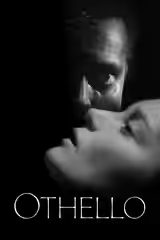
Most critics admire this Othello, and the praise gathers almost entirely around Welles the director. The reviews return to how he turned a starved, interrupted production into a style: locations stitched together across countries, stand-ins, jump cuts and disorienting compositions that put the audience inside the Moor’s head rather than in front of the plot. Several call it the most cinematic Shakespeare on film, and the later reviews, written around restorations, treat its raggedness as part of the appeal. Welles’s voice and MacLiammoir’s Iago are noted approvingly.
The reservations sit on the same point, turned over. The dissenters, chiefly the American critics who saw it on first release in the 1950s, find the staircases, mirrors and chaotic sound a set of tricks that bury the story; The New York Times calls the result hollow. The Independent, writing at the 1992 restoration, grants the flair but finds the film tatty and the locations distracting. The spread is wide, though the rejection is old and the admiration recent.