Critics’ reviews

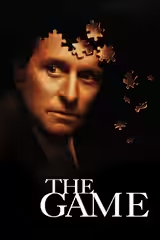
The Game (1997)

11 reviews from 11 publications. Critics’ score 71: 5 positive, 6 mixed, 0 negative.

Back to our review of The Game

71
Positive
5
Mixed
6
Negative
0

Most critics like The Game without quite loving it: five positive, six mixed, none hostile. The praise lands in two places. Michael Douglas is singled out repeatedly, as a cold man played with full commitment or a desperate pawn well cast. Fincher’s direction draws nearly as much approval: the clinical precision, the haunting atmosphere of a waking nightmare, the careful, darkly funny pacing of the twists as Nicholas Van Orton’s controlled life comes apart.

The reservations gather round the ending. Several reviews call the finale implausible; the question is whether that is a flaw or the point. Radio Times finds the film turns glossy and trivial after a fascinating setup; Empire cannot decide whether it is gloriously or irritatingly unbelievable; Variety admires the puzzle more than it warms to it. The later reviews are kinder: The AV Club argues the implausible finale earns its emotional release, and the Los Angeles Times says repeat viewings make the conclusion easier to accept. Nobody dismisses it.

Slant Magazine
25 September 2012 · ★★★★½ · Chris Cabin
90

Cabin praises The Game as an inventive, challenging film and calls the Criterion release a welcome presentation of a masterpiece. He especially singles out Michael Douglas’s performance and the disc’s image and sound quality.

Read the full review →
The AV Club
13 March 2012 · Mike D'Angelo
90*

D’Angelo passionately argues that the film’s implausible finale delivers profound emotional catharsis. He especially praises Fincher’s visual direction and Michael Douglas’s committed performance as a cold, unsympathetic man.

Read the full review →
Total Film
10 October 1997 · ★★★★ · Total Film
80

The critic calls the film a compelling, excellent and unusually challenging ride, though its surreal approach may not suit everyone. They praise Michael Douglas’s performance and Fincher’s darkly funny, carefully paced handling of the twists.

Read the full review →
Los Angeles Times
29 September 2012 · Dennis Lim
70*

Lim argues that the film remains an absorbing, surprising experience, and that repeat viewings make its implausible conclusion easier to accept. He especially praises its immersive waking-nightmare atmosphere and the pleasure of its elaborate game, while acknowledging the ending’s anticlimax.

Read the full review →
RogerEbert.com
65*

The URL identifies a RogerEbert.com review of the 1997 film. The page only displays a browser-check message, so its verdict and specific praise or complaint cannot be verified.

Read the full review →
Variety
14 September 1997 · Todd McCarthy
65*

McCarthy finds the film intellectually intriguing and technically impressive, though its puzzle-like focus makes it easier to admire than embrace. He particularly praises Fincher’s clinical precision and the unnerving way the film shows Nicholas’s controlled life being eroded.

Read the full review →
The New York Times
12 September 1997
64*

The blocked page provides no readable critical verdict. No praise or complaint can be verified from the available text.

Read the full review →
Time Out
· GA
64*

The available page identifies this as Time Out’s review of the 1997 film. Its verdict and specific praise or complaint are unavailable because the article text could not be read.

Read the full review →
Radio Times
★★★ · Alan Jones
60

Jones finds the thriller stylish and suspenseful, with Douglas well cast as a desperate pawn. He faults it for becoming glossy and trivial after an initially fascinating setup.

Read the full review →
Empire
1 January 2000 · Andrew Collins
55*

The review sees the thriller as either gloriously or irritatingly unbelievable, while still calling it a worthy, dark follow-up to Seven. It singles out the film’s escalating collapse of Nick Van Orton’s life as its central appeal.

Read the full review →
Eye for Film
7 May 2006 · Angus Wolfe Murray
80*

The review is clearly positive, calling Michael Douglas electrifying in the lead role. It also praises Fincher’s haunting visual atmosphere and the film’s sustained uncertainty about reality.

Read the full review →

Ordered by the weight we give each publication, then by score. Scores are normalised to 100; * means inferred from an unrated review. Summaries are ours, not quotations; follow the links for the reviews themselves. How we rate