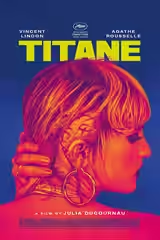
Most critics come out shaken and won over. The reviews are firmly positive, with no outright dismissals among the 28, and the praise gathers in the same two places: Agathe Rousselle’s almost wordless, punishing physical performance, and the tenderness that grows between her Alexia and Vincent Lindon’s Vincent underneath all the body horror. Several critics are surprised to find the film sweet. Ruben Impens’ high-contrast cinematography, the colour and the sound design draw repeated notice.
The reservations are consistent too. A number of critics find the characters thinly drawn and their motives vague, which makes the emotional turn harder to accept, and several say the middle stretch sags after a ferocious opening. The spread is narrow for a film this extreme, running from lukewarm to rapturous with nothing hostile. The coolest voices are Screen Daily’s Jonathan Romney, who finds it provocative but silly, and Deadline’s Anna Smith, who thinks it falls short of Ducournau’s Raw.
S
Sight and Sound
14 July 2021 · festival review · BFI
95*
The critic considers the film a full-throttle masterpiece that exceeds expectations. They single out its astonishing performances and the tender, human relationship at its heart.
Ehrlich praises the film as a daring, moving blend of body horror and found-family fable, while noting that its characters can feel vague. He singles out Ducournau’s skillful balance of shock and tenderness, along with Vincent Lindon’s performance and the film’s vivid visual style.
Strong finds the film audacious, seductive and impressively boundary-pushing, despite its more freeform narrative. She especially praises Agathe Rousselle’s intense physical performance and the film’s striking command of colour and sound.
Chang finds the film a daring, emotionally affecting triumph, despite its occasional self-infatuation and slickness. He especially praises Agathe Rousselle’s virtually wordless performance and the unexpected tenderness of her character’s bond with Vincent.
Debruge finds the film daring and compelling, though its logic and final reveal can be difficult to follow. He praises its boundary-pushing body horror and Ruben Impens’ velvety, high-contrast cinematography.
The review presents the film as a brilliant, exhilaratingly wild ride. It singles out its extreme violence, gender fluidity and provocative car-sex premise.
Rife finds the film ferocious, twisted, and unexpectedly sweet, though its broad characters and ambiguous motivations make its emotional turn difficult to swallow. She singles out Ducournau’s provocative body-and-gender commentary and wicked sense of humor.
Flint finds the film brash, thrilling and weirdly poignant, despite a meandering middle and increasingly absurd plot turns. She praises its vivid sound, horror and colour, along with the intense central performances.
The review finds the film bold and sensorially rich, but says its later sections lack the energy of its opening. It praises the imagery and sound design, especially the film’s exploration of bodily transformation and anxieties about inhabiting the body.
Kermode finds the film a visceral, unsettling fable about unconditional love that delivers for viewers with an appetite for extreme cinema. He praises Agathe Rousselle’s extraordinary physical performance and the film’s glowing visuals and throbbing soundscape.
The critic sees an ambitious, richly cinematic film whose queerness and genre-bending make it exciting and affecting. He praises the central bond between Alexia and Vincent, while noting that Vincent’s relationships could have been developed more fully.
Newland finds the film shocking and bizarre, but ultimately more tender and thoughtful than its provocations suggest. She especially praises the moments of connection between Alexia and Vincent, and Lindon’s tender performance.
Willmore finds Titane a fascinating, confounding film whose grotesque imagery gradually forms a compelling meditation on bodily autonomy. She especially praises its portrayal of the claustrophobia of unwanted pregnancy and the characters’ struggles to control their changing bodies.
Brody finds the film daringly original and physically compelling, though its character psychology and relationships remain thinly sketched. He especially praises Ducournau’s vivid use of bodily extremity to carry the drama.
Romney presents the film as a provocative but decidedly silly follow-up. The standfirst singles out its excess and conceptual ferocity, while acknowledging its sheer silliness.
The critic calls the film an astonishing, convention-defying achievement that is simultaneously grotesque, funny, and tender. He especially praises its hypnotic cinematography and electrifying score, alongside its unusual portrayal of human connection.
Tham finds Titane thrilling and ultimately devastatingly human. The review singles out its portrayal of fierce kinship between two lonely people and its vivid, mythic imagination.
The critic calls the film unforgettable and a major achievement for Julia Ducournau. They praise its striking images and unpredictable shocks, as well as its frank treatment of sexuality and agency.
Sandwell praises the film as singular, unforgettable and unexpectedly tender despite its disturbing horror. He singles out the wild, emotionally powerful ending and Agathe Rousselle’s remarkable performance.
Bui finds the film’s unpredictable shifts exhilarating, though its sentiment arrives late and its middle drags. She especially praises the tender bond that forms between Alexia and Vincent beneath the body horror.
Zigler finds the film’s grotesque, boundary-pushing story ultimately centers on unconditional love and acceptance. She praises Agathe Rousselle’s commanding feature debut and the film’s exploration of gender, isolation, and the human body.
The critic finds the film eventful and entertaining, recommending it to genre fans and newcomers while warning it is not for the faint-hearted. They praise Agatha Rousselle’s early scenes but find the return to an earlier subplot imperfect.
18 November 2021 · festival review · Andrew Robertson
70*
The critic finds the film fiercely unsettling and not for everyone, but ultimately powerful. Agathe Rouselle’s startling physical performance is singled out for praise.
Smith finds the film ambitious and intriguing, though not quite as strong as Ducournau’s Raw. She praises Vincent Lindon’s performance and the film’s exploration of grief and denial.
The critic finds the film unruly but ambitious, original, and a lot of fun. They praise its visual panache and grisly excess, while noting that its themes never cohere around an effective central metaphor.
The accessible page contains no review text, so the critic’s verdict cannot be established. No specific praise or complaint is available from the supplied page.
Ordered by the weight we give each publication, then by score. Scores are normalised to 100; * means inferred from an unrated review. Summaries are ours, not quotations; follow the links for the reviews themselves. How we rate