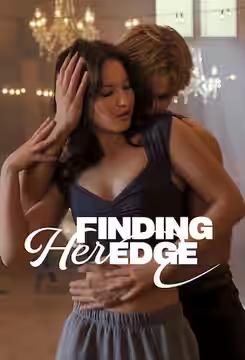
Jennifer Iacopelli’s novel becomes eight gentle episodes about a skating family, a rink and the boy who came back. It is easy company and the Russo sisters are worth the time; the skating is chopped into pieces and nothing is allowed to stay wrong.
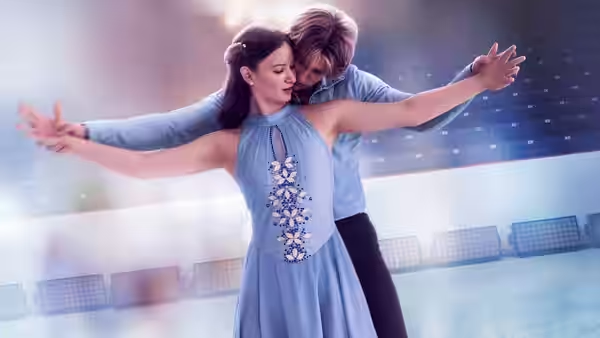
Finding Her Edge is an eight-part adaptation of Jennifer Iacopelli’s novel about a family of ice dancers, and its intentions are plain from the tagline: “It’s a thin line between love and skate.” It wants to be a warm, low-stakes teenage romance with sequins, the sort of thing you watch under a blanket with half your attention. On those terms it is a modest success. Watched with your whole attention it comes apart fairly quickly, because there is not much underneath.
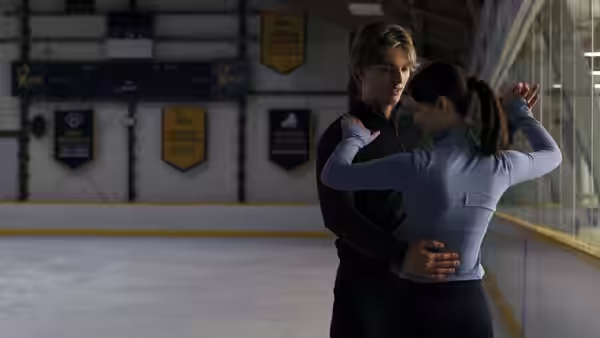
Madelyn Keys plays Adriana as a girl who has been told she is talented so often she has stopped hearing it, and she is good at the small, sulky reactions the part asks for. Cale Ambrozic’s Brayden is the steady one, and the scenes where the two of them argue about a lift or a piece of music are the most alive thing in the series. They look at each other like people who have spent years within arm’s reach, which is what skating partners are, and the writing trusts that. Olly Atkins has the harder job as Freddie, the boy who came back, and for several episodes he is given a great deal of significant looking and little else to do.
The family is where the series is best. Alice Malakhov and Alexandra Beaton play Maria and Elise as sisters who love Adriana and are tired of her in roughly equal measure, and the three of them bicker with a rhythm that sounds like a real kitchen. Harmon Walsh’s Will hovers at the edge of these scenes and is likeable in them. We were bored for the first three episodes and mildly cross about it, and it was the sisters who eventually got us past that: their scenes are quiet, the camera stays back, and nobody says anything important. They are what the series should have been built around, and they are more or less on their own.
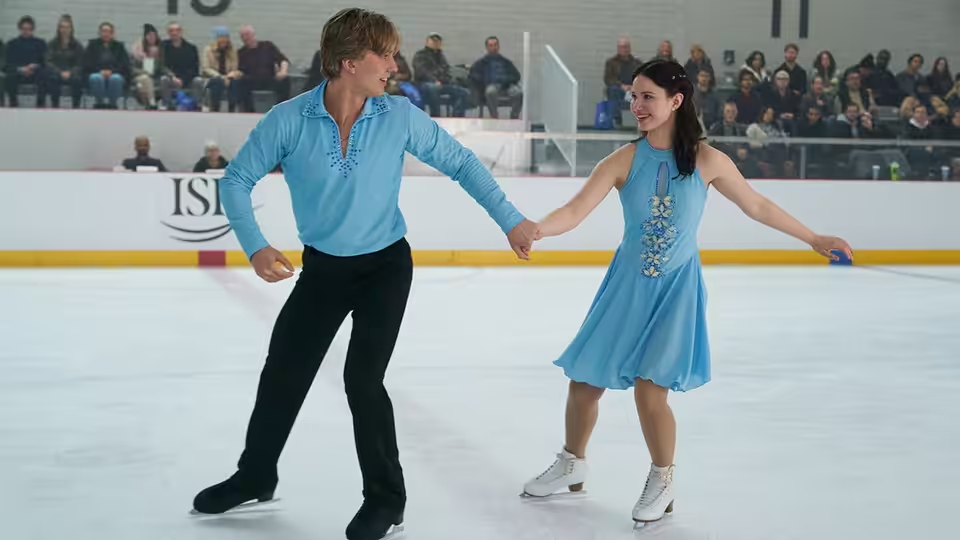
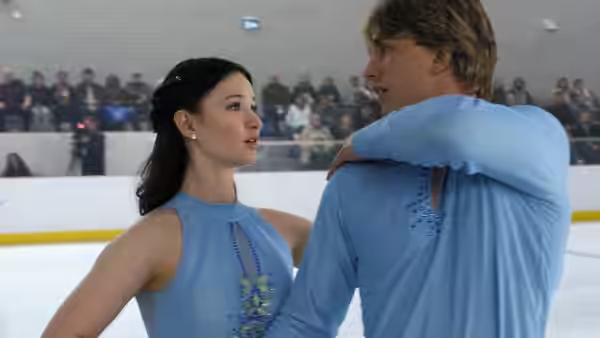
The skating is the puzzle. Ice dancing is the point of the whole enterprise, and yet the series cuts away from it as if embarrassed. A programme arrives as a few seconds of wide shot, then faces, then a reaction in the stands, then the score, so we rarely see a lift begin and end in the same frame. When the camera does hold wide the doubling shows, and when it moves in close the actors are doing the arms and not much else. The rink is lit a cool, clean blue that photographs well and never changes, whether it is a Tuesday practice or a final. Whoever cut these sequences did not trust them, and the series is left with a sport it keeps promising and keeps hiding.
The larger problem is that nothing is allowed to stay wrong. A row in the first ten minutes of an episode is mended by the last, a secret is out within an hour of being kept, and the rink’s troubles rise and fall on a schedule you could set a watch by. Eight episodes is a long time to spend with people who resolve everything before bed. Charlie and Riley Monroe (Niko Ceci and Millie Davis) and Katya Belikova (Nicole Volossetski) are there to be the competition, and the series is too polite to let any of them be properly unpleasant.
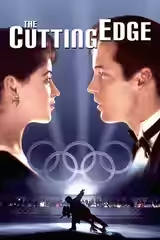
Against the standard of its genre it is middling. The Cutting Edge, from 1992, took the same two ingredients, a rink and a pair who cannot stand each other, and got a whole film out of them in under two hours by letting its people be rude. Spinning Out went the other way and let its skaters be miserable. Finding Her Edge wants the sweetness of the one and the seriousness of the other and settles for being nice.
It is a 12, and a soft one; there is nothing here to trouble a twelve-year-old and not much to keep an adult from checking their phone. Put it on while you do something else and it will pass eight pleasant evenings. Watch it properly and you will find yourself waiting for the sisters, who turn up, and for the skating, which mostly does not.