Critics’ reviews

A Farewell to Arms (1932)

9 reviews from 9 publications. Critics’ score 82: 8 positive, 0 mixed, 1 negative.

Back to our review of A Farewell to Arms

82
Positive
8
Mixed
0
Negative
1

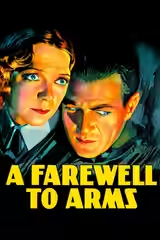
Most critics take warmly to Frank Borzage’s adaptation, and the praise clusters around the same things: the frankness it manages in the years before the Production Code, the pairing of Gary Cooper and Helen Hayes, and the intensity of the direction. Several single out the climactic hospital scene as the film’s high point, and a few point to particular shots, the subjective journey on a stretcher into the hospital among them, as evidence of a director working ahead of his time. Reviews from the first release and from the later reissues broadly agree.

The spread is narrow apart from one outlier. The Guardian is cooler, finding the collision between Hemingway’s fatalism and Borzage’s romanticism awkward as well as interesting. The New York Times, writing in 1932, is the lone negative voice, judging that the film loses the novel’s power and that the camera effects come at the expense of the story. Where reservations appear, they concern fidelity to the book rather than the craft.

The Times
20 August 2021 · ★★★★★ · Kevin Maher
100

This landmark pre-Code romance offers a bittersweet glimpse of the moral complexities classic American cinema might have sustained without the 1934 Production Code clampdown. The critic highlights the film's mature handling of themes including unwanted pregnancies, erotic elements, feminist grievances of nurses and a nihilistic worldview in the Gary Cooper-Helen Hayes love story.

Read the full review →
Time Out
28 May 2014 · ★★★★★ · Tom Huddleston
100

The review deems the film remarkable for kicking against early Hollywood conventions with its flawed, complex characters. It singles out the unforgettable climax and other distinctive scenes as standing out in cinema.

Read the full review →
Sight and Sound
30 May 2014
90*

The critic calls Borzage’s film a masterpiece and one of the director’s finest achievements, worthy of rediscovery. They single out the expressive intensity of the mise-en-scène and the astonishing, truthful climactic Liebestod sequence.

Read the full review →
The New Yorker
10 December 1932 · John C. Mosher
90*

The screen version preserves the essential temper of Hemingway's story and stands as the most satisfactory Hollywood love story to date. Borzage's skill with closeups and pictorial detail enhances the intensity of the lovers' feelings.

Read the full review →
Variety
31 December 1931 · Variety Staff
90*

The film is a corking adaptation that deftly handles delicate situations. Borzage's direction makes the central romance believable and palatable while highlighting strong performances from the leads.

Read the full review →
Film Comment
1 September 1997 · Kent Jones
85*

The critic celebrates Borzage's distinctive romantic sensibility across his films and positions A Farewell to Arms as a key example of his lush, emotionally charged style. He singles out an innovative subjective tracking shot that follows the wounded protagonist on a stretcher into the hospital as emblematic of the director's visual poetry.

Read the full review →
Slant Magazine
27 July 2006 · Dan Callahan
85*

The critic praises Borzage’s version for transforming Hemingway’s pessimism into a testament to eternal romantic love that transcends death. He singles out the transcendent hospital bed finale and the perfect pairing of Gary Cooper and Helen Hayes for particular praise.

Read the full review →
The Guardian
29 May 2014 · Steve Rose
70*

Borzage's reissued 1932 adaptation of Hemingway creates a fascinatingly awkward contrast between the author's spare fatalism and the director's Hollywood romanticism, resulting in a dated yet bracingly modern WWI epic. The critic singles out the film's intriguing avant-garde touches, such as an imitated POV shot of ceiling frescoes and a staggering montage of frontline combat.

Read the full review →
The New York Times
18 December 1932 · Mordaunt Hall
30*

The adaptation is earnest and occasionally affecting with beautiful photography and sincere acting, but it lacks the vitality and power of the original novel. Borzage focuses more on artistic camera effects than a strong conception of the story.

Read the full review →

Ordered by the weight we give each publication, then by score. Scores are normalised to 100; * means inferred from an unrated review. Summaries are ours, not quotations; follow the links for the reviews themselves. How we rate