Film review

A Farewell to Arms

1932 · Directed by Frank Borzage · 1h 29m · MPA NR

In a sentenceGary Cooper spends a world war mumbling at a nurse, and it turns out to be the right approach

DramaRomanceWar

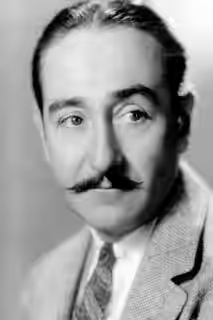
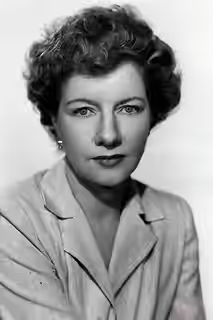
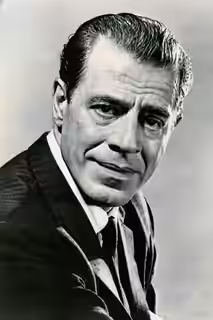
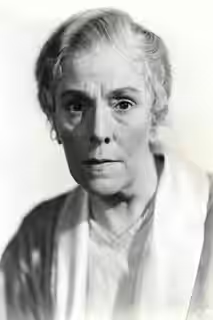
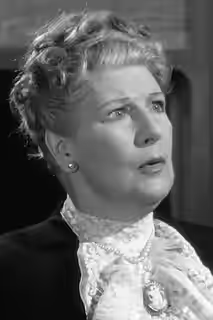
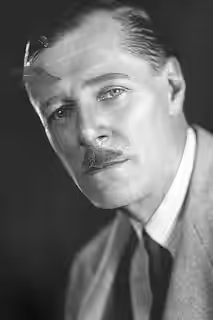
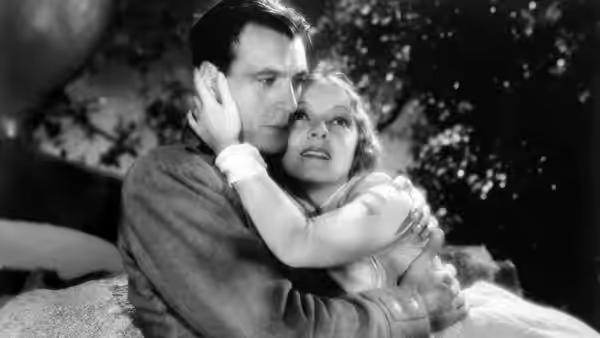
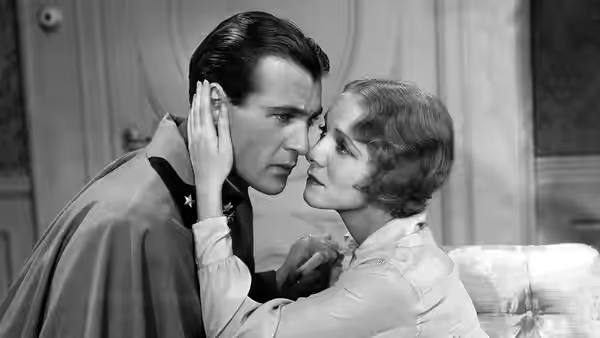
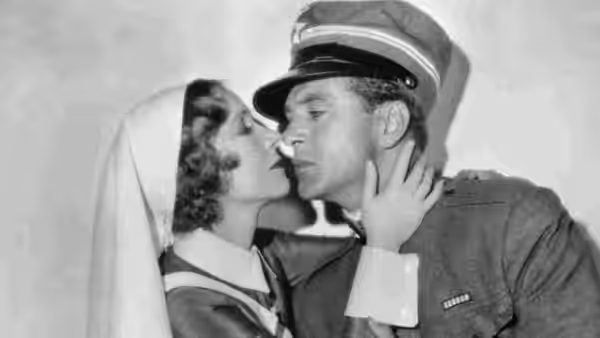
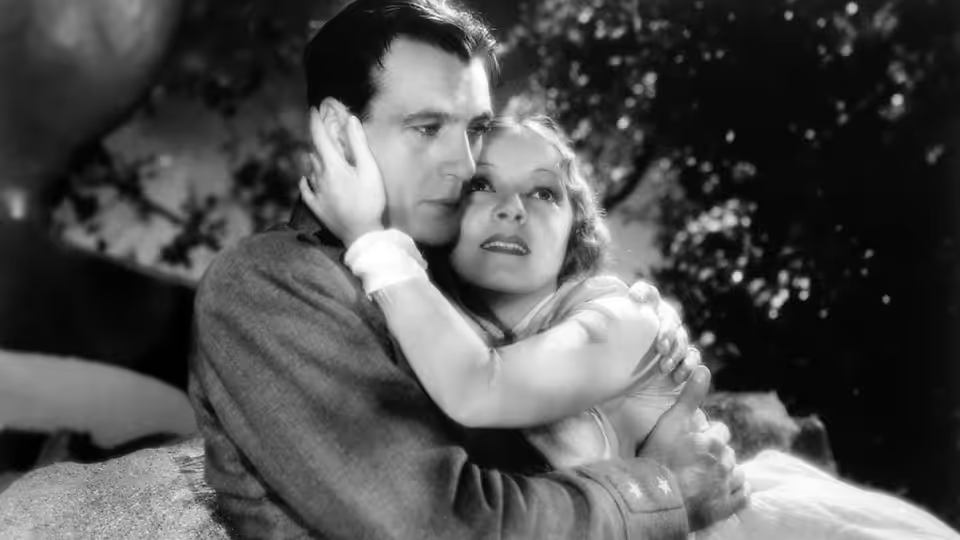
The Italian front, in the First World War. Lieutenant Frederic Henry (Gary Cooper), an American driving ambulances for the Italian army, spends his leave drinking with his friend Major Rinaldi (Adolphe Menjou), a surgeon with an eye for the nurses. During a night bombardment Frederic stumbles into a doorway and finds Catherine Barkley (Helen Hayes), an English nurse grieving a fiancé killed at the front. He flirts; she sees through it and lets him carry on. Her friend and fellow nurse Helen Ferguson (Mary Philips) watches with misgivings. Frederic is wounded by a shell and carried on a stretcher into a hospital in Milan, where the Head Nurse (Blanche Friderici) runs a tight ward. Catherine is posted there. A priest (Jack La Rue) hovers at the edges of it.

Plays from YouTube when you press play; nothing loads from them until then.

Fi1m review

Frank Borzage takes Hemingway’s spare novel about an American ambulance driver and an English nurse and turns it into a swoon of dissolves and choirs. It should not work and mostly does, thanks to Gary Cooper, Charles Lang’s camera and a last reel we will not describe.

Ernest Hemingway wrote A Farewell to Arms in short flat sentences about a war that meant nothing and a love that did not save anyone. Frank Borzage, directing and producing for Paramount with Adolph Zukor, read the same book and saw a romance in which love saves everything, including the two people it happens to. The screenplay, by Oliver H.P. Garrett and Benjamin Glazer, keeps Hemingway’s people and most of his events and changes the temperature entirely. We think the result is a good film and a strange adaptation, and we would rather have it than a faithful dull one.

The film’s best idea arrives early. Frederic Henry (Gary Cooper), the American lieutenant driving ambulances for the Italians, is hit by a shell and carried into a hospital in Milan, and Borzage puts the camera on the stretcher, looking straight up. Ceilings slide past, then painted frescoes, then the faces of orderlies and nurses leaning in, and finally Catherine Barkley (Helen Hayes) bending down to kiss him. Charles Lang lights all of it from above so the faces come out of darkness one at a time. We realised, when it was over, that we had been holding still along with him.

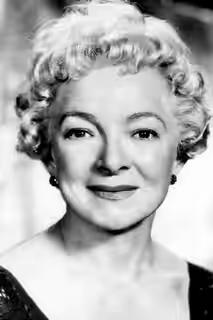
Cooper is the reason the whole thing stays upright. He plays Frederic shy, half-mumbling, a big man who does not know where to put his hands, and he undersells every line. The film around him oversells nearly everything, so the two cancel out and something like a real person emerges. Hayes, a stage actress, is pitched to the back row in the first scenes and it takes a while to adjust. In the hospital, whispering across a pillow, she is fine, and better than fine when she stops performing grief and simply looks tired.

Adolphe Menjou has the most fun as Rinaldi, the surgeon friend who grins while saying the true thing, and whose part in the second half we will leave alone. Mary Philips, as Helen Ferguson, gets the job of seeing the trouble coming and being ignored, and does it without fuss. Jack La Rue’s priest is gentler than we expected, and the scene in which he does his one important piece of business in the ward is played quietly, without a swell, which makes it the most affecting moment in the first hour.

Made before the Production Code was enforced in 1934, the film is franker than the ones that followed about what these two get up to in a hospital bed and about what nurses were and were not permitted to want. Travis Banton dresses Hayes in whites that fill the frame and then, in one or two scenes, in nothing much at all under a sheet. Otho Lovering and George Nichols Jr. cut a combat montage late on that is faster and harder than anything else in the picture, marching feet and wheels and mud and shellfire jammed together, and it is over almost before you have registered it. That is the war’s total allowance. Hemingway would have wanted more of it.

Seven men are credited with the music and it sounds like it. The score barely stops, rises at every kiss, and reaches for Wagner at the end. The middle stretch, letters and waiting and rain on windows, sags under it. At 89 minutes the second half of the novel is squeezed hard, and anyone who knows the book will feel events go past like stations from an express.

Then the last reel, which we will not describe. It moved us more than we thought it would, and we sat for a minute afterwards suspecting we had been got at by a choir and a dissolve. We decided we did not mind. Borzage believed this stuff, and belief, filmed with this much care, is difficult to argue with while it is happening.

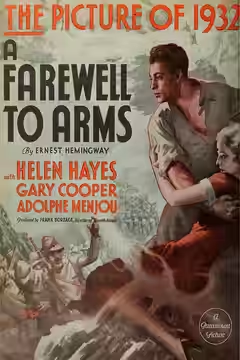
Paramount sold it with the line “Every woman who has loved will understand.” We would widen the invitation.
Critical consensus AI synthesised

82
Positive
8
Mixed
0
Negative
1

Most critics take warmly to Frank Borzage’s adaptation, and the praise clusters around the same things: the frankness it manages in the years before the Production Code, the pairing of Gary Cooper and Helen Hayes, and the intensity of the direction. Several single out the climactic hospital scene as the film’s high point, and a few point to particular shots, the subjective journey on a stretcher into the hospital among them, as evidence of a director working ahead of his time. Reviews from the first release and from the later reissues broadly agree.

The spread is narrow apart from one outlier. The Guardian is cooler, finding the collision between Hemingway’s fatalism and Borzage’s romanticism awkward as well as interesting. The New York Times, writing in 1932, is the lone negative voice, judging that the film loses the novel’s power and that the camera effects come at the expense of the story. Where reservations appear, they concern fidelity to the book rather than the craft.

The Times
20 August 2021 · ★★★★★ · Kevin Maher
100

This landmark pre-Code romance offers a bittersweet glimpse of the moral complexities classic American cinema might have sustained without the 1934 Production Code clampdown. The critic highlights the film's mature handling of themes including unwanted pregnancies, erotic elements, feminist grievances of nurses and a nihilistic worldview in the Gary Cooper-Helen Hayes love story.

Read the full review →
Time Out
28 May 2014 · ★★★★★ · Tom Huddleston
100

The review deems the film remarkable for kicking against early Hollywood conventions with its flawed, complex characters. It singles out the unforgettable climax and other distinctive scenes as standing out in cinema.

Read the full review →
Sight and Sound
30 May 2014
90*

The critic calls Borzage’s film a masterpiece and one of the director’s finest achievements, worthy of rediscovery. They single out the expressive intensity of the mise-en-scène and the astonishing, truthful climactic Liebestod sequence.

Read the full review →
The New Yorker
10 December 1932 · John C. Mosher
90*

The screen version preserves the essential temper of Hemingway's story and stands as the most satisfactory Hollywood love story to date. Borzage's skill with closeups and pictorial detail enhances the intensity of the lovers' feelings.

Read the full review →
Variety
31 December 1931 · Variety Staff
90*

The film is a corking adaptation that deftly handles delicate situations. Borzage's direction makes the central romance believable and palatable while highlighting strong performances from the leads.

Read the full review →
Film Comment
1 September 1997 · Kent Jones
85*

The critic celebrates Borzage's distinctive romantic sensibility across his films and positions A Farewell to Arms as a key example of his lush, emotionally charged style. He singles out an innovative subjective tracking shot that follows the wounded protagonist on a stretcher into the hospital as emblematic of the director's visual poetry.

Read the full review →

Cast

Awards

Academy Awards, 1934

Won
Best Cinematography
Won
Best Sound

If you liked this, try…

Seventh Heaven poster86

Seventh Heaven

1927 · Borzage’s silent version of the same faith: love in a garret, war outside, no irony.

Westfront 1918 poster

Westfront 1918

1930 · Pabst’s trenches from the German side, with the mud Borzage kept off screen.

Brief Encounter poster90

Brief Encounter

1945 · Another doomed affair conducted mostly in whispers, this one in a station buffet.

The Cranes Are Flying poster

The Cranes Are Flying

1957 · A Soviet wartime romance shot with the same swooping camera and a colder ending.

Atonement poster83

Atonement

2007 · Nurses, a soldier, a long war, and a typewriter deciding who gets to be happy.