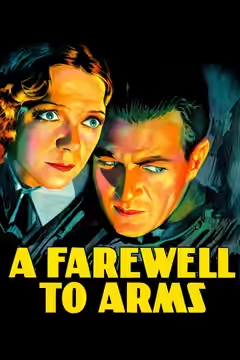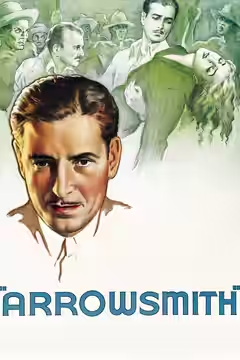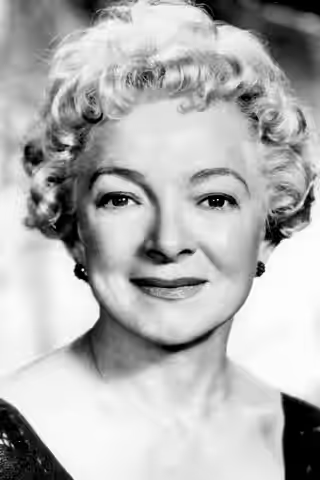
Helen Hayes was a stage actress who made films on the side, and it shows in the best possible way: no display, no plea for sympathy, a woman watching and deciding. The camera got a few years of her and never quite deserved them.
Fi1m perspective
There is a scene early in Arrowsmith (1931) in which Leora watches her husband decide the shape of both their lives, and lets him. Hayes gives it no speech. She does not look for pity and she does not look away. It moved us more than we expected, because she plays a woman who has chosen this with her eyes open and would choose it again, and she gets that across with a face that is mostly still. Ronald Colman, in the same frame, is acting. She is watching.
She had been on stage since she was five and on Broadway from nine, so by the time John Ford put her in front of a camera she had been performing for a quarter of a century. Her 1920s reputation rested first on comic ingenues and then on serious parts, and not every critic was kind about the middle stretch; some found the work strained once the first success had passed. Hollywood took her in 1931. The Sin of Madelon Claudet was the debut, Arrowsmith followed the same year, and A Farewell to Arms (1932) put her opposite Gary Cooper as Catherine Barkley. Then she went back to the theatre for fifteen years and stayed. Victoria Regina (1935), in which she played the queen across decades of her life, is the part she performed close to a thousand times, and none of it was filmed.
Her method was observation. She built people out of ordinary people she had watched rather than out of stage gesture, and on screen that reads as an absence of technique when it is in fact all technique. It is why Leora works. It is also, we suspect, why she never settled in Hollywood. She wanted a live audience to tell her when she was going off track and how to get back, and a camera does not do that. She said late in life that she never enjoyed herself in films, and Leora is proof that not enjoying yourself and not being good at it are different things.
When she came back to film from the 1950s it was in character parts: the Dowager Empress in Anastasia (1956), the stowaway Ada Quonsett in Airport (1970). We have not reviewed them and will not judge them here, beyond noting that the later Hayes is remembered as eccentric and feisty, which is a long way from the wife who waits. She left the stage in 1971 and acting altogether in the mid-1980s.
Start with Arrowsmith. The film is stiff and hurried and Colman is wrong for it, and she is the reason to see it anyway. If the early pictures leave you wanting to know what the fuss was about, the answer is that the work she cared for most happened in rooms without cameras, and is gone.
Biography
Helen Hayes (1900–1993) was an American actress whose career on stage, film and television spanned more than seven decades. She made her Broadway debut as a child and became a leading stage performer in the 1920s and 1930s, appearing in productions including What Every Woman Knows and Victoria Regina.
Her film roles included Leora Tozer Arrowsmith in Arrowsmith (1931) and Catherine Barkley in A Farewell to Arms (1932). She won Academy Awards for The Sin of Madelon Claudet (1931) and Airport (1970), and was one of the first performers to achieve an EGOT (Emmy, Grammy, Oscar and Tony). Hayes received the Presidential Medal of Freedom in 1986 and the National Medal of Arts in 1988.