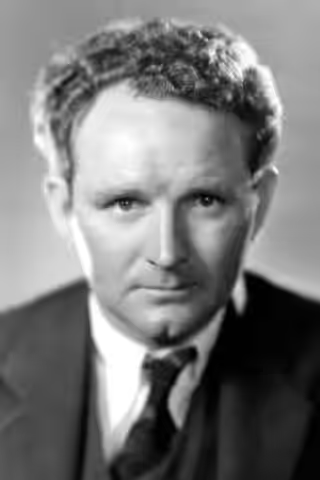
Frank Borzage made films in which two poor young people fall in love and the world tries to stop them, and he meant every frame of it. The sentiment is real, the craft is exact, and the best of them still work.
Fi1m perspective
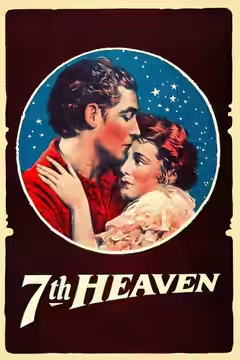
A sewer worker in Paris complains to God that he deserves a better job, in the tone of a man writing to his landlord. He takes in a girl her sister has been beating, lies to a policeman to keep her out of trouble, and installs her in an attic with a bed, a table and a skylight. That is 7th Heaven (1927), and it is the whole of Frank Borzage in one room. Two poor people, a small space, and a director who believes without embarrassment that they can be happy in it.
He came to directing by an unhurried route: travelling theatre companies, then acting in Hollywood from 1912, then a first film of his own in 1915. Through the 1920s he directed steadily, and at Fox, where F. W. Murnau was also working, his pictures took on a softer, more pictorial look. The late silent and early sound years are the peak. 7th Heaven and Street Angel (1928) paired Janet Gaynor with Charles Farrell, and he worked with Farrell four times and Gaynor three. Bad Girl (1931) carried him into sound; A Farewell to Arms (1932) put his lovers in a war; The Mortal Storm (1940) put them under the Nazis, at a time when few Hollywood films would name the threat. The subject never changes. The thing standing in the lovers' way does.
What keeps this from being a formula is that he does the work. In 7th Heaven the happiness is built out of objects: the plate a neighbour lends, the skylight over the bed. When the second half goes to war, his editors cut between the front and the attic so that both seem to be happening at the same hour, which is the point. We sat down expecting to be talked into the feeling and found instead that we had simply arrived at it, somewhere around the moment the neighbour lends the plate, because by then the room was real to us and so were the people in it.
The faults are the faults of the method. He asks his actors to play emotion large, and Farrell in 7th Heaven, chest out and arms going, took us a good half hour to accept; he is better when Borzage lets him be quiet, and Borzage gives him more quiet as the film goes on. The villain there is a stock colonel with a moustache, and the middle sags while he circles, because the film has no interest in him. After Moonrise (1948), which still has admirers for how closely it stays inside its young lovers' heads, the work thinned out, and he made films only occasionally until The Big Fisherman (1959). He died in 1962.
Start with 7th Heaven. If the attic works on you, the rest will. If it does not, he made more of them, all pointed the same way, and none of them will change your mind.
Biography
Frank Borzage (23 April 1894 – 19 June 1962) was an American film director and actor. Born in Salt Lake City, Utah, to Italian and Swiss immigrant parents, he began working as an actor in Hollywood in 1912 and made his directorial debut in 1915 with the short film The Pitch o' Chance.
Borzage directed 7th Heaven (1927), for which he received the first Academy Award for Best Director. He won a second Oscar for Bad Girl (1931). His other credits include Street Angel (1928), A Farewell to Arms (1932), History Is Made at Night (1937), The Mortal Storm (1940) and Moonrise (1948). His final feature was The Big Fisherman (1959).