Frank Borzage gives the Hawaiian first act a real glow and Powell and Keeler are easy company, but once the film reaches West Point it swaps romance for drill and never quite marches back. Pleasant, slight, and a good hour short of its 97 minutes.
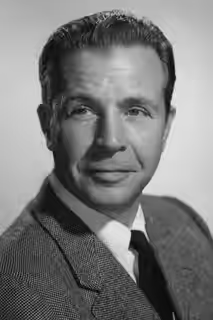
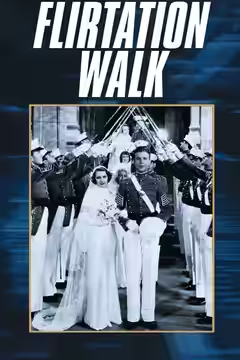
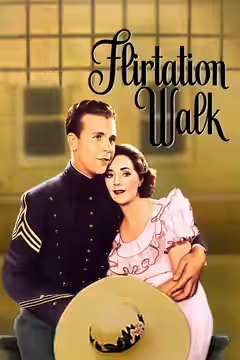
Flirtation Walk is a Warner Bros. musical from 1934 with Dick Powell and Ruby Keeler, the pairing that had done well for the studio in 42nd Street the year before, and it is directed by Frank Borzage, who had made Seventh Heaven and A Farewell to Arms and knew more about lovers in trouble than almost anyone in Hollywood. Those two facts pull in different directions. Warner wanted a bright, brassy service picture with a uniform on every extra. Borzage wanted two people alone in the dark. For about half an hour he gets his way, and that half hour is the reason to watch.
The Hawaiian section is lovely in a plain, unhurried way. Sol Polito and George Barnes shoot the luau at night with the fire low and the sea behind it, and the camera stays close on Powell and Keeler while the dancers work in silhouette around them. Powell sings softly rather than at the balcony, which suits him. Keeler, who was never a great actress and knew it, is at her best here because she is asked only to be a girl who has decided to enjoy herself. We were charmed, more than we expected from a studio programmer, and it was the quiet that did it: Borzage lets a look run a beat longer than the script needs, and Heinz Eric Roemheld’s music drops to almost nothing behind it.
Then Dick goes to West Point, and the film goes with him, and something is lost on the crossing.
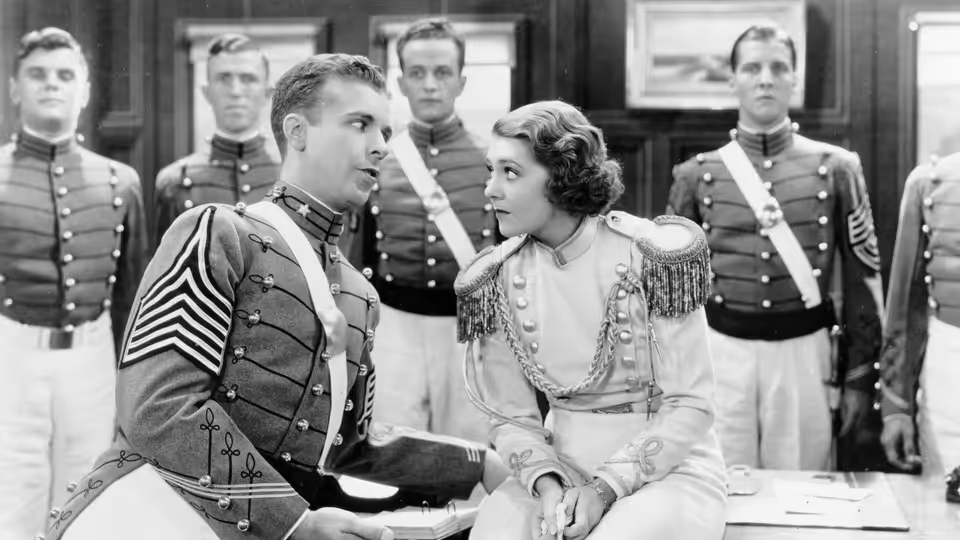
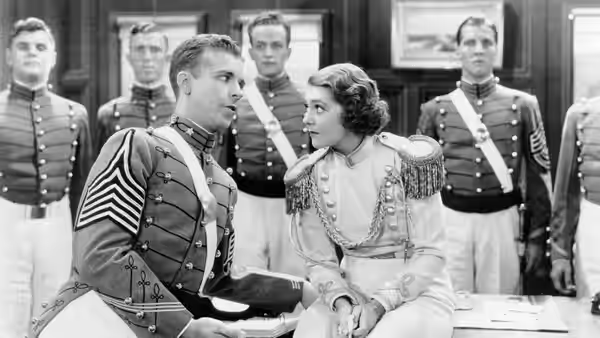
Delmer Daves’s screenplay turns the second half into an academy tour. There is reveille, there is parade, there is a great deal of standing to attention while Henry O’Neill’s General Fitts inspects things. Some of it is plainly shot on the actual grounds, and the location work has a documentary interest: the grey stone, the long lines of cadets, the river below. But a love story needs its lovers in the same frame, and for long stretches Kit is somewhere else entirely, engaged to John Eldredge’s decent, colourless Biddle, while Dick learns to fold a blanket. We were bored, and we were surprised to be bored, because the first act had promised something warmer.
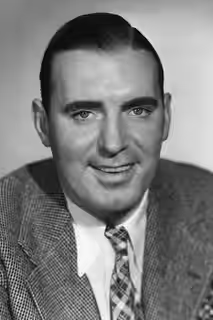
The comedy carries it through the dry patch. Ross Alexander as Oskie, Dick’s roommate, has the best lines and the loosest delivery in the picture, a lazy drawl that undercuts every bit of brass. John Arledge and Guinn ‘Big Boy’ Williams fill out the barracks with the usual dopes and heavies, and Pat O’Brien, who spent most of the decade playing the fast-talking friend, plays it again with his customary speed. He is off screen too long once the story leaves Hawaii, and the film misses him.
As a musical it is thin. Keeler dances once properly, in a cadet show that the film builds towards, and Bobby-Connolly-style spectacle is not what Borzage does; the numbers are staged flat, front on, like a college revue photographed from the stalls. William Holmes cuts them cleanly enough, but there is nothing here to set beside the Warner back catalogue of the same two years. Orry-Kelly, given a cast in uniform, has almost nothing to dress and does what he can with Keeler’s evening gowns.
The two reviews we have read from its release split cleanly, one finding it rousing and one finding it rubbish, and we land in the middle, which is where the film itself sits. It is not lazy. The Hawaiian passages are the work of a director who cared, and the West Point passages are the work of a studio that wanted its money’s worth from the permission to film there. The trouble is that the second lot are longer.
Watch it for the beach and be patient with the parade ground. If you have never seen Borzage, this is not the place to start; if you have, you will spot him in the first act and wait, mostly in vain, for him to come back.