Film review

From Here to Eternity

1953 · Directed by Fred Zinnemann · 1h 58m · MPA NR

In a sentenceThe most famous kiss in the cinema lasts a few seconds; the bullying goes on for two hours

WarRomanceDrama

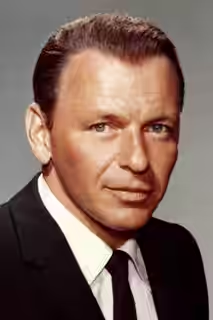
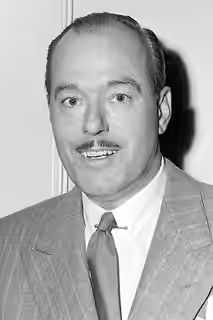
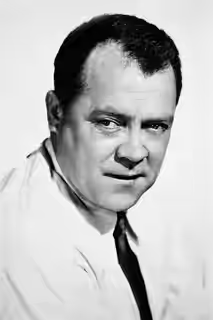
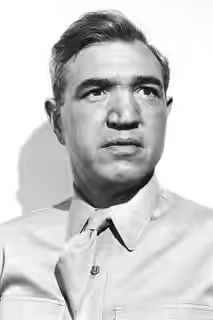
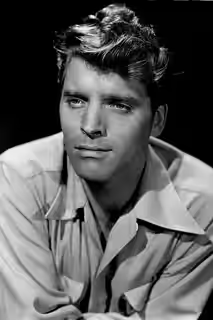
Schofield Barracks, Oahu, the summer of 1941. Private Robert E. Lee Prewitt (Montgomery Clift) transfers into a rifle company after losing his place as a bugler. Captain Dana Holmes (Philip Ober) wants him on the company boxing team; Prewitt used to box, has stopped, and will not put the gloves on again. Holmes leaves it to his sergeants to change his mind, and the drill ground, the kitchens and the parade square become the places where they try. First Sergeant Milton Warden (Burt Lancaster) runs the company and begins an affair with the captain’s wife, Karen Holmes (Deborah Kerr). Prewitt’s only friend, Private Angelo Maggio (Frank Sinatra), picks a quarrel with the stockade sergeant, Judson (Ernest Borgnine), and on a night out Prewitt meets Lorene (Donna Reed), a hostess at a club in Honolulu.

Fi1m review

Fred Zinnemann’s version of James Jones’s novel is remembered for a kiss in the surf and is really about a barracks full of bullies. Montgomery Clift and Frank Sinatra are the reason to watch; the melodrama around them creaks, but it holds.

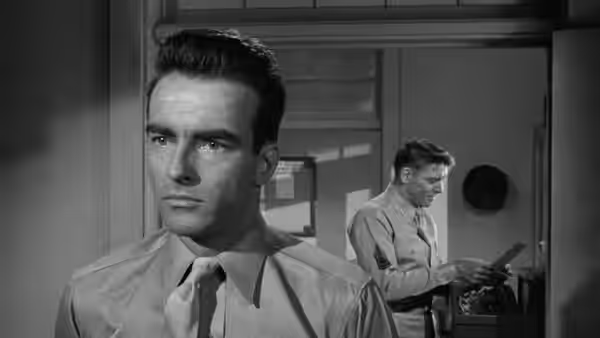
From Here to Eternity is set in the months before Pearl Harbor, in a peacetime army with nothing to do but drill, drink and torment one another. Private Prewitt (Montgomery Clift) arrives at Schofield Barracks and refuses to box for his new captain. Captain Holmes (Philip Ober) wants a trophy and lets his sergeants apply what they call the treatment: extra duty and full-pack runs. First Sergeant Warden (Burt Lancaster) keeps the company running while its commander is elsewhere, and finds the commander’s wife (Deborah Kerr) is elsewhere too. Daniel Taradash’s screenplay cuts James Jones’s long, angry novel to 118 minutes.

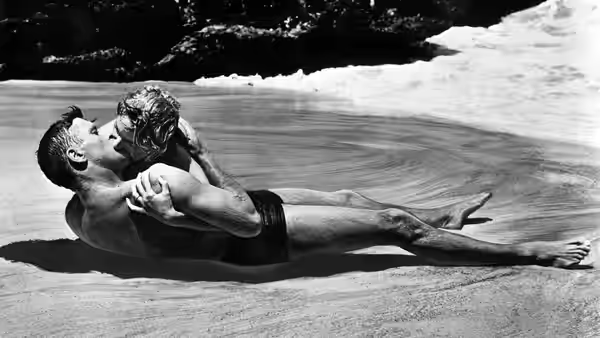
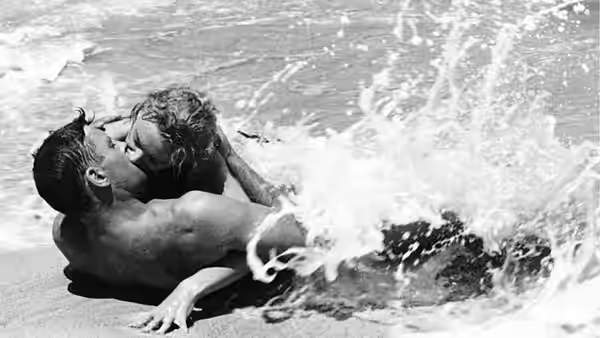
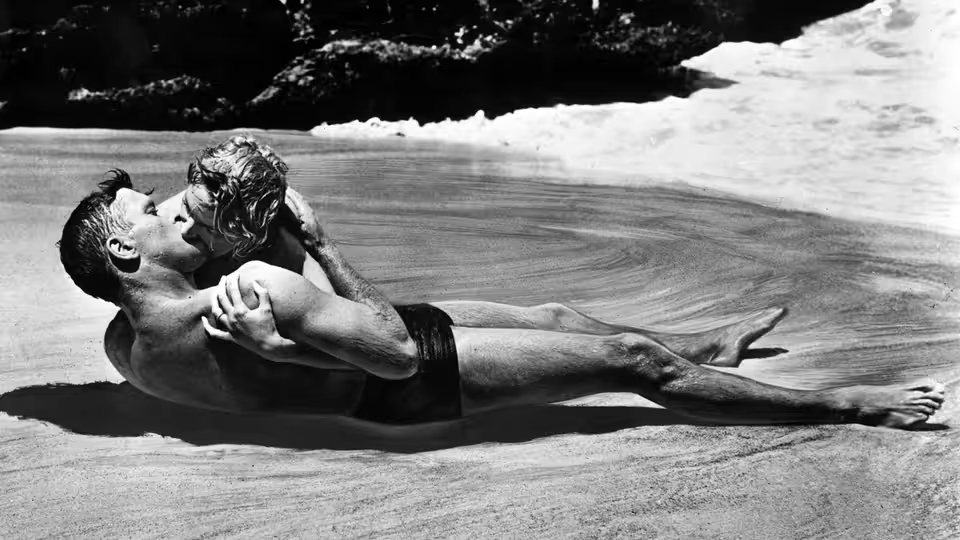
It is a fine film remembered for the wrong thing. Everyone remembers two people kissing as a wave breaks over them; that shot is in it, and it is short. What the film is about is a man who will not do what he is told, and an institution with all day to make him. We would recommend it to almost anyone, with the warning that the love stories are the weakest part.

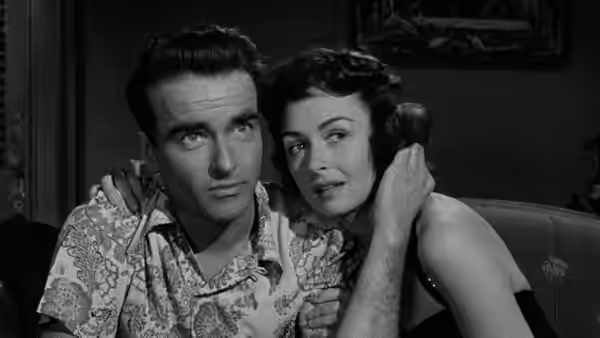
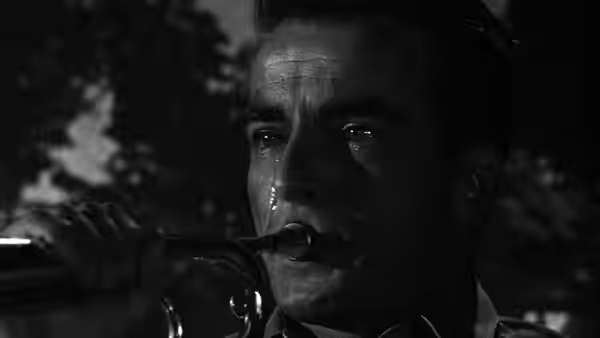
Clift plays Prewitt as someone who has decided in advance to absorb whatever is coming. Burnett Guffey shoots the drill ground in a flat white glare so that the punishment looks like weather. When Sergeant Galovitch (John Dennis) stands over him on the parade square, we were angry on Prewitt’s behalf and, a moment later, angry at him, because a word would end it and he will not say the word. Clift carries that double feeling without a raised voice.

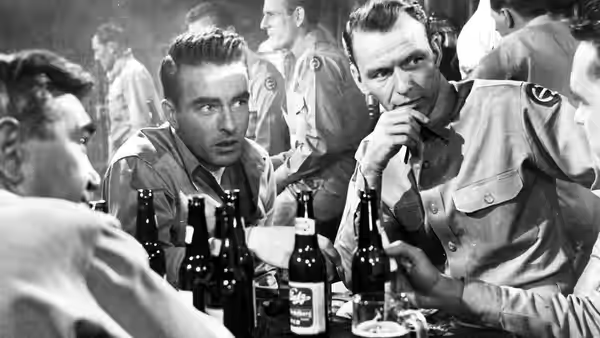
Frank Sinatra is the surprise. Maggio is small, loud and loyal, and Sinatra plays him as if he has never been near a microphone. Ernest Borgnine’s Judson runs the stockade and plays piano in the club, and the night Maggio objects to his playing we did not move. Borgnine does not shout. He smiles, picks up a bottle, and the men around him go quiet. It is the most frightening scene in the film and not a shot is fired in it.

Lancaster and Kerr get the beach. He is all shoulders and certainty; she had spent years playing well-bred women, and Zinnemann puts her in a bathing costume and lets her be bitter and bored. Jean Louis dresses her plainly, so that when she does dress up we notice. The kiss is fine. The conversation after it, on the sand, when she tells him what her marriage has been, is better, and Kerr does more with a cigarette than most actors do with a monologue. Donna Reed has the harder job as Lorene, because Taradash has made her respectable enough for the censors and the character has lost her point.

George Duning’s score does not trust the actors. It swells under nearly every quiet exchange. William Lyon’s editing is another matter: the film moves through a great deal of story without hurrying, and when the attack finally comes, Lyon cuts between men in undershirts running across the yard and aircraft crossing the sky with a speed the rest of the film has been saving up. Zinnemann stages it from the ground, among men who have been polishing boots for two hours and now cannot find the ammunition.

Zinnemann had made High Noon the year before, a film with one idea and one clock. This is a more crowded picture, with four love affairs and a barracks full of grudges, and it is less clean for it. Some of the melodrama has dated: people announce their feelings in complete sentences. The bullying has not dated at all.

Watch it for the barracks and tolerate the beach. The PG certificate is right; nothing is shown that a child could not see, and almost everything that matters happens on a man’s face while someone else is shouting at him.
Critical consensus AI synthesised

81
Positive
9
Mixed
0
Negative
0

The reviews are uniformly positive, though the warmth cools a little with the decades. Critics writing in 1953 treat the film as a model of studio craft: Fred Zinnemann’s direction, a tight screenplay and a cast taking roles well outside their usual range, with Frank Sinatra, Deborah Kerr and Donna Reed picked out for reinventing themselves. Later writers agree on the essentials and return to the same two sequences, the surf kiss between Lancaster and Kerr and the Pearl Harbor attack, as the moments that still land.

The spread is narrow, from good to excellent, and the reservations are small. Time Out finds the direction anonymous and the tone occasionally hysterical while still being seduced by it. The Guardian thinks Montgomery Clift’s subplot the weakest strand, a view Time Out flatly contradicts by calling him outstanding. Eye for Film and Empire note that the novel has been softened and that some of its attitudes have dated.

Los Angeles Times
1 October 1953 · Edwin Schallert
90*

The picture assumes to delineate peacetime troop conditions in Pearl Harbor before Dec. 7, 1941, and scores a great technical coup through casting, direction by Fred Zinnemann, and treatment of a story once thought too hot to handle. Deborah Kerr, Frank Sinatra, and Donna Reed break completely with their cinema past in new moods and roles.

Read the full review →
The New York Times
6 August 1953 · Bosley Crowther
90*

The film captures the essential spirit of James Jones's novel about military life in pre-Pearl Harbor Hawaii, emerging as a towering and persuasive drama through expert editing, direction, and performances. It stands as a shining example of professional moviemaking that purifies the book's brutality while retaining its power and scope.

Read the full review →
Variety
29 July 1953 · William Brogdon
90*

The James Jones bestseller has become an outstanding motion picture in this smash screen adaptation, presenting socko entertainment for big business with exceptionally good cast names and topnotch exploitation values. Fred Zinnemann’s direction solidly builds scenes and develops characters into cohesive, gripping drama spiced with action and humor, backed by an exceptionally fine screenplay.

Read the full review →
Empire
1 January 2000 · Kim Newman
80*

The critic praises the film's iconic scenes and strong performances while noting it remains endlessly rewatchable as old-school drama, despite some themes feeling dated. The beach scene and Pearl Harbor recreation stand out as highlights.

Read the full review →
The Guardian
23 September 2010 · Peter Bradshaw
80*

The critic finds that most of the power, fervency and soapy compulsion of Fred Zinnemann's 1953 Oscar-winner survives in this new restoration. They single out the brilliant and spectacular Pearl Harbor bombing set-piece and the iconic Lancaster-Kerr surf kiss (noting its brevity) for praise, while observing that Montgomery Clift's subplot is less compelling.

Read the full review →
Time Out
21 September 2010 · ★★★★ · David Jenkins
80

The critic finds the 1953 film a garish but compelling ode to the lonely lot of the pacifist, with Montgomery Clift outstanding as the blighted boxer-bugler. It is anonymously directed and sometimes hysterical, yet seduces as a hot-blooded spectacle stitching emotional detail onto history.

Read the full review →

Cast

Awards

Academy Awards, 1954

Nominated
Best Actor
Nominated
Best Actress
Nominated
Best Costume Design, Black-and-White
Nominated
Best Original Dramatic or Comedy Score
Won
Best Cinematography, Black-and-White
Won
Best Director
Won
Best Film Editing
Won
Best Picture
Won
Best Sound
Won
Best Supporting Actor
Won
Best Supporting Actress
Won
Best Writing, Adapted Screenplay

If you liked this, try…