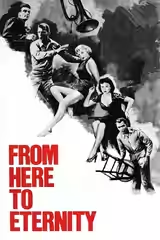
The reviews are uniformly positive, though the warmth cools a little with the decades. Critics writing in 1953 treat the film as a model of studio craft: Fred Zinnemann’s direction, a tight screenplay and a cast taking roles well outside their usual range, with Frank Sinatra, Deborah Kerr and Donna Reed picked out for reinventing themselves. Later writers agree on the essentials and return to the same two sequences, the surf kiss between Lancaster and Kerr and the Pearl Harbor attack, as the moments that still land.
The spread is narrow, from good to excellent, and the reservations are small. Time Out finds the direction anonymous and the tone occasionally hysterical while still being seduced by it. The Guardian thinks Montgomery Clift’s subplot the weakest strand, a view Time Out flatly contradicts by calling him outstanding. Eye for Film and Empire note that the novel has been softened and that some of its attitudes have dated.