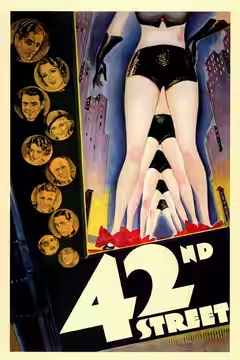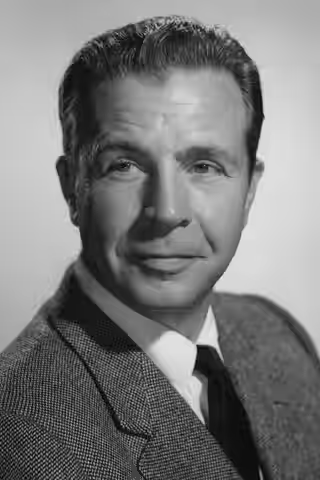
Dick Powell spent a decade as Warner Bros.' boyish crooner, singing to Ruby Keeler rather than at the balcony, then traded it for Philip Marlowe and a run of hard-boiled men. The early quiet is the thing to go back for.
Fi1m perspective
In 42nd Street (1933) Dick Powell is the boy grinning at Ruby Keeler over a piano, and the grin is doing most of the work. Keeler reads her lines as if they had been handed to her a minute before; Powell supplies the warmth for the pair of them and asks for nothing back. That was the job Warner Bros. signed him for in 1932, a singer and bandleader out of the Pittsburgh theatres, and for the best part of a decade he did it: the clean-cut juvenile in the Busby Berkeley musicals, opposite Keeler or Joan Blondell, the tenor who sang to the girl.
He was better at it than the parts deserved. The usual charge against the early Powell is that he was wooden, or at any rate a genial crooner and not much more, and there are stretches of Gold Diggers of 1933 (1933) where the charge sticks. But watch him in Flirtation Walk (1934), in the Hawaiian half hour that Frank Borzage shoots by low firelight before the film marches off to West Point. He sings softly, lets a look run a beat longer than the script needs, and stays still while the dancers work in silhouette around him. We were charmed, more than a studio programmer had any right to charm us, and it was his quiet that did it. The film around him is slight; he is not.
The turn came in 1944. Powell had been asking for dramatic parts, and RKO cast him as Philip Marlowe in Murder, My Sweet, with Edward Dmytryk directing. We have not reviewed it, so we will say only what the record shows: the crooner did not come back. What followed was a run of tired, hard men in film noir, Pitfall (1948) among them, and then The Bad and the Beautiful (1952). The change of image was as complete as Hollywood has managed, and it took because he kept the underplaying and dropped the smile.
He directed six films from 1953 and co-founded Four Star Productions for television, and he described himself in a way that suggests he knew exactly what he was. "I started out with two assets: a voice that didn't drive audiences into the streets, and a determination to make money." The first is too modest; the voice was pleasant and he used it with more taste than the studio did. The second explains a career that always went where the work was. If you know only the Marlowe, go back to 42nd Street and look at the boy at the piano. He is already holding something back.
Biography
Dick Powell was an American actor, singer, producer and director. Born Richard Ewing Powell in Mountain View, Arkansas, he began his career as a singer with the Charlie Davis Orchestra and later worked as a master of ceremonies in Pittsburgh theatres. He made his film debut in Blessed Event (1932) and rose to prominence as a boyish crooner in Warner Bros. musicals, including his credited role as Billy Lawler in 42nd Street (1933), as well as Gold Diggers of 1933 (1933) and Footlight Parade (1933).
Powell later reinvented himself in dramatic roles, notably as Philip Marlowe in Murder, My Sweet (1944). He directed several films, among them The Enemy Below (1957) and The Conqueror (1956), and co-founded the television production company Four Star Productions. He appeared in The Bad and the Beautiful (1952) and died in Los Angeles in 1963.