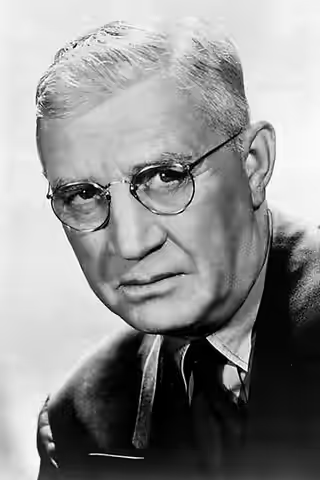
Lloyd Bacon made more than a hundred films for Warner Bros and left his mark on few of them in any way a viewer would notice. That is not the insult it sounds: the backstage hour of 42nd Street is his, and it still bites.
Fi1m perspective
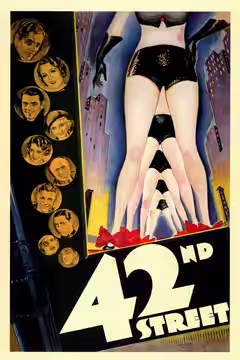
Nobody in 42nd Street (1933) puts on a show for love. Julian Marsh needs the money because the crash took his, the backer pays because he wants the star, and the chorus turns up because the alternative is the breadline. Lloyd Bacon directs that backstage hour as a comedy with its teeth showing, fast and funny and hard about who is paying, and then hands the last reels to Busby Berkeley for the dance numbers. It is the arrangement his reputation has never got out from under.
He came to directing from the other side of the camera. Bacon acted on stage and then in more than forty films, including supporting parts with Charlie Chaplin in the mid-1910s, and directed shorts from the early 1920s, some of them for Mack Sennett, before joining Warner Bros in 1926. There he made over a hundred features, in whatever genre the studio needed that month: musicals, gangster and crime pictures, comedies, westerns, war films. He worked with James Cagney fourteen times and Humphrey Bogart five. Later he moved to Twentieth Century-Fox and other studios, and he worked until the mid-1950s.
The 1933 musicals are the peak, 42nd Street and Footlight Parade in the same year, and the fairest thing to say about them is that Berkeley did the numbers and Bacon did everything else. Everything else is most of the film. Then came the topical Warners pictures: Marked Woman (1937), a crime drama with Bette Davis; A Slight Case of Murder (1938), a comedy with Edward G. Robinson; Knute Rockne, All American (1940), a sports biopic with Ronald Reagan; Action in the North Atlantic (1943), a war film with Bogart. We have not reviewed them, so we will not pretend to weigh them here, but the list tells you what he was: the man the studio sent when it had a large cast, a subject torn from the papers and a date it meant to keep.
The case against him is that a director whose films are known for the choreographer or the star has not left much of himself in them, and that his standing rests on volume and consistency rather than on anything you could call a style. Some of that is true. He delivered on schedule and did not fuss, and the studio valued him for it. But watch the first hour of 42nd Street again. We laughed through it and were faintly shocked at how little anyone cared about the show; Warner Baxter's Marsh is a man saving his own skin, and the jokes land because Bacon never lets the film pretend otherwise. That pace and that unsentimental eye did not come from Berkeley.
The finale arrives, the chorus forms its patterns, and everybody remembers whose name goes on the dancing. The hour before it kept moving because somebody made it move. Give Bacon that hour, and then judge him on what else you can find.
Biography
Lloyd Bacon was an American film director and former actor. Born in San Jose, California, he began his career on stage and in silent films, appearing in more than 40 productions including several with Charlie Chaplin. He directed his first feature in 1926 and went on to direct over 100 films until 1955, working primarily at Warner Bros. for nearly two decades.
Bacon directed films across many genres. He is best known for the Warner Bros. musicals 42nd Street (1933) and Footlight Parade (1933), the crime drama Marked Woman (1937), the comedy A Slight Case of Murder (1938) and the war film Action in the North Atlantic (1943). Other credits include Brother Orchid (1940) and My Darling Clementine (1946, co-director).
He died in Burbank, California, on 15 November 1955.