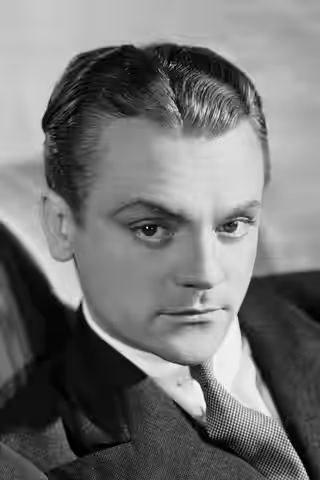
James Cagney moved like a dancer and talked faster than anyone else on screen, and the two together made him the most alive thing in any frame Warner Bros put him in. Typecast as a hoodlum, he was better than the type.
Fi1m perspective
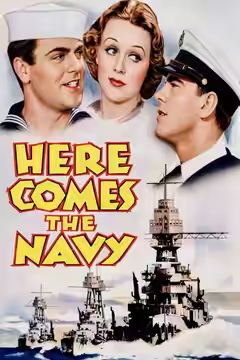
Watch James Cagney stand still. In Here Comes the Navy (1934) he is made to stand at attention, jaw working, saying nothing and hating every second, and he is funnier than when he talks. That is the trick of him. He came out of vaudeville as a tap dancer, and every part he played afterwards kept the dancer's habits: weight forward, hands busy, the walk arriving a beat ahead of the line. He talks faster than anyone else on screen and is already moving when the line ends.
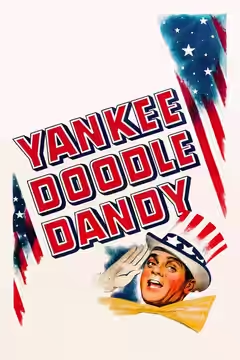
Warner Bros found out what they had with The Public Enemy (1931). Tom Powers made his name and fixed his image, and the studio spent most of the decade asking for the same man again. He fought them over it, went briefly to Grand National in 1936 and 1937, and came back. In between the hoodlums he made Footlight Parade (1933) for Lloyd Bacon, a Busby Berkeley musical that let the hoofer out, and Angels with Dirty Faces (1938), where Rocky Sullivan is a tough guy with a conscience he is not sure he wants. Yankee Doodle Dandy (1942) gave him George M. Cohan and the song and dance back in full. White Heat (1949) sent him back to the gangster, and Cody Jarrett is the one people mean when they say Cagney. He retired after One, Two, Three (1961) and returned once, for Ragtime (1981).
What works is the pressure. He is the same size in a comedy as in a shooting, and in Here Comes the Navy Bacon simply points him at Pat O'Brien and lets them argue for 87 minutes. O'Brien bellows, Cagney needles, and the film needs both. They made nine films together, and O'Brien was the straight man he needed: someone who has read the rulebook aloud so that Cagney can knock it off the table. We laughed out loud at the dance hall fight in that film, which arrives exactly on schedule, and then were surprised by how much we enjoyed him doing nothing at all, standing to attention a few scenes later with his jaw going and not a word coming out.
What does not work is sentiment. When a script asks him to be admired rather than watched, the pressure drops. Here Comes the Navy is a small case of it: the second half wants Chesty taken seriously as a hero, and we could not quite manage it. The complaint followed him into the 1950s, and Mister Roberts (1955) is the film most often held against him on that count.
He put it plainly himself: "Once a song and dance man, always a song and dance man." Start with The Public Enemy if you want the legend. Then watch Here Comes the Navy on a wet afternoon and keep your eye on his feet, which is where the acting was all along.
Biography
James Cagney (1899–1986) was an American actor and dancer. Born in New York City, he began in vaudeville as a song-and-dance performer before making his Broadway debut in the 1920s. He entered films with Sinners’ Holiday (1930) and signed with Warner Bros.
Cagney became a star with his role as gangster Tom Powers in The Public Enemy (1931). He received Academy Award nominations for Angels with Dirty Faces (1938) and Love Me or Leave Me (1955), winning Best Actor for his portrayal of George M. Cohan in Yankee Doodle Dandy (1942). Other notable performances include roles in The Roaring Twenties (1939), White Heat (1949) and Mister Roberts (1955).
After retiring from films in 1961, Cagney returned for Ragtime (1981). He appeared in Here Comes the Navy (1934) as Chesty O’Conner.