Film review

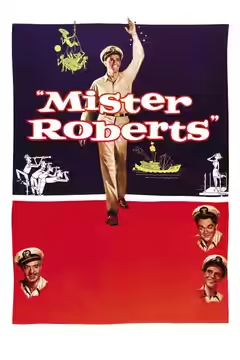
Mister Roberts

1955 · Directed by John Ford, Mervyn LeRoy · 2h 03m · MPA NR

In a sentenceJack Lemmon spends the war plotting revenge on a captain who does not know he is aboard

ComedyDramaWar

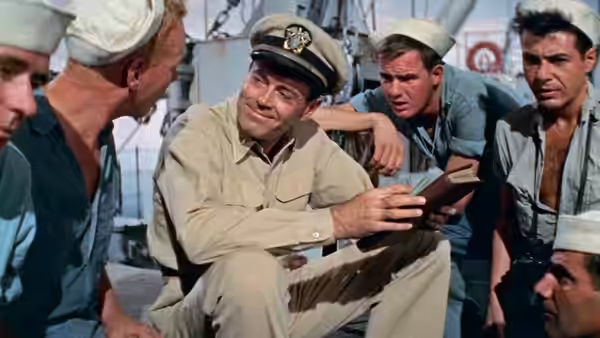
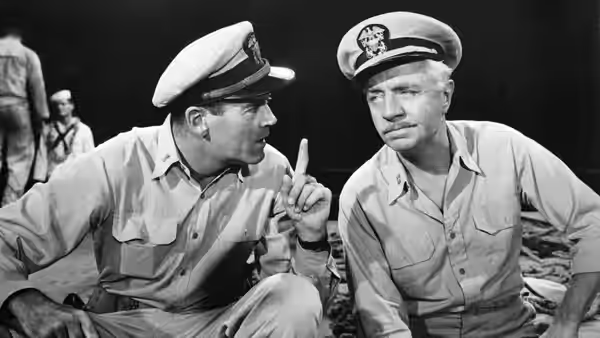
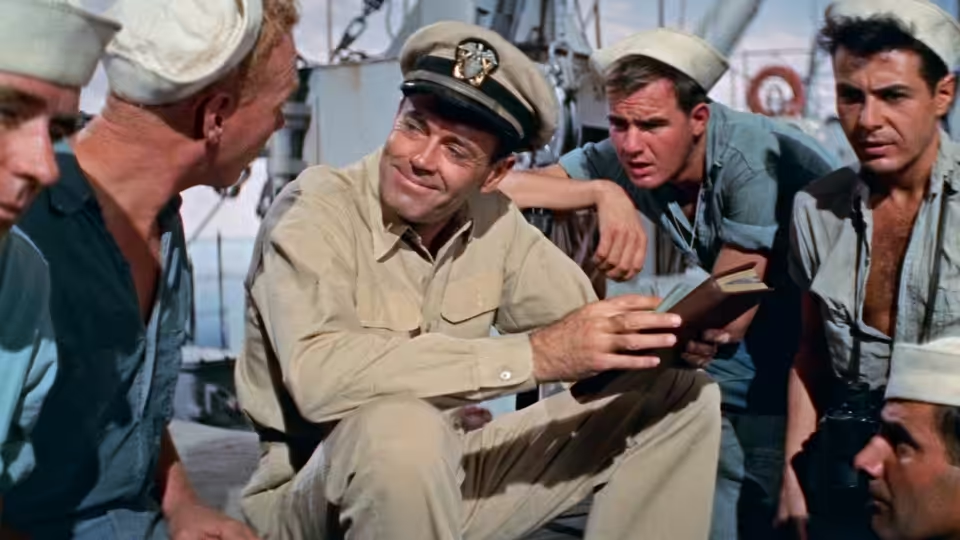
The Pacific, the last months of the Second World War, on a Navy cargo ship carrying toothpaste and toilet paper between islands the war has passed by. Lieutenant Roberts (Henry Fonda), the cargo officer, watches the warships steam past and writes another letter requesting a transfer to a ship that fights. Captain Morton (James Cagney), who keeps a potted palm tree on the bridge, refuses to forward it and denies the crew any shore leave. Roberts drinks with Doc (William Powell), the ship’s surgeon, and shares a cabin with Ensign Frank Pulver (Jack Lemmon), the laundry officer, who has avoided the captain for over a year and plots revenges he never carries out. A party of nurses, among them Ann Girard (Betsy Palmer), arrives on the island opposite.

Plays from YouTube when you press play; nothing loads from them until then.

Fi1m review

A stage comedy about a cargo ship the war forgot, carried by four actors who could carry anything. The direction changed hands and it shows, and the comedy is louder than the material needs, but the sadness underneath is real and Fonda makes it count.

Thomas Heggen’s novel became a Broadway play, the play became this film, and Henry Fonda came with it, having played Roberts on stage before the cameras arrived. That history is on the screen. Mister Roberts is a war film in which nobody fires a shot, set on a Navy cargo ship in the Pacific in the last months of the Second World War, and its subject is what the war did to the men it forgot. It is a good film, often a funny one, carried by four actors at the top of their form, and for long stretches of its middle it is broader and louder than it needs to be.

The credits list two directors, and the reviews since have told the story: John Ford started it and fell ill, and Mervyn LeRoy finished it. Whoever shot what, no single hand is on the film. Scenes are played out on deck as they would be on a stage, with the actors arranged along the rail and the camera set back to watch. Winton Hoch, who shot She Wore a Yellow Ribbon and The Quiet Man for Ford, gives the ship a hard, bright heat: the sea is flat, the sky is white and the paint on the bulkheads looks sweated on. That is the right look for a film about boredom. Jack Murray cuts patiently and lets speeches run. Franz Waxman’s score is jaunty and nautical and rather too pleased with itself, arriving a second after each joke to confirm that it landed.

Fonda holds it together. Roberts is adored by the crew and wants off; he writes for a transfer every week, and every week Morton refuses to forward it. Fonda plays him with almost nothing, a lean man leaning on a rail. Early on, a fleet of warships steams past on the horizon at dusk while Roberts watches from the deck, and Fonda does not move, and the film waits with him. It moved us more than we thought a scene of a man looking at ships could. Everything the film has to say about wasted years is in that face, and it says it without a line.

James Cagney’s Morton is the villain, and Cagney makes him small rather than large: a man who came up through the ranks, resents every college boy on his ship and has decided that a palm tree in a pot is the sum of his achievement. He barks, but the barking is fear. William Powell, in his last screen role, plays Doc as the ship’s only grown-up, turning medicinal alcohol into something drinkable and speaking like a man who has stopped expecting anything. And Jack Lemmon, as Pulver, is the reason people still put this film on. Pulver has hidden from the captain for over a year and spends his days devising elaborate revenges. Lemmon plays him as a boy who talks fast so nobody will notice he has done nothing, and we laughed harder at him than we have at any comedy of this age in some time.

The trouble is the crew. Heggen and Joshua Logan wrote them as a chorus and Frank S. Nugent’s screenplay leaves them one; Ward Bond’s Dowdy is a face and a voice, and the rest are names on a roster. When the film hands them a shore leave in the middle, the comedy goes wide, with brawls and arrests and men carried back up the gangway, and what was rueful becomes a service farce any studio could have made. Betsy Palmer’s Ann Girard gets one good scene of being looked at through binoculars and is then put away; the script has no further use for a woman. Moss Mabry keeps everyone in salt-stained khaki, and Pulver’s shirts are better pressed than anyone else’s, which is the right joke for a man with nothing to do.

Against Ford’s own work this is nowhere near the top; there is none of the composure of his westerns, and no landscape for men to stand in, only a deck. Against the service comedies that came after it, it looks like the source: war as paperwork and waiting, with authority as the enemy and the fighting somewhere over the horizon. Most critics have liked it about as much as we do.

It runs 123 minutes and a fair half hour of that is men shouting on a deck. Put up with it for the rest, which belongs to Fonda, Powell and Lemmon, one of them at the end of a career and one at the start. Watch it on a hot evening with the windows open.

Critical consensus AI synthesised

75
Positive
5
Mixed
1
Negative
0

Most critics like Mister Roberts, and the praise gathers almost entirely around the four leads. Henry Fonda is admired in every review for a lean, quiet Roberts; James Cagney’s captain, William Powell’s doctor and Jack Lemmon’s Ensign Pulver are named nearly as often. Several reviews also credit the dialogue and the film’s unusual interest in boredom and grumbling rather than combat, and the more recent ones find more feeling in its account of tired men than its reputation as a comedy suggests.

The reservations concern the move from stage to screen. The New Yorker thinks the comedy has been broadened until some scenes stop being believable, though it finds the sadder passages effective. Time Out goes further, calling the direction anonymous after John Ford’s illness handed the film to Mervyn LeRoy, and treating the cast as the only reason to watch. The spread is narrow: nobody dislikes it, and the argument is whether the performances carry a good film or rescue an ordinary one.

The New York Times
15 July 1955 · A. H. Weiler
90*

The film is a strikingly superior entertainment, hilariously funny and wonderfully sentimental about the crew of a Navy cargo ship. It features visual improvements over the play and a beautifully lean, sensitive performance by Henry Fonda as Mr. Roberts.

Read the full review →
The AV Club
29 January 2016 · Gwen Ihnat
80*

The critic praises the film's unique take on military life focusing on boredom and questioning authority, highlighting shimmering dialogue and strong performances by Fonda, Powell, Cagney, and Lemmon. She notes the behind-the-scenes clash between Fonda and Ford but commends the film's captivating qualities and Lemmon's Oscar-winning turn.

Read the full review →
The New Yorker
16 July 1955 · John McCarten
70*

The screen version broadens the comedy too much, making some humorous scenes implausible, but the rueful dramatic scenes are effective. Henry Fonda is consistently admirable, as are James Cagney, Jack Lemmon, and William Powell.

Read the full review →
Variety
31 December 1954
70*

The salty comedy transfers successfully to the screen with strong direction shared by John Ford and Mervyn LeRoy. Henry Fonda repeats his stage success, James Cagney is great as the captain, William Powell excels as the doctor, and Jack Lemmon is a big hit as Ensign Pulver.

Read the full review →
Time Out
10 September 2012 · ATu
60*

The critic calls it a trouble-bound adaptation of the Broadway hit, noting that Ford fell ill and Mervyn LeRoy took over with some uncredited help from Joshua Logan. The seamless anonymity highlights the strength of the star performances by Fonda, Cagney, Powell and Lemmon as the only real reason to watch.

Read the full review →
Collider
8 March 2025 · Liam Gaughan
85*

The film is a brilliant World War II satire that examines the everyday challenges of a U.S. cargo ship's crew during the final days of the war. It stands out for its surprisingly emotional depth in portraying soldiers' depression, anxiety, and camaraderie, delivered through individualistic and compassionate filmmaking.

Read the full review →

Cast

Awards

Academy Awards, 1956

Nominated
Best Picture
Nominated
Best Sound
Won
Best Supporting Actor

If you liked this, try…

The Caine Mutiny poster76

The Caine Mutiny

1954 · The same year, the same Navy, and a captain nobody finds funny

Stalag 17 poster

Stalag 17

1953 · Wilder’s prison-camp comedy, where boredom is the enemy and jokes are rations

The Cruel Sea poster

The Cruel Sea

1953 · The British version of men and a ship, with no laughs and more salt

M*A*S*H poster72

M*A*S*H

1970 · What this film’s mockery of brass grew into once the studios let go

Dad's Army poster86

Dad's Army

1968 · A platoon the war forgot, plotting small victories over their own captain