Film review

The Quiet Man

1952 · Directed by John Ford · 2h 09m · MPA NR

In a sentenceEveryone in Ireland is drunk, singing or matchmaking, and the sheep are the only ones not in on the joke

RomanceComedyDrama

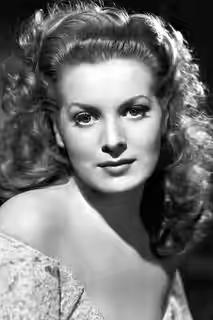
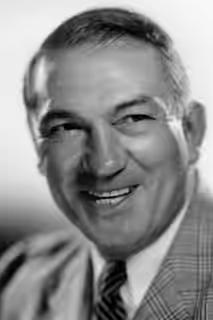
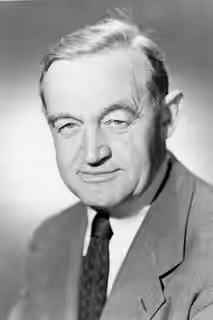
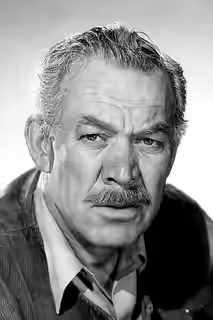
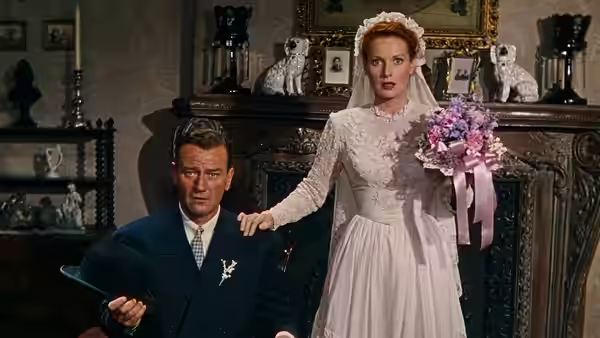
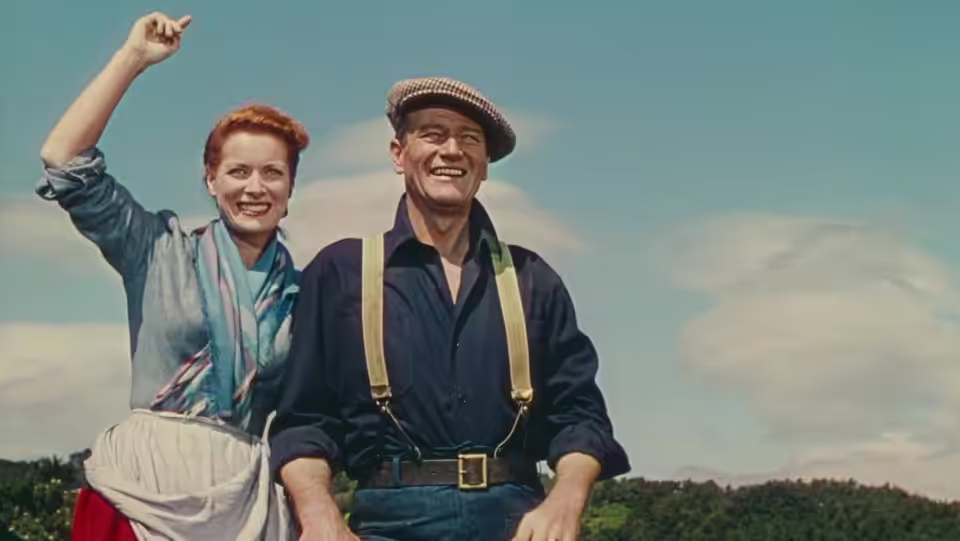
Sean Thornton (John Wayne), an American with a past he does not discuss, steps off a train in the west of Ireland and asks the way to the village he left as a child. Michaleen Oge Flynn (Barry Fitzgerald), the village matchmaker, drives him out, and on the road Sean sees Mary Kate Danaher (Maureen O’Hara) herding sheep and cannot look at anything else. He wants two things: his dead mother’s cottage, and her. The cottage belongs to the Widow Tillane (Mildred Natwick). Mary Kate belongs, in the village’s eyes, to her brother, Squire ‘Red’ Will Danaher (Victor McLaglen), the biggest farmer for miles, who wants the cottage himself and has no intention of letting the Yank have either. Father Lonergan (Ward Bond) would rather be fishing.

Plays from YouTube when you press play; nothing loads from them until then.

Fi1m review

John Ford’s Irish holiday is a picture-book fantasy and knows it, and for most of its 129 minutes the fantasy is good company. Maureen O’Hara gives it a spine; Barry Fitzgerald’s whiskey jokes and one ugly late scene take some of it away.

John Ford made The Quiet Man about the Ireland his people came from, and he made it as a holiday from the Westerns he is known for. From a story by Maurice Walsh, it follows an American who comes back to the village of his birth, buys a cottage, and sets about marrying the woman he saw on his first afternoon. Everyone he meets is a type: the matchmaker, the priest, the bully, the widow. Ford does not mind, and for most of 129 minutes neither did we. It is a good film, warm and slow and green, and it has one scene in it that has aged badly.

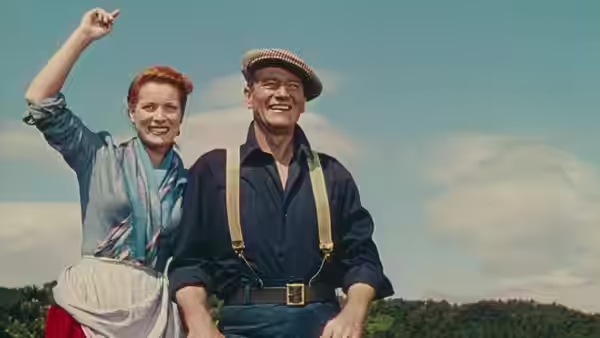
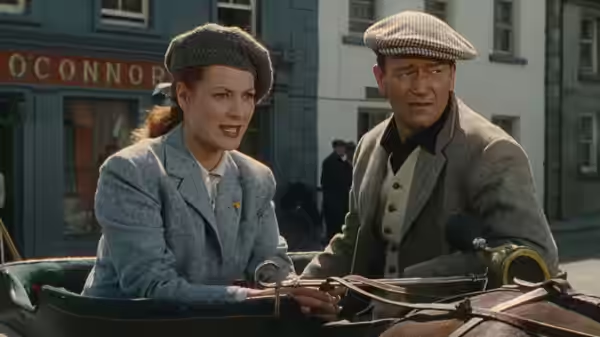
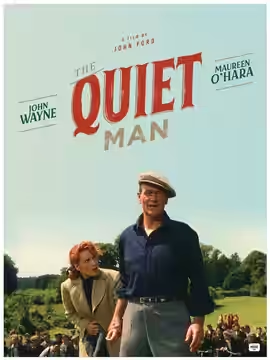
Winton Hoch shot it in Technicolor, on location, and the colour is the first reason to see it. The fields are the green of a painted sign, the sky comes and goes behind heavy cloud, and the cottage sits at the end of a lane with a mountain behind it. Ford holds his wide shots longer than a comedy usually allows, and lets people walk into them and out again. The first sight of Mary Kate, red hair in a field of sheep with Thornton staring from the cart, is the shot the film is remembered for, and we understood why the instant it happened: it stopped us the way it stops him. Victor Young’s score is fiddles and slow airs, laid on with a shovel, and Hoch’s pictures can take it.

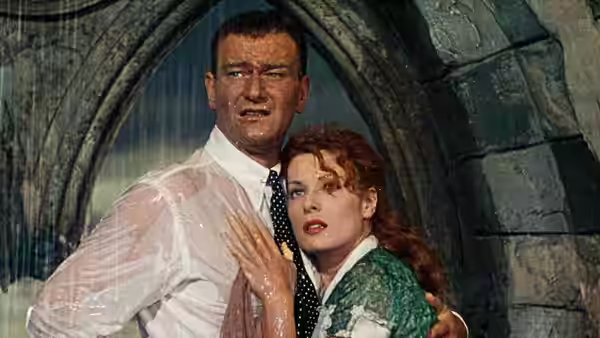
Maureen O’Hara is the second reason. Mary Kate wants Thornton and says so, wants her dowry and says so, and will not keep house in a home she has not furnished herself. O’Hara plays her at full volume, chin up, and Frank S. Nugent’s screenplay gives her the best lines in it. Wayne, for once, is the quiet one. He plays Thornton as a big man who has decided to say as little as possible, and it suits him. There is a courtship scene in a churchyard in the rain, the two of them soaked through and grinning, that is as close as Ford ever got to filming desire, and it is closer than we expected.

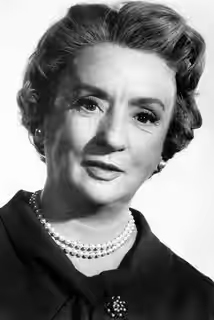
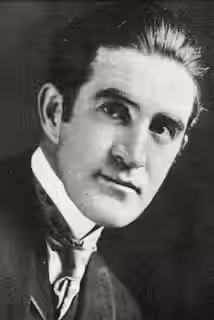
Victor McLaglen’s Red Will Danaher is a bully with a great deal of noise, and McLaglen plays him as a man who would be startled to learn anyone was afraid of him. Ward Bond’s Father Lonergan, who tells us the story, would rather be fishing and mostly is. Mildred Natwick’s widow is dry and watchful and given too little to do. Then there is Barry Fitzgerald, whose matchmaker is a small drunk man with a pipe, a pony and a running commentary. We laughed at him the first three times. After that we started counting.

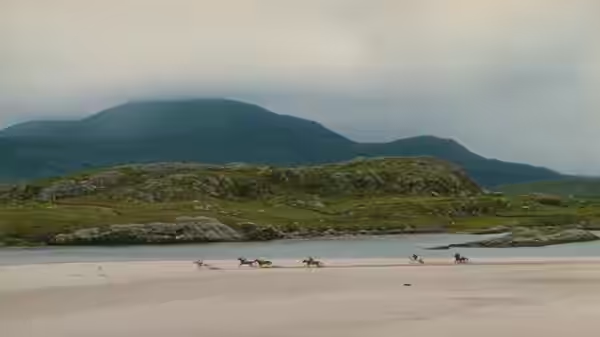
The Ireland here is a picture book. Nobody works, everybody drinks, the train is late by hours and the two clergymen are the best of friends. The village is played as stage Irish and the accents wander. Jack Murray’s editing is loose; the horse race on the beach runs on past the point where we knew who would win, and the film as a whole could lose a quarter of an hour. Adele Palmer’s costumes are the place where the picture book pays its way: Thornton in a flat cap and tweed bought to fit in, and not fitting in, and Mary Kate in colours chosen for Hoch’s camera.

And there is the scene near the end, which we will not describe, in which Thornton handles his wife in a way the whole village turns out to cheer. It is played for laughs and got none from us. We winced, and kept wincing, because Ford plainly thinks it is the best joke he has. The one notice from the film’s own year that took against it complained of treacle. That is the wrong complaint. The sweetness is fine; it is that scene.

Set against Ford’s own work, this is his lightest film and, by most accounts, one of his most personal. It has none of the weight of Stagecoach or The Grapes of Wrath, and it does not want any. Watch it on a wet Sunday afternoon with the heating on, and be ready to look away once. The U certificate is accurate about the language and the blood. It is silent about that one scene.
Critical consensus AI synthesised

77
Positive
11
Mixed
0
Negative
1

Most critics like The Quiet Man a great deal, and the praise gathers in the same places. The Technicolor photography of the Irish countryside is mentioned in nearly every review, and several treat it as the film’s chief pleasure. Maureen O’Hara draws the warmest notices, for a heroine with more independence and appetite than the period usually allowed. The big fight is singled out repeatedly, and a number of critics admire how Ford moves between romance, comedy and something sadder without the joins showing.

The reservations are about the view of Ireland. Several reviews call it rose-tinted, nostalgic or stage-Irish, and The Skinny adds casual misogyny and some hammy acting to the charge sheet while still recommending it. The spread is otherwise narrow. The one outright dissent is the oldest: The New Yorker, reviewing it on release in 1952, finds the whole thing cute, quaint and overlong, and thinks Ford has slipped into treacle.

Radio Times
★★★★★ · Tony Sloman
100

John Ford won his fourth best director Oscar for this immensely popular chunk of old blarney; John Wayne and Maureen O'Hara shine, with fantastic support, a lilting score and deservedly Oscar-winning Technicolor photography, though the picture-book view of Ireland may seem rose-tinted and dated now.

Read the full review →
Slant Magazine
2 November 2016 · Carson Lund
90*

The review celebrates the film’s sublime Technicolor visuals and Ford’s fluid blending of romance, comedy, and character complexity in a personal passion project that feels like an oral folk tale. It singles out the lush Irish landscapes and O’Hara’s fiery presence for particular visual praise while noting the film’s tonal variety and thematic depth.

Read the full review →
The AV Club
17 February 2015 · Ignatiy Vishnevetsky
85*

The critic argues The Quiet Man deserved the 1952 Best Picture Oscar over High Noon, praising Ford’s masterful handling of tones and a large ensemble in an episodic Irish pastoral that feels like an entire universe rather than a single story.

Read the full review →
Sight and Sound
30 January 2015 · David Parkinson
80*

Nostalgia tinges Ford's postwar output, most unrepentantly in this adaptation of a Maurice Walsh story. Maureen O'Hara's feisty colleen stands out for her independence and sensuality, while the rousing donnybrook and verdant Technicolor photography are highlights.

Read the full review →
The New York Times
8 February 2013 · Dave Kehr
80*

The Quiet Man is an uplifting fantasy of a traditional community thriving by resisting modern encroachments, featuring a magnificent couple born out of conflict and a broken man finding redemption; it is one of Ford's prestige projects he was proudest of, earning him a best director Oscar.

Read the full review →
Empire
1 January 2000 · David Parkinson
75*

The critic views the film as more than charming Oirish whimsy, noting its inversion of Ford's earlier social messages, strong Technicolor imagery, memorable fight sequence, and depiction of underlying social and religious tensions alongside American cultural insensitivity.

Read the full review →

Cast

Awards

Academy Awards, 1953

Nominated
Best Art Direction, Color
Nominated
Best Picture
Nominated
Best Sound
Nominated
Best Supporting Actor
Nominated
Best Writing, Adapted Screenplay
Won
Best Cinematography, Color
Won
Best Director

If you liked this, try…

Local Hero poster86

Local Hero

1983 · An outsider falls for a Scottish village, and the village quietly sells him on it

The Field poster

The Field

1990 · The same hunger for Irish land, with the charm taken out and Richard Harris put in

Waking Ned poster

Waking Ned

1998 · A whole village in on a lie, and an old man on a motorbike in only a helmet

Adam's Rib poster

Adam's Rib

1949 · Tracy and Hepburn argue for ninety minutes and you want them to keep going

Man of Aran poster

Man of Aran

1934 · Flaherty’s islanders, no blarney and all weather; the Ireland Ford’s film is dreaming of