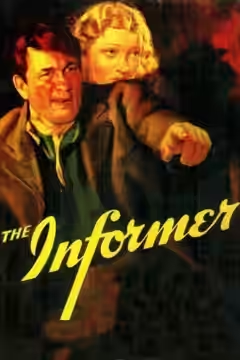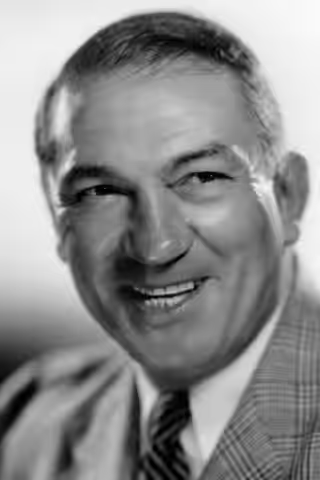
A boxer's body and a face that takes a long time to catch up. Under John Ford that slowness became the point, and The Informer still holds because of it; left to himself, McLaglen tended to shout with his hands.
Fi1m perspective
Watch what McLaglen does when the money arrives. In The Informer (1935) an officer counts out twenty pounds and pushes the notes across with his stick rather than touch the man who has earned them, and Gypo Nolan does nothing for a long moment, then picks them up as if they were hot. That is the McLaglen we rate: a big man with a slow mind, shoulders forward, hands hanging, a face that reaches each thought several seconds after we have. The scene got at us more than we expected, and it did so because nobody says a word. The shame is all in the pause.
He came to acting late and sideways. He had been a professional boxer and a British soldier, serving in the First World War as Provost Marshal in Baghdad, before British silent films took him in 1920; in 1936 he said, "My getting into pictures was all accidental." Hollywood followed in 1925, and for a while he was a leading man in action pictures and dramas. Sound moved him into character parts, and that is where Ford found a use for him: as the sergeant of The Lost Patrol (1934), then as Gypo, and on through twelve films together, ending with The Quiet Man (1952).
A Stepney boy of Scottish descent, he spent most of those years playing Irishmen, usually large, usually loud, frequently drunk. Sergeant Mulcahy in Fort Apache (1948) set the pattern for the cavalry pictures; Red Will Danaher squaring up to John Wayne in The Quiet Man is the version most people remember. He made seven films with Wayne, and Ford liked him best as the rogue or the comic turn at the edge of the frame. Gunga Din (1939), without Ford, gave the same persona an adventure to run about in. We have not reviewed these, so we will only say the man on screen is the one from Dublin, turned up for laughs.
The complaint that has followed him is fair as far as it goes. His style belongs to its time: gestures sized for the back of the stalls, a grimace where a later actor would hold still, and away from Ford it could slide into mugging. Ford's answer was to slow him down. In The Informer the fog does half the work, and McLaglen's job is to stand in it and be frightened, which he does with his whole body and no help from the dialogue. It is a broad performance about a simple man, and the fit is exact. What lets the film down is elsewhere, in Max Steiner's score and Dudley Nichols's script, which keep announcing what his face has already told us.
Start with The Informer, and watch the hands as closely as the face. Then, if you want him happy, find him beside Wayne with Ford behind the camera. Without Ford, go carefully: the body is all still there, but nobody is telling it to wait.
Biography
Victor McLaglen was a British-American actor and former boxer. Born in Stepney, East London, he appeared in films from the 1920s to the 1950s, initially as a leading man and later as a character actor, often in Westerns and action roles.
He is best known for his performance as Gypo Nolan in John Ford's The Informer (1935), for which he received the Academy Award for Best Actor. McLaglen collaborated frequently with Ford, appearing in films including Fort Apache (1948), She Wore a Yellow Ribbon (1949), Rio Grande (1950) and The Quiet Man (1952). Other notable credits include Gunga Din (1939) and Around the World in 80 Days (1956).
His son, Andrew V. McLaglen, became a film and television director.