Maureen O'Hara was the woman the studios put in Technicolor to show what the process could do, and she spent thirty years standing up to anyone the frame put beside her. Ford got the best of her; too many others settled for the hair.
Fi1m perspective
Watch Maureen O'Hara square up to John Wayne. The chin comes up, the shoulders set, and whatever the script has decided she is going to lose, she does not look like a woman who has read that far. She did it opposite him in five films, and the point of her in them was never the looks, though the studios thought it was. The point was that she would not be moved, and that he seemed to know it.
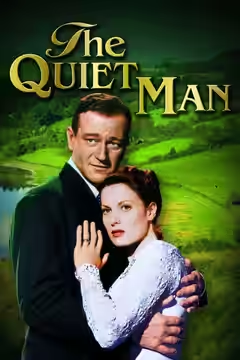
She trained at the Abbey Theatre School in Dublin from the age of fourteen, which is where the carriage comes from. Charles Laughton signed her, changed her name from FitzSimons, and put her in Hitchcock's Jamaica Inn (1939) and then The Hunchback of Notre Dame (1939). Hollywood followed, and so did John Ford: How Green Was My Valley (1941) was the first of five films they made together. After that she worked steadily through the 1960s in adventure films, westerns and comedies: Rio Grande (1950), the first of the Wayne pictures, The Quiet Man (1952), which she counted her own favourite, and The Parent Trap (1961), a Disney comedy that let her be funny. She largely stopped after Big Jake (1971), came back once for Only the Lonely (1991), and died in 2015.
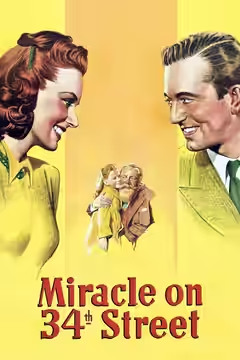
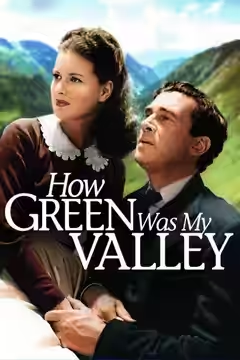
Ford got the best of her, and it is not hard to see why. He loved being Irish and she was the real thing, and in his films the poise loosens into warmth. In How Green Was My Valley she is Angharad, the daughter of a Welsh mining household, and she plays her as the one who holds the family's decency without asking to be thanked for it. The film moved us more than it strictly earns, and she is part of the reason: there is a stillness in her that the wandering accents around her cannot touch. Miracle on 34th Street (1947) uses the same quality another way, a mother playing everything straight while the film around her decides whether Father Christmas is real.
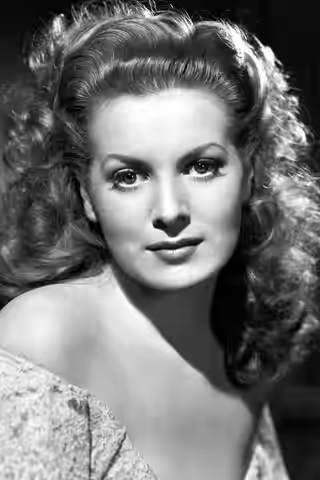
What did not work was the studio's idea of her. She was called the Queen of Technicolor, for the red hair and green eyes and a complexion the process flattered, and too many parts asked for nothing but that. She knew it. "Hollywood would never allow my talent to triumph over my face," she wrote, and the shelf of spirited-redhead adventures bears her out. Some of the early assignments, Dance, Girl, Dance (1940) among them, drew complaints that she lacked intensity or humour, which is a strange thing to say about a woman who would later go toe to toe with Wayne for a living. It says more about the parts.
Start with Ford. The rest is handsome, and much of it is only that.
Biography
Maureen O'Hara, born Maureen FitzSimons, was an Irish-American actress and singer. She was born on 17 August 1920 in Ranelagh, County Dublin, Ireland, and died on 24 October 2015 in Boise, Idaho.
She began her film career in Britain with Jamaica Inn (1939) before moving to Hollywood, where she appeared in The Hunchback of Notre Dame (1939). O'Hara is known for her roles as Angharad Morgan in How Green Was My Valley (1941), Doris Walker in Miracle on 34th Street (1947), Mary Kate Danaher in The Quiet Man (1952), and Margaret McKendrick in The Parent Trap (1961). She frequently collaborated with director John Ford and actor John Wayne, and received an honorary Academy Award in 2014.