Film review

Around the World in 80 Days

1956 · Directed by Michael Anderson · 3h 02m · MPA G

In a sentenceEvery famous face in Hollywood wanders past David Niven, who checks his watch and declines to notice

AdventureComedyFamilyFantasy

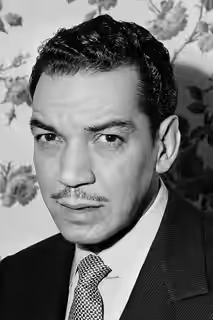
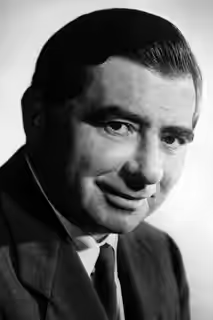
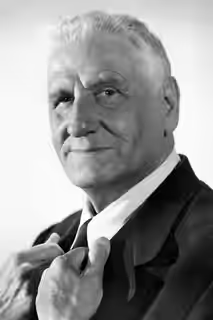
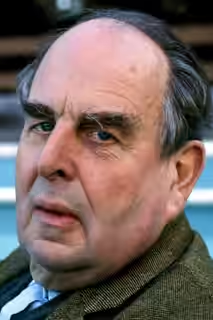
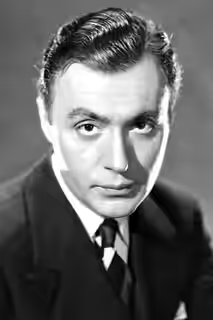
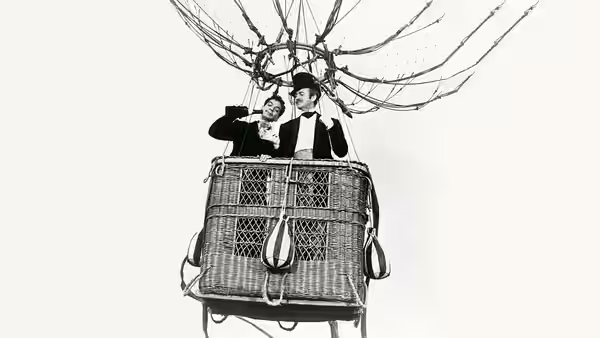
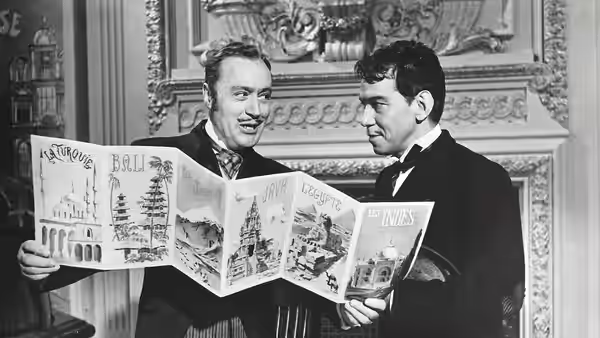
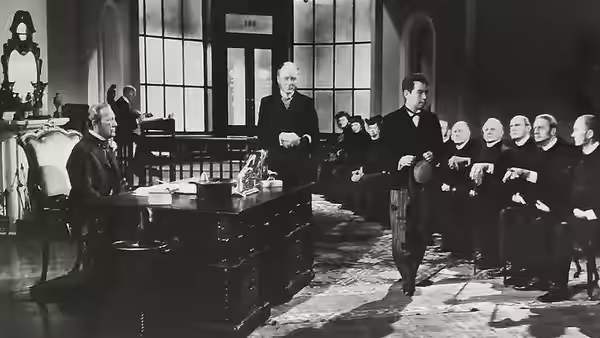
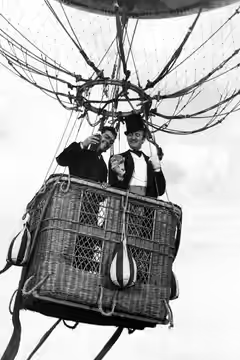
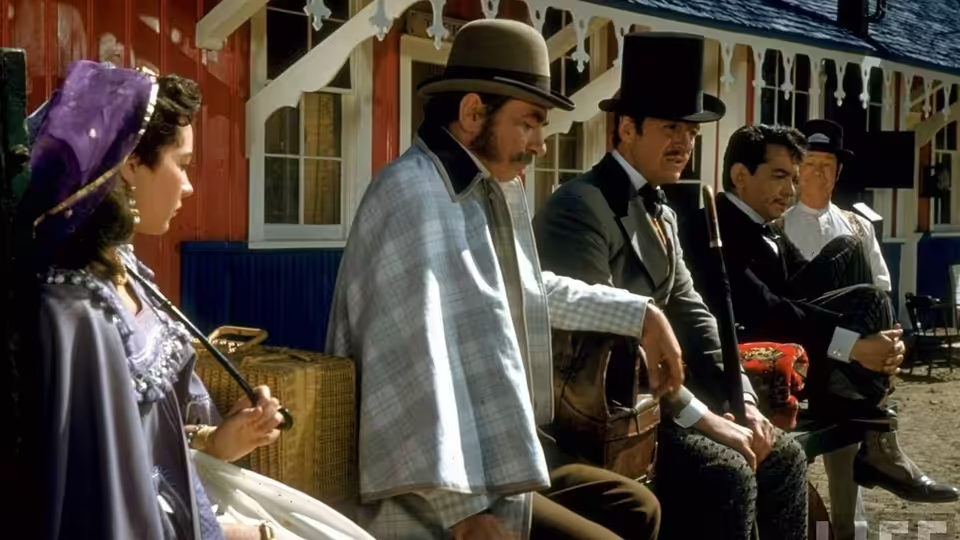
London, 1872. Phileas Fogg (David Niven) is a gentleman of clockwork habits with a new valet, Passepartout (Cantinflas), who has barely learned where the hats are kept when his master goes to the Reform Club and wagers his whist partners, among them Ralph (Robert Morley), that he can circle the globe in 80 days. The stake is half his fortune. That same week the Bank of England is robbed, and Mr. Fix (Robert Newton) decides that the punctilious man leaving town in a hurry is the thief he is after. In Paris a travel agent, Monsieur Gasse (Charles Boyer), points master and servant towards a hot-air balloon, and the journey begins with the two of them drifting over the French countryside while Fix, on the ground, tries to keep up.

Fi1m review

Mike Todd’s three-hour Jules Verne is handsome, amiable and generous with its cameos, and David Niven is exactly the man for Fogg. It is also a travelogue with a wager attached, and somewhere over the Pacific it stops being a film and becomes a slideshow.

Mike Todd was a showman before he was a producer, and Around the World in 80 Days is a showman’s film: Jules Verne’s 1873 novel taken as a licence to visit as many countries as the budget allowed and to put a famous face at every stop. Four writers are credited on the screenplay, S.J. Perelman, James Poe and John Farrow alongside Verne himself, and Michael Anderson directs. It opens with a prologue built around Georges Méliès’s A Trip to the Moon, an old silent film about a journey, and then the screen widens and the colour comes in. Todd wanted a spectacle, and for a long while he has one. It is handsome and it is an hour too long.

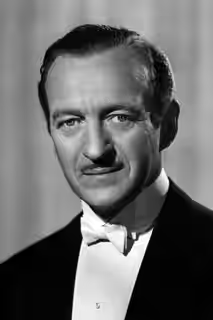
David Niven is the reason it works at all. His Phileas Fogg is dry, exact and untroubled by anything the world can throw at him, and Perelman gives him lines to match, small deflations delivered without looking up. Niven does almost nothing and it is exactly right; the joke of the film is that the globe is spinning round a man who declines to be impressed by it. Cantinflas, as Passepartout, is the opposite, all elbows and eyebrows, and his bullring sequence in Spain is the best physical comedy in the picture, a long stretch in front of a crowd where he is given room to work and takes all of it.

Lionel Lindon’s photography is what the money bought, and it was well spent. The balloon over the French countryside, the Indian plains seen from a train, the American West with a herd of buffalo across the tracks: he shoots them from far back and lets the frame fill, and at that width you can see what the size was for. Ken Adam’s London is all fog, brass and club leather. Victor Young’s score does more for the film’s mood than most of its stars, a waltz that turns up wherever they land and makes the whole thing feel like one long afternoon out.

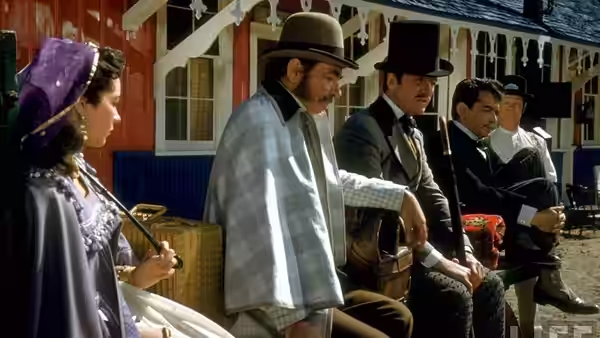
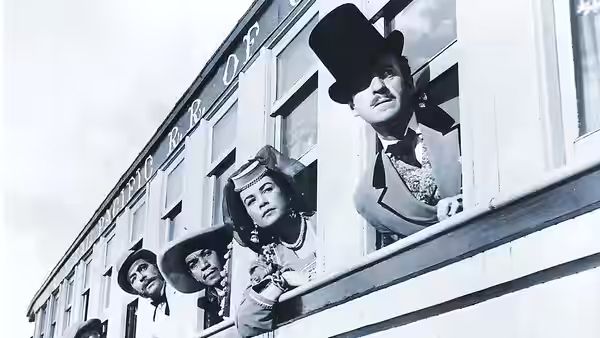
The cameos are the game, and some are worth the wait. Robert Newton, as Mr. Fix, is not a cameo but a proper performance, a policeman of red-faced conviction who follows Fogg across the world on a hunch he cannot prove; he has the film’s second-best comic role and knows how to play a man who is always one boat behind. Marlene Dietrich runs a San Francisco saloon and Frank Sinatra turns round from her piano once, which is his whole part. Buster Keaton is the conductor on the train west, and his one scene reminds you how much better he was at this sort of thing than anyone else on the screen. John Carradine, as Proctor Stamp, picks a quarrel with Fogg on that train. Finlay Currie and Robert Morley, as the whist partners, wait in London and harrumph.

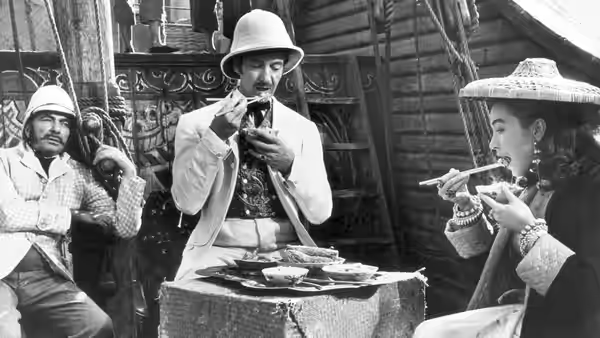
Here is where we were. The balloon and the bull had us delighted, grinning at the nerve of it. Somewhere on the Pacific we realised we were looking at our watch more often than Fogg looked at his, and that the film had stopped noticing where it was. Three editors are credited, Paul Weatherwax, Gene Ruggiero and Howard Epstein, and between them they let it run to 182 minutes; a travelogue can afford that and a comedy cannot. Anderson directs each stop competently and none of them urgently. Shirley MacLaine, as Princess Aouda, is asked to be Indian and to be grateful, and manages the second, through no fault of her own; the casting was wrong in 1956 and time has not helped it.

It is a big, benign comedy with no interest in being sharp. The pleasure is in the scenery and the star-spotting, and both survive a small screen better than you would think, though at home the invitation to wander off and make tea is hard to resist. It carries a U, and children will love the balloon, the bull and the buffalo, and be asleep before Fogg reaches America, which is a sensible response. Stay awake for the last twenty minutes, which is where the wager finally remembers it is a plot.
Critical consensus AI synthesised

72
Positive
5
Mixed
0
Negative
1

Most critics like it, and they like it for the same reasons: scale, cheer and cameos. The reviews describe a sprawling, jolly travelogue put together by showman Michael Todd, with locations across thirteen countries, panoramic visuals and a script that keeps finding small inventions along the way. David Niven’s lead is singled out more than once, as is Cantinflas, and nearly every review makes a game of spotting the guest stars. The comedy is called offhand, British and sly rather than sharp.

The spread is wide rather than narrow. The one dissent is Time Out, which finds the film interminable, reckons the cameos offer only occasional relief, and saves its warmest words for the Méliès footage at the start. Even the admirers concede the length: three hours is called a minor drawback by one, overstuffed by another. Nobody claims it is tightly made; the question is whether the parade is worth the sitting.

Variety
24 October 1956 · Hift
90*

The critic hails the film as a smasheroo with big colorful visual values, healthy humor and impressive backgrounds that make it highly entertaining. He singles out the shrewd casting, witty script and overall showmanship for praise.

Read the full review →
Radio Times
★★★★ · Tony Sloman
80

This is a vastly entertaining, star-studded travelogue of its era assembled by showman Michael Todd, with an unbeatable cast led by David Niven and effective use of locations across 13 countries; guest-star spotting adds extra fun.

Read the full review →
The New Yorker
20 October 1956 · John McCarten
80*

The critic calls the film a large, jolly exercise in improvisation with vast panoramic visuals and diverting inventions in the script. He singles out the performances of David Niven and Cantinflas for praise while noting the length as a minor drawback.

Read the full review →
The New York Times
28 October 1956 · Bosley Crowther
75*

The critic describes the film as a mammoth, mad pictorial rendering that is a sprawling yet amusing conglomeration of comedy, travel panoramics and burlesque. He praises the director's handling of the many guest stars and the overall entertainment value.

Read the full review →
Los Angeles Times
11 June 1992
70*

The piece presents the 1956 film as an overstuffed yet sly charmer that is a diverting three-hour comic travelogue. It singles out the offhanded British humor and the parade of cameo stars for praise.

Read the full review →
Time Out
10 September 2012 · TM
40*

Mike Todd's version of the Jules Verne story becomes an interminable travelogue with star cameos providing occasional relief; it has some nice period touches, but the best element is the use of Méliès' Trip to the Moon at the start.

Read the full review →

Cast

Awards

Academy Awards, 1957

Nominated
Best Art Direction, Color
Nominated
Best Costume Design, Color
Nominated
Best Director
Won
Best Cinematography, Color
Won
Best Film Editing
Won
Best Original Dramatic or Comedy Score
Won
Best Picture
Won
Best Writing, Adapted Screenplay

If you liked this, try…

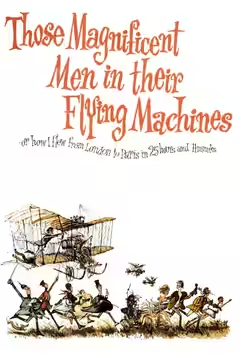
Those Magnificent Men in Their Flying Machines poster

Those Magnificent Men in Their Flying Machines

1965 · The same continental race idea, with better machines and a proper finish line.

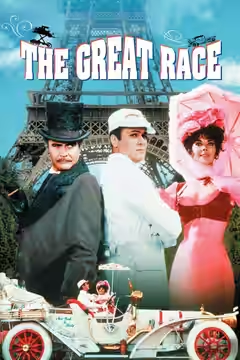
The Great Race poster

The Great Race

1965 · Blake Edwards’ New York to Paris car race, stuffed with slapstick and Jack Lemmon.

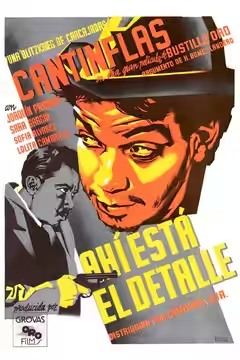
Ahí está el detalle poster

Ahí está el detalle

1940 · Cantinflas at full speed in Mexico, before Hollywood tidied him up.

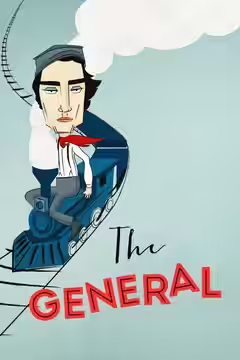
The General poster91

The General

1926 · Keaton on a train for seventy minutes, doing what this film only gestures at.

The Adventures of Baron Munchausen poster

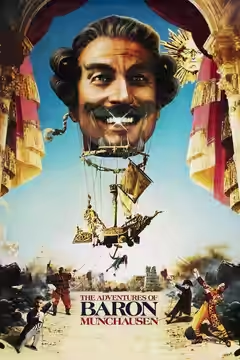
The Adventures of Baron Munchausen

1988 · Terry Gilliam’s tall-tale travelogue, with balloons, and no interest in punctuality.