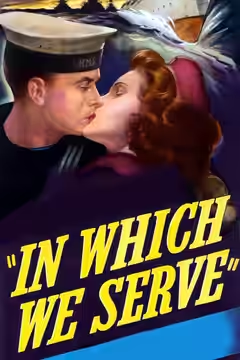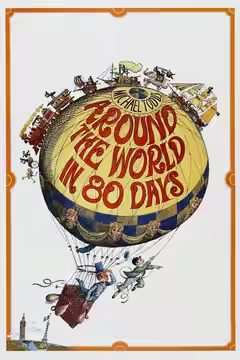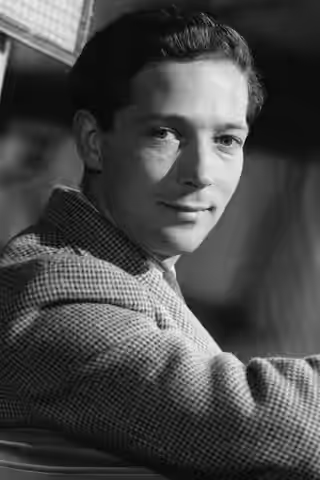
Michael Anderson was the steady hand producers hired when the picture was large and the schedule tight. He could stage a raid, a chase or a balloon over France with real competence; what he rarely supplied was urgency, and over three hours it shows.
Fi1m perspective
Watch the balloon in Around the World in 80 Days (1956). It carries David Niven's Fogg, exactly the man for the part, out over the countryside and eventually down to a bull, and the whole business is handled with care. We were delighted, grinning at the nerve of it. Then the film reached the Pacific and we found ourselves checking our watch more often than Fogg checks his. That is Anderson in miniature: each stop directed competently, none of them urgently.
He learned the trade at Elstree from 1936, first as a runner and then as assistant director to Noël Coward, David Lean and Anthony Asquith, and the apprenticeship is visible in everything he made. He knew how a big production is kept moving. War service in the Royal Signals Corps introduced him to Peter Ustinov, with whom he co-directed Private Angelo (1949); his solo debut was Waterfront (1950). The Dam Busters (1955) made his name, the most popular British film of that year and the one he later said he liked best of his own. Mike Todd then brought him in to replace John Farrow on Around the World in 80 Days, and he inherited a showman's picture with a famous face at every port.
The next twenty years mixed British war films and thrillers with Hollywood and international work: the first cinema 1984 (1956), Operation Crossbow (1965), The Quiller Memorandum (1966), a Berlin spy story with a Harold Pinter script, The Shoes of the Fisherman (1968) and Logan's Run (1976), the dystopia that became one of his best-known later films. Erwin Hillier shot ten of them, and Hillier is the reason an Anderson picture sometimes looks bolder than it behaves. Richard Todd appeared three times, Ustinov three, Gary Cooper twice.
His reputation rests on suspense, action and effects, and on marshalling a crowd of actors without losing any of them. The trouble was the film around the set pieces. Operation Crossbow has been faulted for a muddled plot, The Shoes of the Fisherman was received coolly, and on Around the World three editors, Paul Weatherwax, Gene Ruggiero and Howard Epstein, let 182 minutes through. The stitching between the stops was somebody else's problem, and often nobody's.
He moved to Canada in 1981, worked mostly in television, and made his last feature in 1999. If you want to know what he could do, start with the dam. Then, if you have a free evening and a comfortable sofa, the balloon.
Biography
Michael Anderson was an English film director. Born in London on 30 January 1920, he began his career in the film industry as an office boy at Elstree studios and worked as an assistant director before serving in the Royal Corps of Signals during the Second World War.
Anderson made his feature debut in 1949 and directed The Dam Busters (1955). He was hired to direct the epic Around the World in 80 Days (1956), for which he received an Academy Award nomination for Best Director. His other films include the 1956 adaptation of 1984, Operation Crossbow (1965), The Quiller Memorandum (1966) and Logan's Run (1976). He died on 25 April 2018 in British Columbia, Canada.