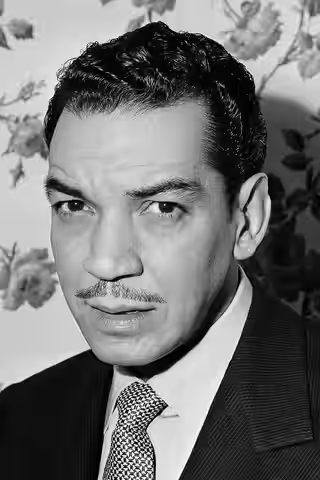
A man in trousers held up with a rope talks his way round every policeman, landlord and magistrate in Mexico City without once finishing a sentence. English-speaking audiences got the trousers and missed the talk, which was most of the joke.
Fi1m perspective
He stands in trousers that stop well short of his waist, held up with a length of rope, under a coat with the elbows gone and a hat that has been sat on. A policeman or a landlord asks him a plain question. He answers at once, at length and with complete confidence, and the answer loops back on itself, changes subject twice and never lands, until the man in the uniform is nodding as if he had followed it. The style has its own verb, cantinflear. The audience knows what he means and authority does not, and that is the whole joke and most of the politics.
He learned the body first. In the 1930s Mario Moreno worked the carpas, the travelling tent shows, as a dancer, acrobat and comic, and took the stage name so his family would not find out. Small film parts followed from the middle of the decade, then Ahí está el detalle (1940), which fixed the character and made him a star across Latin America, and Ni sangre, ni arena (1941), a satire on bullfighting, both from Santiago Reachi's Posa Films. Miguel M. Delgado directed him from the 1940s onward, picture after picture, and for two decades Spanish-language comedy was largely his.
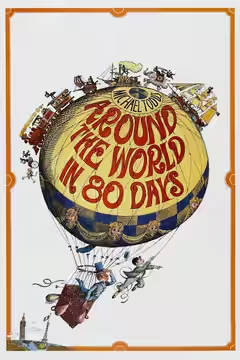
Hollywood met him in his forties. In Around the World in 80 Days (1956) he is Passepartout to David Niven's Fogg, and where Niven does almost nothing he does everything, all elbows and eyebrows. We laughed hardest at the bullring in Spain, and it is worth saying why: with a crowd in front of him and room to work, he needed no translation, and it is the one long stretch where the film lets him take all of it. It is also his own bullfighting satire of fifteen years earlier, replayed for people who had never seen the original. Pepe (1960) followed, and the talk that made him did not survive the crossing into English. The film failed and he went home.
What came after was long and, seen from here, uneven. El analfabeto (1961), with him as Inocencio Prieto y Calvo, is among the best liked of the later comedies; El patrullero 777 (1978) put him back in a police uniform as Diógenes Bravo and brought him a late success. After Su excelencia (1967) the Delgado films were made for less and made to a pattern, and he kept making them into the early 1980s. He had told an interviewer in 1948 that "Cantinflas represents the humble Mexican who wants to overcome himself and accomplish something in life." He said it once and then repeated it, with a different hat, for thirty years.
The Hollywood picture is how most English speakers meet him, and it is a supporting part in somebody else's film. Start instead with Ahí está el detalle, with subtitles, and accept early that the subtitles will lose the race. That is not the translator's fault. The man was built so that nobody writing things down could keep up with him.
Biography
Cantinflas, born Mario Fortino Alfonso Moreno Reyes on 12 August 1911 in Santa María la Redonda, Mexico City, was a Mexican comedian and film actor. He began his career in travelling tent shows as a dancer and comic before appearing in his first feature film in 1941.
He appeared in dozens of Mexican films, often portraying the pelado character, including El Siete Machos (1951), El analfabeto (1961), El señor doctor (1965) and El profe (1971). In 1956 he played Passepartout opposite David Niven in the Hollywood film Around the World in 80 Days.
Cantinflas died of lung cancer on 20 April 1993 in Mexico City.