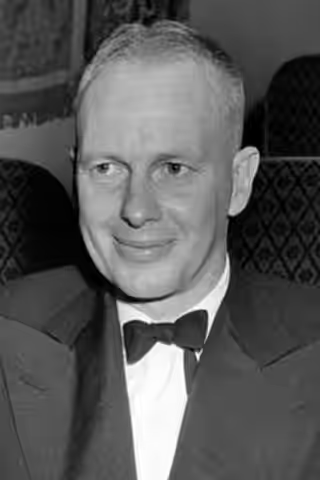
A sailor who taught himself to write and then to direct, John Farrow kept the camera moving and said he wanted to be the damnedest commercial director in the business. The best of his films are better than that sounds.
Fi1m perspective
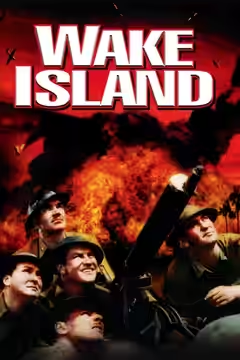
The last ten minutes of Wake Island (1942) go nearly silent. The jokes stop, the narrator stops, most of the music stops, and John Farrow watches faces in a dugout as the shelling comes closer. Everyone who saw it in 1942 knew how the battle ended, and Farrow does not pretend otherwise. We went in expecting a lecture and came out sitting quieter than we had planned to, because a director who had spent 87 minutes recruiting chose, at the finish, simply to look. That is the Farrow worth knowing about: quick, blunt, and able to hold still when it counts.
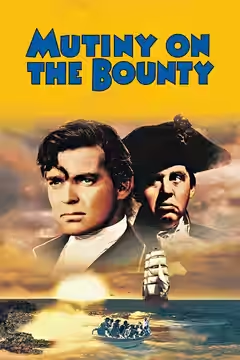
He came to Hollywood in 1927 as a screenwriter and technical adviser, having been a sailor first, and he was one of the writers on Mutiny on the Bounty (1935), a film we rate highly, though what we remember of it is Charles Laughton's Bligh and Frank Lloyd's direction rather than anything we could trace to a script credit. Farrow directed his first features at Warner Bros. from 1937, B-pictures made fast, and Five Came Back (1939) did well enough to get him a contract at Paramount. He then served in the Royal Canadian Navy, left it in 1942, and made Wake Island within months of the events it describes.
What critics noticed, then and since, was the camera. Farrow liked long tracking shots and a frame that rarely stopped moving, and he used them to make pace rather than to show off. In the late 1940s that habit found its genre in film noir, and The Big Clock (1948) is the one people still point to for its style and its speed. Jonathan Latimer wrote three of his scripts; Alan Ladd made five films with him and Ray Milland three. He also kept an eye on the small parts and the losers. In Wake Island the men in the dugout are drawn as sharply as the officers, while the enemy, tellingly, never gets a face.
Farrow said he set out "to become the damnedest commercial director in the business", and for most of his career he was taken at his word: a journeyman who could do a war film, a noir or a western without leaving fingerprints. By reputation he was a hard man to work for. Both charges have something in them. Wake Island is a recruiting film and knows it, and the version of the enemy it offers is a blank. The 1950s were freelance westerns and adventures, Hondo (1953) with John Wayne among them, and a start on Around the World in 80 Days (1956) that he did not get to finish as director, though his name stayed on the script.
Start with Wake Island, which is short, and stay for the last ten minutes. Then find The Big Clock. The commercial director he wanted to be is in both; so is a better one, who occasionally forgot to be commercial.
Biography
John Villiers Farrow was an Australian-born film director, producer and screenwriter who worked primarily in Hollywood. Born in Sydney in 1904, he began his career as a screenwriter in the late 1920s and contributed uncredited to the screenplay for Mutiny on the Bounty (1935). He directed his first features in 1937 and went on to helm a range of films including Five Came Back (1939), Wake Island (1942), The Big Clock (1948), Where Danger Lives (1950), His Kind of Woman (1951), Hondo (1953) and The Sea Chase (1955).
Farrow received an Academy Award nomination for directing Wake Island and shared the 1957 Oscar for Best Adapted Screenplay for Around the World in 80 Days (1956), on which he also worked as a special guest director. He was married to actress Maureen O'Sullivan and had several children who entered the film industry.