Powell played men who were never quite sober and never quite ruffled, and made it look like the only sensible way to live. Nick Charles is the finest of them, and the murder he is meant to be solving is the least interesting thing in the film.
Fi1m perspective
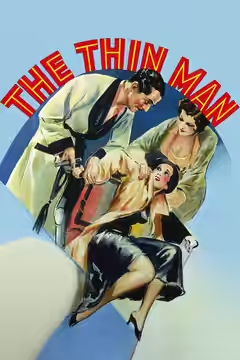
In The Thin Man (1934) Nick Charles lies on a sofa and shoots the baubles off the Christmas tree with an air gun his wife has given him, and does not look at the tree. That is most of William Powell in one shot. He plays a man who has decided that nothing, not a corpse, not a missing inventor, not a wife who wants in on the case, is worth sitting up for, and who is nonetheless never wrong about any of it. The voice does a good deal of the work, a warm baritone that arrived with sound and seemed built for it. The rest is timing: he lets the other person finish, waits a beat longer than is polite, and answers as though the question were a mild social inconvenience.
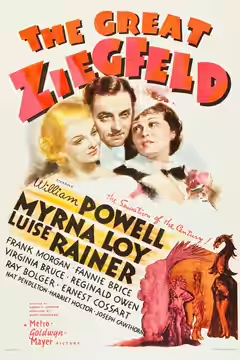
He did not start as anyone's idea of good company. He came into films in 1922, in silents, usually as the villain, including opposite John Barrymore in Sherlock Holmes. Sound gave him the detective Philo Vance from 1929 and a run of suave parts at Paramount and Warner Bros., opposite Kay Francis among others. Then MGM signed him in 1934, W.S. Van Dyke put him next to Myrna Loy, and the silent-era villain became Nick Charles. There were six Thin Man films and fourteen pairings with Loy in all, along with The Great Ziegfeld (1936) and, opposite Carole Lombard, My Man Godfrey (1936).
What works is the ease, and how little he does to point at it. Nora is the invention in The Thin Man; Nick is the instrument, and Powell has the sense to let Loy talk over him and to look pleased about it. We went in expecting to admire the banter and found instead that we minded whenever the film left the flat. The scenes with the suspects are competent; the scenes on the sofa are the reason to watch, because Powell and Loy behave like two people who married for the conversation and have not yet run out.
The weakness is built into the parts. A detective who is never entirely sober and never remotely drunk eventually has to stand up and explain the murder, and when Powell does, for a long stretch near the end, the air goes out of him. Van Dyke stages the explanation as well as anyone could; it is still a man reading out the answers. Powell is better at the pause before the line than at the paragraph after it, and the mysteries kept handing him paragraphs.
He moved into character parts later, the stern father of Life with Father (1947), Doc in the ensemble of Mister Roberts (1955), and then stopped, with Mister Roberts his last film. Start with The Thin Man, and expect to have forgotten who did it by the time the credits finish. That was rather the point.
Biography
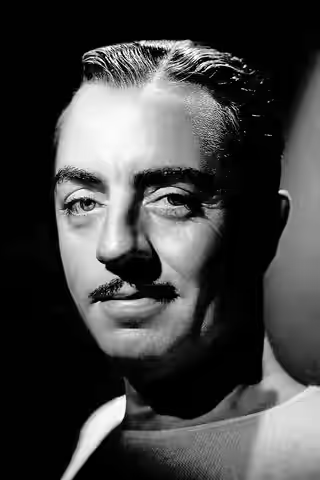
William Horatio Powell (also credited as William H. Powell) was an American actor. He was born on 29 July 1892 in Pittsburgh, Pennsylvania, and died on 5 March 1984 in Palm Springs, California.
After training at the American Academy of Dramatic Arts and working in vaudeville, stock companies and on Broadway, Powell began his film career in 1922. He became a major star at Metro-Goldwyn-Mayer and appeared with Myrna Loy in 14 films, including six entries in the Thin Man series as Nick Charles, beginning with The Thin Man (1934).
Powell received Academy Award nominations for Best Actor for The Thin Man (1934), My Man Godfrey (1936) and Life with Father (1947). Among his other notable films were The Great Ziegfeld (1936) and Mister Roberts (1955).