Film review

The Thin Man

1934 · Directed by W. S. Van Dyke · 1h 31m · MPA NR

In a sentenceNick Charles solves a murder between drinks, and it is never quite clear which he regards as the interruption

ComedyMysteryCrime

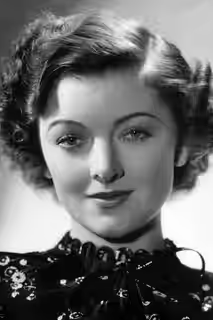
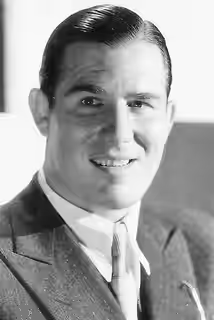
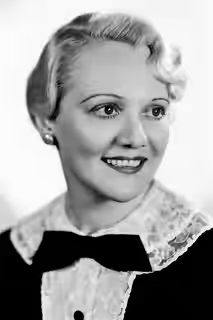
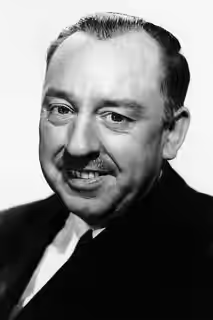
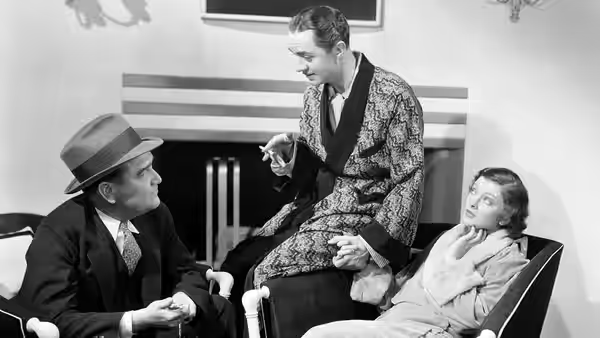
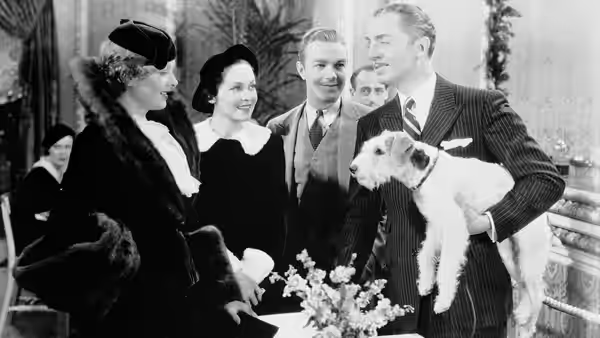
New York, the week before Christmas. Nick Charles (William Powell), a retired detective who has married money, and his wife Nora (Myrna Loy), who is the money, arrive from San Francisco with a wire-haired terrier called Asta and no plans beyond the bars. Dorothy Wynant (Maureen O’Sullivan), the daughter of an old client, finds Nick in a nightclub and asks him to trace her father, an inventor who walked out of his workshop months ago and has not been seen since. Nick declines. Then the inventor’s secretary, Julia Wolf (Natalie Moorhead), is found dead in her flat, Inspector Guild (Nat Pendleton) comes calling at the Charleses’ hotel suite, and Nora, who has never seen a murder and would rather like to, decides her husband is taking the case whether he wants it or not.

Plays from YouTube when you press play; nothing loads from them until then.

Fi1m review

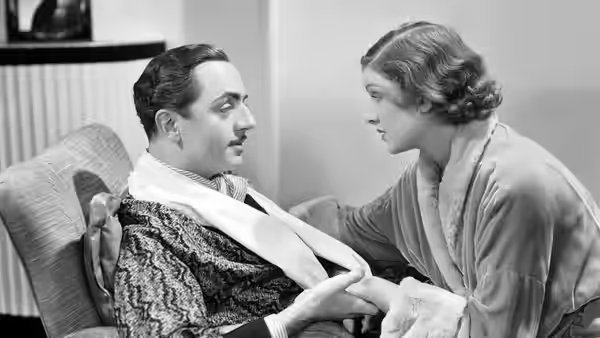
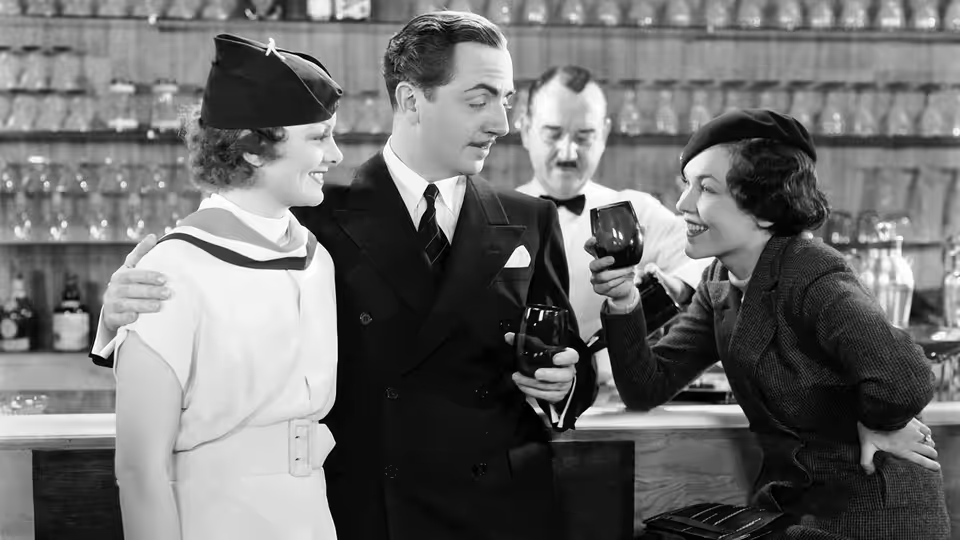
William Powell and Myrna Loy play a married couple who plainly enjoy each other, which was rarer on screen in 1934 than a murder. The murder is here too, and it is the weakest thing in the film. The marriage carries it without noticing the weight.

Dashiell Hammett’s novel is a hardboiled mystery about a missing inventor and a dead secretary. Frances Goodrich and Albert Hackett read it, kept the corpse, and built the film round the couple who trip over it on their way to the next cocktail. Nick Charles (William Powell) used to be a detective and has since married Nora (Myrna Loy), whose fortune means he need never work again. They are in New York for Christmas with their dog and a great deal of spare time. When Dorothy Wynant (Maureen O’Sullivan) asks Nick to find her vanished father, he says no, and Nora, who has never seen a murder, says yes on his behalf.

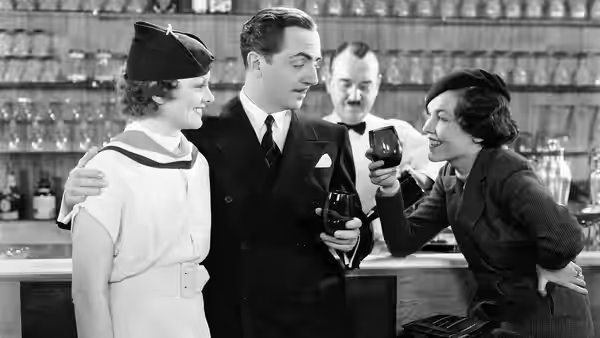
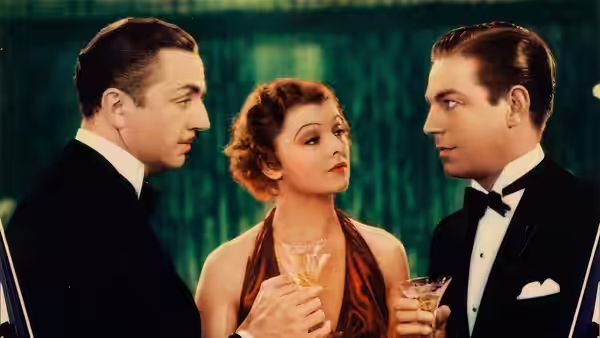
We recommend it warmly and with one caveat, which is that the mystery is a coat rack. What hangs on it is the best married couple Hollywood had put on screen up to that point. Nora’s first entrance has her dragged across a nightclub floor by the dog, arms full of parcels, after which she asks how many drinks Nick has had, is told six, and orders five more so she can catch up. We laughed out loud, and then noticed we were smiling at the screen for the next ten minutes, which is not something we often do with films of this age.

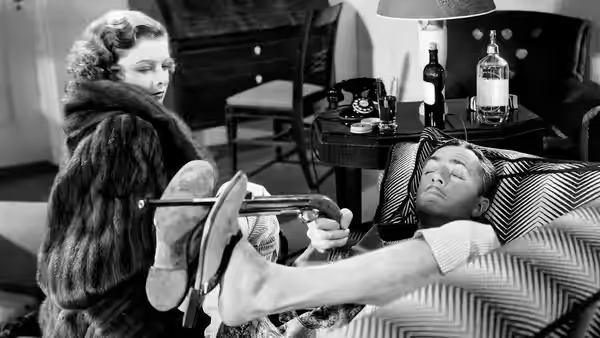
Powell’s timing is the engine. He plays Nick as a man who is never entirely sober and never remotely drunk, and who treats each new development in the case as a mild social inconvenience. He shoots the baubles off the Christmas tree with an air gun Nora has given him, lying on the sofa, and does not look at the tree. Loy is the invention. Nora is not the nagging wife of a hundred detective pictures and not the frightened one either; she wants in on the case, she resents being left behind, and she says so, and the film thinks she is right. The two of them talk over each other like people who have been married long enough to stop being polite and not long enough to stop being interested.

W. S. Van Dyke directs at speed and it shows in the good way. Scenes end the moment the joke has landed, and Robert J. Kern’s cutting gets the whole thing done in 91 minutes with room for two nightclubs, a Christmas morning and a police interrogation. James Wong Howe lights the hotel suite bright and flat, which suits a film that lives in daylight and dressing gowns; he saves the shadows for one visit to the inventor’s shuttered workshop, torch beams and dust sheets, and the change is sharp enough to make the murder feel briefly like a murder. Dolly Tree dresses Loy in striped suits and long, plain gowns that look like clothes rather than costumes. William Axt’s music is barely there, which is the correct decision.

The trouble is the Wynants. Minna Gombell’s Mimi, the inventor’s ex-wife, is shrill by design and stays that way; William Henry’s Gilbert, the son, reads about psychology and is a joke rather than a person; Cesar Romero’s Chris Jorgenson barely registers. Every time the film leaves the Charleses’ suite for the Wynant house it slows down, and it goes there often. Nat Pendleton’s Inspector Guild is a broader sort of comedy than the leads, and the gap shows. When a gunman (Edward Brophy’s Joe Morelli) turns up at the hotel, Nick gets Nora out of the line of fire by punching her unconscious, and the film plays it as a gag. We did not entirely laugh.

The solution, when it comes, arrives in a lump. Powell has to talk for a long stretch, and Van Dyke stages it as well as anyone could, which is not the same as making it interesting. We will not say where it happens or who is present. Most of the reviews of the time were happier with it than we were; the New Yorker thought it an improvement on the book. We think it is the price of the previous eighty minutes, and a fair one.

It started a series, and more than that it started a way of doing marriage on screen: two clever people who would rather be with each other than with anyone else, and who show it by teasing. Very few films have managed it since. Watch it with someone you are still fond of, and a drink you can defend.
Critical consensus AI synthesised

82
Positive
6
Mixed
0
Negative
0

The reviews are uniformly warm, and they agree on why. Almost every critic puts William Powell and Myrna Loy first: the marital banter between Nick and Nora Charles is the thing most say they remember, and the thing the adaptation is built around. Several note that W. S. Van Dyke and his writers have turned Dashiell Hammett’s hardboiled novel into something closer to sophisticated comedy, and most think the trade is a good one, with the pacing and comic timing singled out for particular praise.

The reservations are mild and the spread is narrow. The cooler notices, from Variety and The Guardian, do not dispute the leads or the direction; they simply treat the mystery plot as scaffolding for the repartee rather than as a strength in itself. The New Yorker goes the other way, finding the solution scenes handled better on screen than in print. Nobody dissents on the central pairing.

Empire
3 July 2006 · David Parkinson
90*

The critic hails the film as a true masterpiece that remains tense and slick. He singles out the ultra-chic chemistry and urbane banter between William Powell and Myrna Loy as Nick and Nora Charles.

Read the full review →
The Hollywood Reporter
25 May 2018 · THR Staff
90*

The critic hails the film as a smart, sophisticated hit with a brilliant cast, script, direction, and photography. Powell and Loy shine in witty roles, Van Dyke's pacing and comedy timing are masterful, and the whole production is enthusiastically recommended.

Read the full review →
The New Yorker
7 July 1934
90*

The screen version of Dashiell Hammett’s mystery story retains much of the staccato, hardboiled, and ribald quality of the book, with the whole performance bright. William Powell and Myrna Loy play the detective and his devoted wife beautifully, and the final scenes of the mystery solution are handled on a higher note than in print.

Read the full review →
Time Out
9 December 2016 · TM
80*

The film adapts Hammett's novel into sophisticated banter rather than a hardboiled thriller, with Powell and Loy perfectly cast. It particularly enchants through the witty marital relationship between Nick and Nora Charles.

Read the full review →
The Guardian
26 June 2004
70*

The critic highlights how the film streamlines the novel's plot to focus on the witty repartee between Nick and Nora Charles, turning it into a defining screwball comedy. The piece praises the leads' chemistry and the director's efficient style while noting the film's influence on later adaptations.

Read the full review →
Variety
1 January 1934
70*

The film is an entertaining adaptation of the Dashiell Hammett novel that captures the spirit of the jovial, companionable relationship between Nick and Nora Charles. The comedy inserted by the adapters and director W. S. Van Dyke, along with strong performances by William Powell and Myrna Loy, carries the picture through its mystery plot to a fast finish.

Read the full review →

Cast

Awards

Academy Awards, 1935

Nominated
Best Actor
Nominated
Best Director
Nominated
Best Picture
Nominated
Best Writing, Adapted Screenplay

If you liked this, try…

After the Thin Man poster

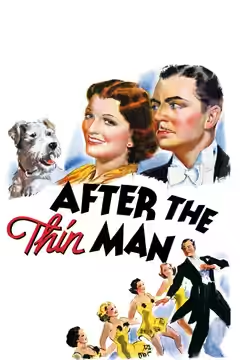
After the Thin Man

1936 · The first sequel, with the same couple, the same dog and a tighter puzzle.

The Awful Truth poster

The Awful Truth

1937 · Grant and Dunne divorcing at full speed; the same pleasure in a couple who talk.

Charade poster

Charade

1963 · Hepburn and Grant in Paris, murder as an excuse for flirting; the direct descendant.

8 Women poster

8 Women

2002 · Ozon’s French country-house murder, played as musical comedy with the corpse upstairs.

Knives Out poster81

Knives Out

2019 · A dreadful rich family and a detective enjoying himself; the tradition, still alive.