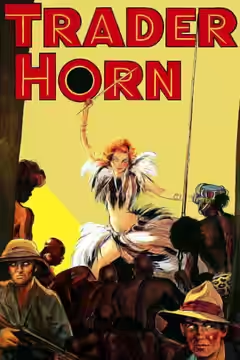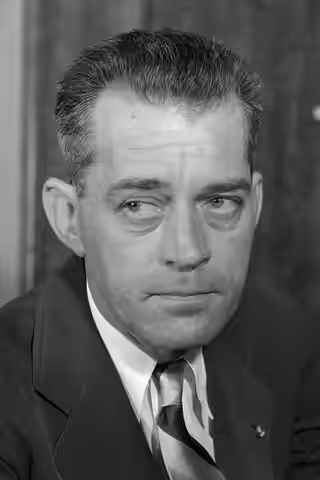
W. S. Van Dyke put a camera in front of things that were really there, a lion on a plain, William Powell and Myrna Loy trading lines, and let them get on with it. The method still plays; Trader Horn we admire more than we enjoy.
Fi1m perspective
Somewhere in the first hour of Trader Horn (1931) a hippo surfaces beside the boat, and the boat is a real boat on a real river with real people in it. Nobody has arranged the light. In the villages the extras look straight at the camera, because nobody told them where else to look. That is W. S. Van Dyke's method in a single shot: go to where the thing is, put a camera in front of it and let it happen. He said as much himself. "I don’t try for Art. I don’t try to make epics."
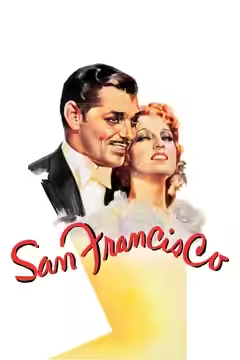
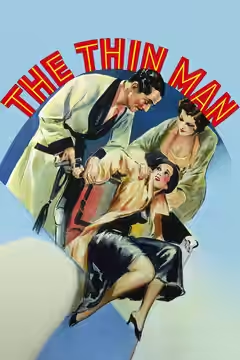
A child stage actor from the age of three, he assisted D. W. Griffith on The Birth of a Nation (1915) and Intolerance (1916), then directed serials and westerns for Pathé from 1917. MGM took him on in 1926 and he became the studio's man for going somewhere difficult and coming back with a picture: he took over White Shadows in the South Seas (1928), went to Africa for Trader Horn, and saw the footage he brought home used again in Tarzan the Ape Man (1932). From 1934 he directed William Powell and Myrna Loy in The Thin Man and the films that followed it to 1941, made six musicals with Jeanette MacDonald and Nelson Eddy, and staged the disaster in San Francisco (1936). The nickname was One-Take Woody. It was not a joke about his standards; it was a description of them.
The question with Van Dyke is whether speed is a virtue or a habit, and Trader Horn answers both ways. Left alone with animals he is superb. The lions on the plain and the herds at the river were not faked because they could not be, and no Hollywood feature had gone to Africa for them before. Left with a script, he shoots what he is given, and what Richard Schayer and Dale Van Every gave him is an old trader, a greenhorn and a missing girl, strung out over 122 minutes. We watched it in two states. The animals astonished us, and twenty minutes later we were checking how much of the film was left. The footage did the first and the story did the second, and Van Dyke plainly cared far more about one than the other.
Colleagues found him brusque and some thought him careless, and the charge that he chose getting it done over getting it right has followed him since. It is not the whole picture. The Powell and Loy films are remembered for two actors left to talk, and leaving them alone is a decision too, the same instinct that let the villagers look at the lens. Whether that instinct made better films than the one we have seen is a question for another day. On what we have seen, he made one film worth an hour of anyone's time and two hours of almost nobody's.
Biography
W. S. Van Dyke was an American film director. Born Woodbridge Strong Van Dyke II on 21 March 1889 in San Diego, California, he died on 5 February 1943.
He directed Trader Horn (1931), the first non-documentary feature filmed on location in Africa. His other notable films include Tarzan the Ape Man (1932), The Thin Man (1934), San Francisco (1936) and several musicals starring Nelson Eddy and Jeanette MacDonald. He earned the nickname "One Take Woody" for his efficient working methods and received Academy Award nominations for Best Director for The Thin Man and San Francisco.