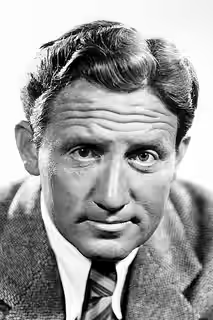
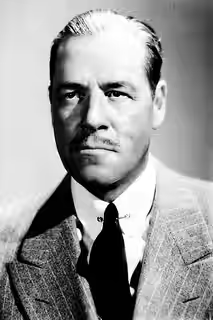
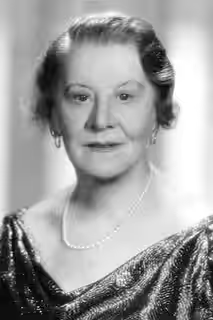
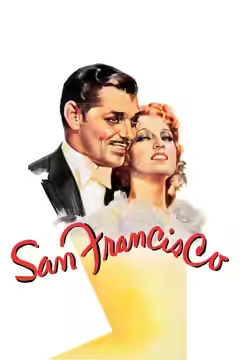
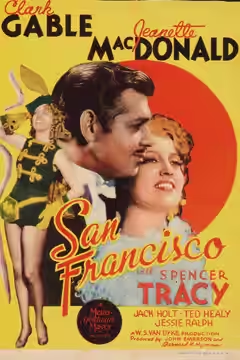
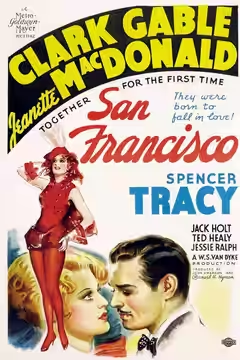
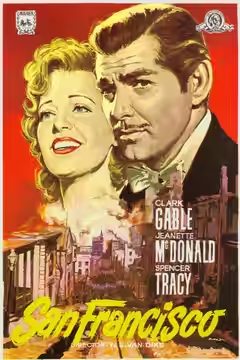
Film review

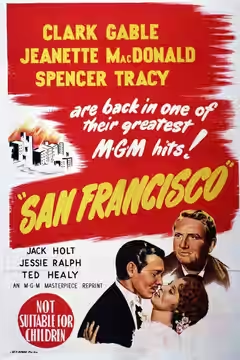
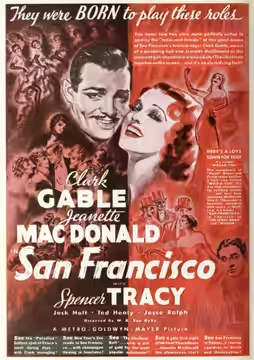
San Francisco

1936 · Directed by W. S. Van Dyke · 1h 55m · MPA NR

In a sentenceA love triangle, an opera, a sermon, and then MGM knocks the whole city down

DramaRomanceMusic

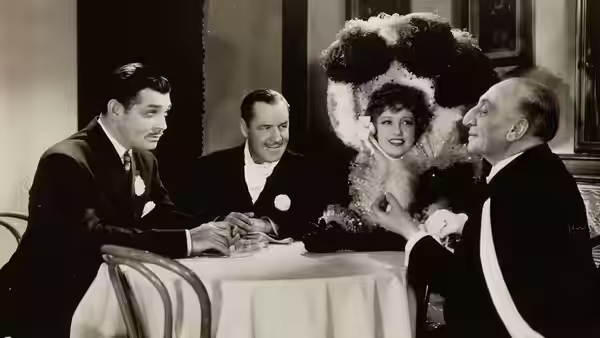
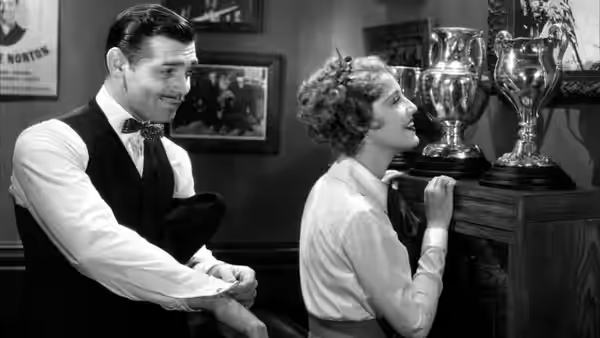
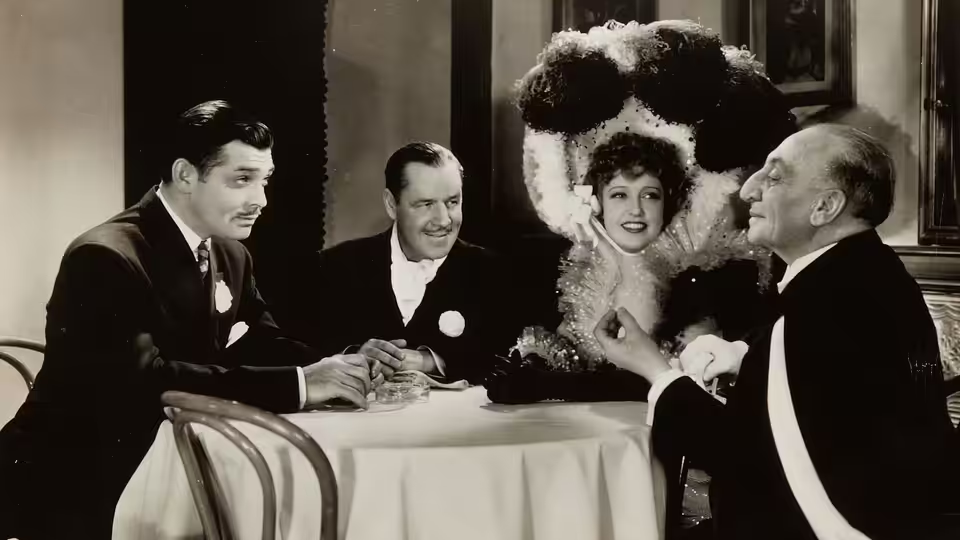
San Francisco, New Year’s Eve 1905. Blackie Norton (Clark Gable) runs the Paradise, a saloon, gambling hall and music room on the Barbary Coast, and runs it his way: no church, no charity, no arguments. Mary Blake (Jeanette MacDonald), a minister’s daughter from Colorado, walks in on the night her boarding house burns down and asks for work as a singer. Blackie asks to see her legs, hears her sing and hires her. His boyhood friend Father Tim Mullin (Spencer Tracy) runs the mission up the street and boxes with him on Sundays, and he tells Blackie the girl is too good for the Paradise. Jack Burley (Jack Holt), a Nob Hill swell who owns the Tivoli Opera House, agrees, and wants her for the opera. Blackie, meanwhile, stands for city supervisor to fight for fire-safe buildings on the Coast.

Fi1m review

For ninety minutes this is a handsome, preachy Barbary Coast melodrama kept upright by Clark Gable’s grin and Spencer Tracy’s patience. Then the earthquake arrives, and it is still one of the great pieces of studio destruction. Worth the wait.

MGM’s San Francisco is three films stacked on top of one another. The first is a Barbary Coast romance between a saloon keeper and a soprano. The second is an argument between the saloon keeper and his priest about whether a man can be decent without God. The third, which every cinemagoer in 1936 knew was coming, is the earthquake of 18 April 1906, and when it arrives after an hour and a half it knocks the other two flat. The first two are well made and faintly tiresome. The third is why the film is still watched.

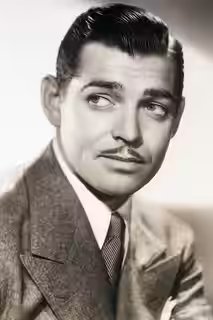
Clark Gable’s Blackie Norton is both the engine and the problem. He runs the Paradise as a benign tyrant, keeps his hat on in church, and greets every mention of the Almighty with the expression of a man who has been offered a tract. Gable plays it with the grin and the impatience that made him, and for a while it is enough. Spencer Tracy’s Father Tim Mullin is the better performance and does not need to try. He takes Blackie’s punches in the mission gym, never raises his voice about anything holy, and plays goodness as a habit rather than a halo. The scenes between the two men are the best acted in the picture, partly because neither of them is singing.

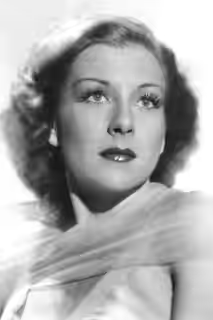
Jeanette MacDonald sings a great deal: music-hall numbers at the Paradise, arias once Jack Holt’s Nob Hill impresario gets hold of her, and the title song more than once. Her voice is clean and enormous and slightly airless, and W. S. Van Dyke shoots her standing very still under a key light while the drinkers at the tables put their glasses down and listen. Herbert Stothart and Edward Ward’s music runs from saloon brass to a full opera pit to hymns, which tells you where the film is heading before the script does. Adrian dresses her in gowns that grow grander as she climbs the hill from the Coast to the opera house, and Oliver T. Marsh lights the Paradise bright and smoky, so that the crowds behind the principals never stop moving.

The trouble is the middle hour. Anita Loos’s screenplay, from Robert Hopkins’s story, is sharp about the Coast and about the toffs who come down to slum in it, and Jessie Ralph, as Burley’s mother, gets the best lines and knows what to do with them. But the film has decided Blackie must be brought to his knees, and it spends a long time arranging it. Every time the picture is enjoying itself somebody mentions God. We squirmed at the sermons, not because they are insincere, which they are not, but because they are aimed at Gable as though the studio were slightly embarrassed to have cast him.

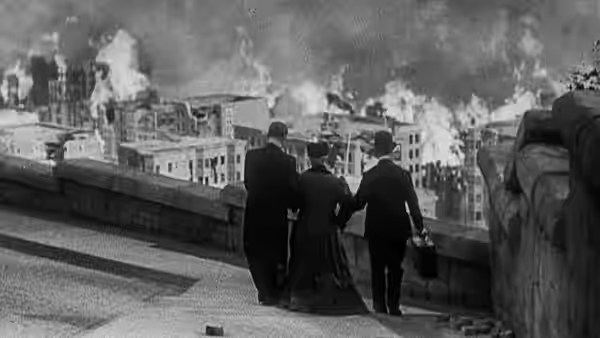
Then the ground moves. Tom Held cuts the earthquake as a barrage: a pavement opens under a crowd, walls slide into the street, ceilings come down in clouds of plaster, miniature facades fold up and real people run among them so the join never shows. Marsh keeps the camera low, so that bricks fall towards the lens. Nothing stays on screen long enough to look like a model. We knew it was coming and it still made us jump, and then it kept going, past the point where a modern film would cut to a hero, into fires and dynamite and streets full of people who do not matter to the plot. It is the one stretch of the film that does not sort the deserving from the rest.

Van Dyke made The Thin Man in 1934, quick and light and over in an hour and a half. Here he is dutiful for ninety minutes and then, for twenty, very good indeed. That is the shape every disaster film since has copied: make us sit through the romance so the falling masonry has someone to land on. It runs 115 minutes, and you should not skip to the earthquake, because without the sermons it is only a very well-built pile of rubble.
Critical consensus AI synthesised

73
Positive
6
Mixed
0
Negative
0

All six reviews are favourable, and every one of them arrives at the same place: the 1906 earthquake. Critics agree the sequence is the film’s reason for being, with more than one calling it among the finest action set pieces in cinema and noting the miniatures and rapid cutting that make the destruction startling even now. The cast is the second point of agreement, with Gable, MacDonald and Tracy praised across the board and Tracy singled out for particular notice.

The reservations are mild and cluster around everything before the quake. Several reviews find the Barbary Coast redemption story familiar and the melodrama shameless, and Time Out suggests the first hour gets by on star power alone. Variety points to one survival moment that strains belief; The New Yorker finds the sin-and-redemption message a touch preachy. The spread is narrow, and the only real dissent runs upward: The New York Times treats the film as a satisfying whole rather than a long build-up to one spectacle.

The New York Times
27 June 1936 · Frank S. Nugent
90*

The film is a prodigally generous and completely satisfying photoplay that functions as an anthology encompassing operatic, romantic, dramatic and documentary elements. It excels as a vigorous tale of the city with expert direction, a fine cast including standout work from Spencer Tracy, and a spectacular earthquake sequence.

Read the full review →
Empire
26 June 2006 · David Parkinson
70*

The critic highlights the innovative special effects of the 1906 earthquake sequence as a key strength in this period melodrama. Performances by Jeanette MacDonald, Clark Gable and Spencer Tracy are praised, with the director's behind-the-scenes contributions also noted.

Read the full review →
The AV Club
29 June 2020 · Mike D'Angelo
70*

The critic presents the film as a shameless but effective melodrama that pairs romance with disaster spectacle, creating a template later used by films like Titanic. The earthquake sequence stands out for its brutal, startling montage of destruction using miniatures and quick cuts.

Read the full review →
The New Yorker
27 June 1936 · John C. Mosher
70*

The film successfully combines Barbary Coast material with a spectacular earthquake that arrives at the perfect dramatic crisis and makes a fine show. It is a thorough, strenuous production of substantial class, elevated by strong music including opera and agreeable performances, though it carries an evangelical note about sin and redemption.

Read the full review →
Time Out
10 September 2012 · ATu
70*

The critic finds the film scrapes by on star power from Gable, MacDonald and Tracy until the 1906 earthquake sequence, which stands as one of the greatest action sequences in cinema history.

Read the full review →
Variety
31 December 1935 · Variety Staff
70*

The picture's forte is its noisy and terrifying earthquake sequence after more than an hour of strong cast and production values. It follows a familiar Barbary Coast redemption arc with musical elements, though one survival moment strains credulity.

Read the full review →

Cast

Awards

Academy Awards, 1937

Nominated
Best Actor
Nominated
Best Director
Nominated
Best Picture
Nominated
Best Story
Won
Best Sound

If you liked this, try…

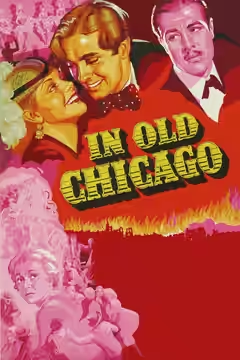
In Old Chicago poster

In Old Chicago

1938 · Fox’s answer: another city, another romance, another catastrophe held back for the last reel

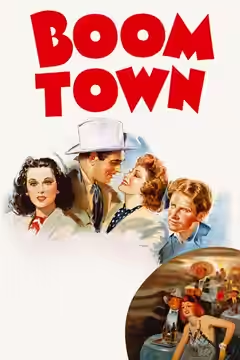
Boom Town poster

Boom Town

1940 · Gable and Tracy again, this time arguing over oil instead of the Almighty

A Night to Remember poster

A Night to Remember

1958 · The British approach to disaster: no love triangle, no sermon, just the ship going down

Titanic poster84

Titanic

1997 · The San Francisco template rebuilt at colossal expense, and it still works

Aftershock poster

Aftershock

2010 · Feng Xiaogang’s Tangshan earthquake, where the real damage happens over the next thirty years