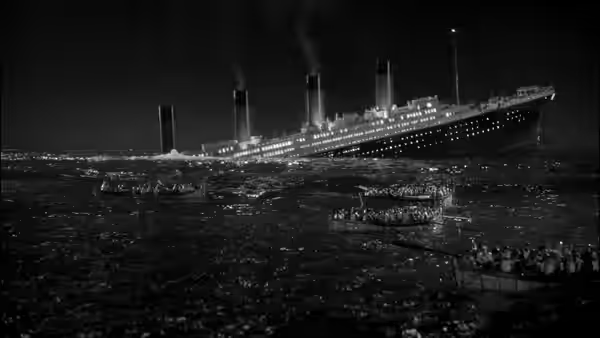
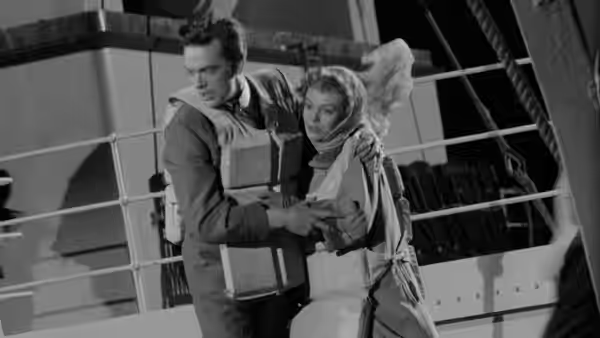
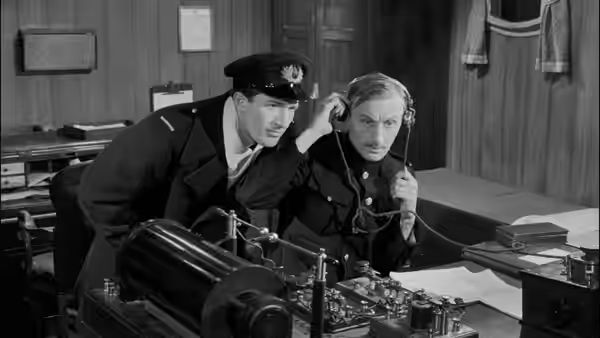
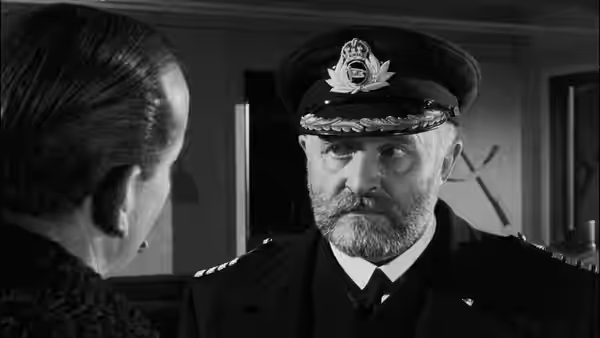
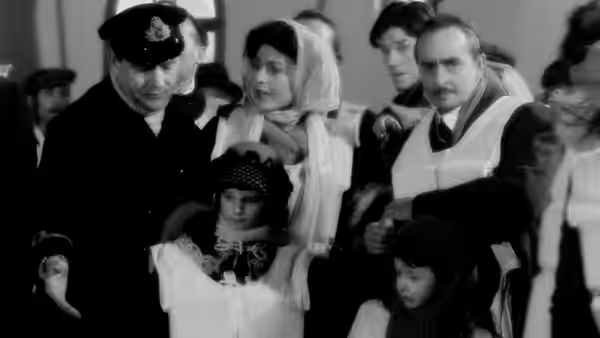
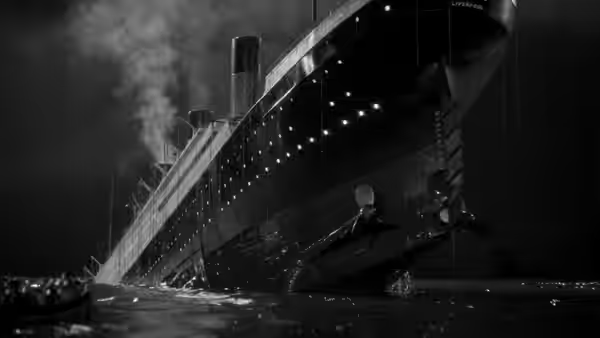
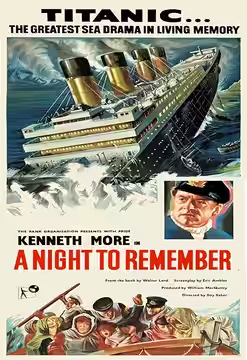
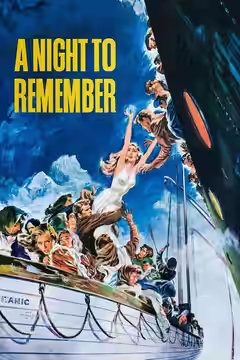
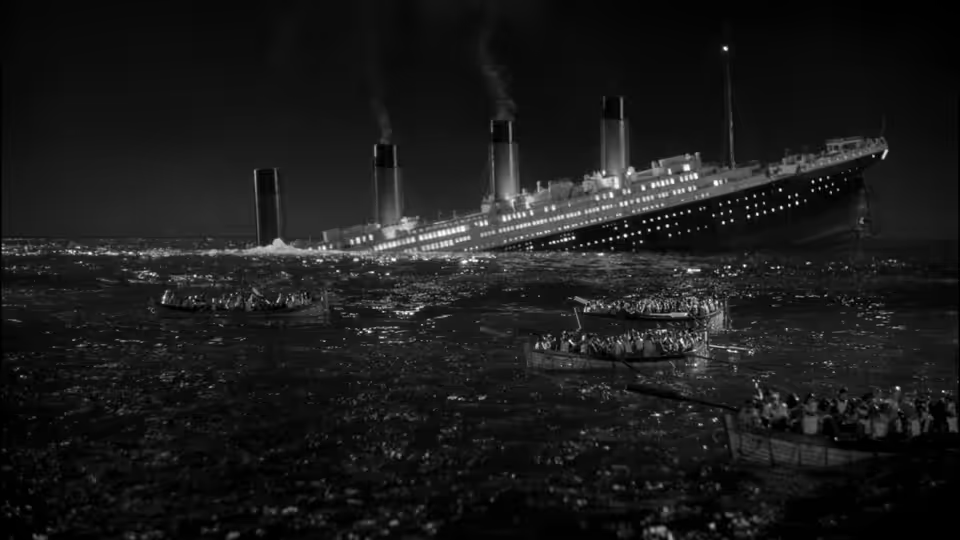
The Titanic sinks as lifeboats drift across the dark sea
Film review

A Night to Remember

1958 · Directed by Roy Ward Baker · 2h 03m · MPA NR

In a sentenceEveryone stays polite about the end of the world, and it is the politeness that gets you

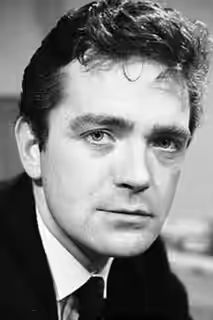
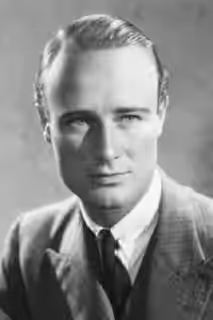
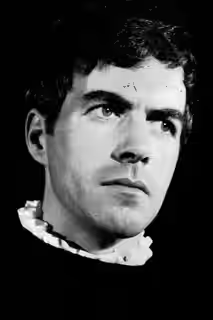
April 1912. The liner Titanic leaves Southampton on her first crossing to New York, advertised as unsinkable and carrying lifeboats for barely half the people aboard. Second Officer Charles Herbert Lightoller (Kenneth More) kisses his wife Sylvia (Jane Downs) goodbye and joins the bridge. Thomas Andrews (Michael Goodliffe), who designed the ship, walks her decks making notes of small things to fix. In the wireless room John ‘Jack’ Phillips (Kenneth Griffith) works through a stack of passengers’ telegrams while ice warnings from other ships come in around him. Honeymooners Mr and Mrs Clarke (Ronald Allen, Jill Dixon) settle into second class; Irish emigrants, among them Mr Murphy (John Cairney), travel in steerage far below. On the night of 14 April, with the sea flat calm and the stars out, the lookouts see an iceberg too late to miss it.

Fi1m review

Roy Ward Baker’s account of the Titanic’s one voyage is calm, procedural and, for that reason, upsetting. The model work has aged and a few passengers are sketches, but Kenneth More’s Lightoller and Eric Ambler’s careful script make it the version to see.

Everyone knows how this ends, and Roy Ward Baker’s film does not pretend otherwise. There is no invented romance, no villain twirling a moustache in first class, no attempt to make the iceberg a surprise. Eric Ambler’s screenplay, taken from Walter Lord’s book, treats the sinking as a night’s work done by a great many people at once, and follows the work. The ship strikes ice well before the hour is out. The remaining ninety-odd minutes are given to what happens between the impact and the water, and we did not once want them shorter.

Kenneth More is the nearest thing to a lead, and he plays Lightoller as a man with a job rather than a man with a destiny. He loads boats, argues about numbers, tells people to hurry in a voice that never quite rises. It is a performance made of small decisions, and it holds the film together because everything else keeps moving away from it. Baker cuts to the bridge, the wireless room, the boiler rooms, the steerage gates and back, and Sidney Hayers keeps the clock in our heads throughout; we always know roughly how much time is left and how little has been done with it.

What got at us was not the water. It was the ship on the horizon. A few miles off, the Californian has stopped for the night, and its wireless operator switches off his set and goes to bed. Later its officers stand on deck and watch white rockets go up over the dark and wonder what they are for. Baker keeps returning to them, and each time the gap between what they can see and what they decide to do grows a little wider. We were angry in a way the film never is, which is the point of the restraint.

Geoffrey Unsworth shoots it in black and white, and lights the boat deck as if only the ship’s own lamps were on, so the sea around the hull is simply black and the people on it are small and pale. William Alwyn’s score is generous over the departure and then almost absent once the ship is holed; the band on deck carries the music from there, and the choice of what they play is left to do its work without underlining. Yvonne Caffin puts first class into furs over nightdresses and steerage into the clothes they have been wearing for a week, and that alone tells us who was given time to pack.

The cast around More is large and mostly good in the way British character actors of the period were good: quickly, without fuss. Michael Goodliffe’s Thomas Andrews walks about telling people to put on their lifebelts in the tone of a man recommending a coat. Kenneth Griffith’s Phillips stays at his key. Anthony Bushell, as Captain Rostron of the Carpathia, turns his ship round and starts swinging out boats and rigging lights in a sequence that moved us more than we expected, because it is the one stretch where competence is rewarded. Honor Blackman has a few scenes as a mother getting her children dressed. Robert Ayres and James Dyrenforth, as two of the more prominent American passengers, get a line each that lands.

Some of them get little else. The Clarkes, a honeymoon couple in second class, are written to a pattern we have seen before, and Ronald Allen and Jill Dixon cannot do a great deal with it. The stiff upper lip is admired once or twice more than it is examined. And the effects have aged. The wide shots of the hull tilting in a studio tank look like a hull tilting in a studio tank, and a modern viewer will notice. We minded less than we thought we would, because the film keeps cutting back to a face before the model has time to embarrass itself.

James Cameron’s Titanic spent its money on the water. This one spends its attention on the people looking at it, and it remains the account we would send someone to first. Two hours and three minutes, PG, and nothing in it a twelve-year-old could not follow. Watch it in a quiet room with the sound up. Its loudest moments are people declining to shout.
Critical consensus AI synthesised

77
Positive
9
Mixed
1
Negative
1

Most critics admire the film, and for the same reason: it keeps its head. Nine of eleven reviews are positive, and the praise gathers around its restraint, its documentary manner and its choice of hundreds of ordinary people over an invented hero. Roy Ward Baker’s direction is singled out for holding intimate scenes and the sinking itself in the same steady frame, and the British ensemble, with Kenneth More at its centre, is thought well used. Several reviews call it the best screen account of the Titanic.

The reservations are small and scattered: dated effects, a cast so large that few characters develop, a couple of historical myths repeated as fact. The spread is wide all the same, from full marks to plain dislike, and the dissent comes from the film’s own era. The New Yorker, on release, finds the story too familiar to build suspense. The warmest notices arrive around the 2012 centenary.

Time Out
10 April 2012 · ★★★★★ · Tom Huddleston
100

Huddleston calls the film a terrific melodrama and the best screen treatment of the Titanic story. He singles out its lasting superiority amid the centenary-year flood of Titanic memorabilia.

Read the full review →
Empire
1 January 2000 · Andrew Collins
90*

The critic calls it the best Titanic film and a landmark of British cinema. He praises Kenneth More as an effective focal character and the film’s technical inventiveness.

Read the full review →
Evening Standard
13 April 2012 · The Standard
90*

The critic calls the film the most accurate and best version of the Titanic disaster. They praise its enduring drama, while noting that the special effects have dated.

Read the full review →
Slant Magazine
28 March 2012 · ★★★★½ · Budd Wilkins
90

Wilkins praises the film’s understated, human-scale approach to the Titanic disaster. He singles out Roy Ward Baker’s skill at framing intimate moments and large-scale spectacle, while noting one emotionally powerful shot is weakened by a premature fade.

Read the full review →
The Guardian
12 April 2012 · Catherine Shoard
85*

Shoard recommends the film as a worthy, moving and dignified account of the Titanic disaster. She praises its restrained ensemble storytelling and reliance on survivor testimony.

Read the full review →
Radio Times
★★★★ · David Parkinson
80

The critic finds the film a deeply moving and compelling account of the disaster. They praise its documentary style and human focus, along with the performances of its British cast.

Read the full review →

Straight answers AI written, from our review

Is A Night to Remember worth watching?
A Night to Remember is worth watching for anyone who wants the Titanic story told plainly, and we scored it 85. Roy Ward Baker follows the sinking as a night's work done by many people at once, with Kenneth More's Lightoller holding it together. The model shots have aged and a few passengers are thin, but the calm is what makes it upsetting.
How long is A Night to Remember, and what is it rated?
A Night to Remember runs 2h 03m and is rated NR by the MPA in the US. It is a drama and action film.
Where can I watch A Night to Remember in the US?
A Night to Remember is streaming on The Roku Channel and Tubi in the US, and it is also available to rent from Amazon Prime Video and Apple TV from $3.99. Availability is checked daily; the links above go straight to each service.
How does A Night to Remember compare to Das Boot?
A Night to Remember and Das Boot are both about men doing their jobs while the sea tries to kill them, but they work in opposite directions. Petersen's film shuts you in a submarine with one crew and makes the waiting unbearable; Baker's keeps cutting between decks, bridge and a ship on the horizon, and is the calmer and more measured of the two. We would send most viewers to the Titanic film first, and the impatient to the submarine.
Is A Night to Remember based on a true story or a book?
A Night to Remember is based on Walter Lord's book about the real sinking of the Titanic in April 1912, adapted by Eric Ambler. It sticks to what happened rather than inventing a romance or a villain, and the people on screen are the ship's officers, designer and passengers. You do not need to have read Lord; everyone already knows how the night ends, and the film assumes as much.
What should I watch after A Night to Remember?
After A Night to Remember, try Das Boot (1981, Fi1m 89): The German submarine film that makes waiting in a steel tube unbearable. Then United 93 (2006, Fi1m 88): A known disaster told in real time, without heroics, and all the harder for it; and Titanic (1997, Fi1m 84): Cameron’s version has the money and the romance; compare what each chooses to look at.

Cast

If you liked this, try…

  1. The Cruel Sea (1953) · not on Fi1m yetAnother British crew doing its job at sea while the sea does its worst.

  2. Das Boot (1981, Fi1m 89)The German submarine film that makes waiting in a steel tube unbearable.

  3. United 93 (2006, Fi1m 88)A known disaster told in real time, without heroics, and all the harder for it.

  4. Titanic (1997, Fi1m 84)Cameron’s version has the money and the romance; compare what each chooses to look at.

  5. Apollo 13 (1995, Fi1m 84)Calm people solving a lethal problem with what they have to hand.