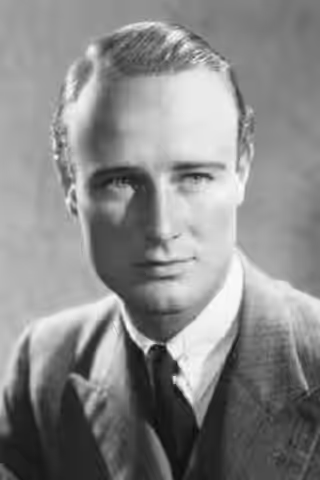
Anthony Bushell was cast for his bearing before he was cast for anything else, and Hollywood spent it on juvenile lovers. Once someone put him in a uniform and gave him a decision to make, the stillness started to earn its keep.
Fi1m perspective
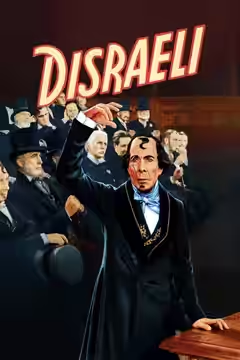
In Disraeli (1929), Anthony Bushell's Lord Charles Deeford is told by the Prime Minister to make himself useful, and he goes away and does it somewhere we cannot see. That is the shape of his first Hollywood years. He was tall, well spoken and good in a collar, and the studios took one look and gave him young men whose job was to want a girl and wait for her. It is the least interesting thing you can do with a man who stands like that.
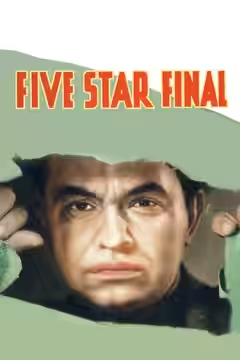
His talkies began with Disraeli, on George Arliss's recommendation, and the parts that followed had more spine in the writing than in the acting. In Journey's End (1930) he was Second Lieutenant Hibbert, the officer in the dugout who cannot face going up the line, and the uniform stuck. By Five Star Final (1931) he is Phillip Weeks in a newspaper picture we like a good deal, and our own review does not mention him, which is a kind of note in itself: he does the job and stays out of Edward G. Robinson's way. He went back to Britain in 1932, played Sir Andrew Ffoulkes in The Scarlet Pimpernel (1934), and then spent the war in the Welsh Guards, which is the point at which the officer stopped being a costume.
What works, after that, is authority. Post-war casting reached for him whenever a scene needed a man to receive bad news standing up, and the parts people still remember him for, Captain Rostron in A Night to Remember (1958) and Colonel Breen in the BBC's Quatermass and the Pit (1958), are men defined by their rank. He never seems to be performing steadiness; he has it, and the camera reads it off his posture and his vowels. What does not work is anything that asks him to be lit from inside. Watching Disraeli we were bored by his scenes with Joan Bennett, and then faintly irritated that a 90-minute film had found room for them, because the man plainly had something and the picture had no use for it.
The second half of his career is the odder one. From Hamlet (1948), in which he also took an uncredited bit part, he worked beside Laurence Olivier as associate producer and associate director, and from 1950 he directed features of his own and later television, Danger Man and The Saint among them. His first feature, The Angel with the Trumpet (1950), was thought slow at the time. He retired in 1964.
If you want to see what he was for, begin with him in uniform and in middle age. Leave Disraeli until last, and watch the young lovers as a lesson in what Hollywood did with Englishmen of good posture before anyone had worked out what else they could do.
Biography
Anthony Bushell (also credited as Anthony Arnatt Bushell) was an English actor and director. Born in Westerham, Kent, he was educated at Magdalen College School and Hertford College, Oxford, before training at the Royal Academy of Dramatic Art. He made his stage debut in 1924 in Diplomacy at the Adelphi Theatre.
Bushell appeared in 56 films between 1929 and 1961, beginning with the role of Lord Charles Deeford in Disraeli (1929). His other screen credits include Five Star Final (1931), The Scarlet Pimpernel (1934), A Night to Remember (1958) as Captain Arthur Rostron, and The Battle of the River Plate (1956). He also directed films such as The Angel with the Trumpet (1950) and episodes of television series including Danger Man and The Saint.
During the Second World War he served as a tank squadron commander in the Welsh Guards, reaching the rank of major. He retired from acting in 1964 and died in Oxford in 1997.