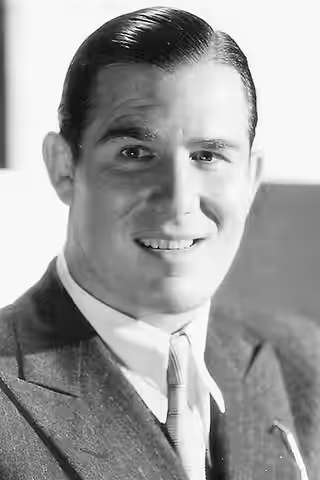
A wrestler's shoulders and a face that reads as slow before he has said a word: Nat Pendleton spent two decades playing heavies, policemen and strongmen, and was at his funniest when a film let him stand still and think.
Fi1m perspective
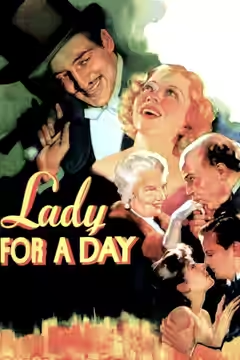
In Lady for a Day (1933) he is a heavy called Shakespeare, one of Dave the Dude's gang, and he stands at the back while Warren William and Ned Sparks do the talking. We laughed at him before he had done anything, and it took a moment to work out why. It is the face: heavy brow, small anxious eyes, the expression of a man adding up a bill and getting a different answer each time. Pendleton had that face and the studios knew exactly what to do with it.
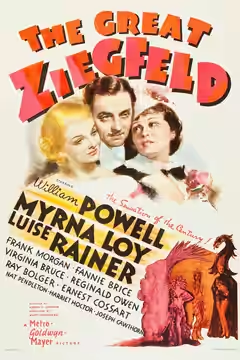
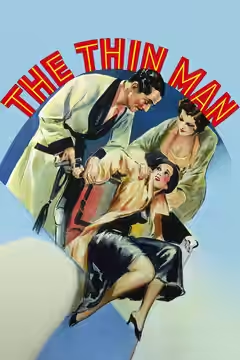
He came to acting from the mat. He wrestled at Columbia and at the 1920 Olympics, then professionally, and the body came with him when he went on stage in the mid-1920s and into films from the end of that decade. By the early thirties the casting was fixed: thugs, cops, strongmen, the slow man in a fast picture. Two parts recurred. He was Lieutenant John Guild, the New York policeman, from The Thin Man (1934) onward, and Joe Wayman in the Dr Kildare films. He was the strongman Sandow in The Great Ziegfeld (1936), a strongman again as Goliath in At the Circus (1939), and a sergeant set against Abbott and Costello in Buck Privates (1941). He kept working in features until 1947 and did some television into the fifties.
The limits are plain in The Thin Man. Guild is a broader sort of comedy than Powell and Loy are playing, and the gap shows; W.S. Van Dyke, who directed him four times, uses him as the plodder Nick can run rings round, and once the joke is established there is nowhere else for it to go. That is the trouble with the lunkhead as a type. A film can use him for punctuation and not much more, and Pendleton was almost never given more. Lady for a Day is the better showing precisely because Capra asks so little: each of the Runyon crowd gets a turn, Pendleton's is the shortest, and he registers anyway. The Sandow role drew the best notices he ever had, and if the type interests you that is the one to look for.
Nobody built a film around him, and probably nobody should have. He was the man in the doorway who makes the doorway look small, and that is a job, done here for twenty years without visible strain. Start with The Thin Man if you want the policeman, and Lady for a Day if you want the face.
Biography
Nat Pendleton (born Nathaniel Greene Pendleton) was an American actor and former wrestler. He was born in Davenport, Iowa, and studied at Columbia University, where he was twice Eastern Intercollegiate Wrestling Association champion in the 175 lb class (1914–1915) and graduated in 1916. He represented the United States at the 1920 Summer Olympics in Antwerp, winning a silver medal in heavyweight freestyle wrestling.
After turning professional, Pendleton moved into acting and appeared in over 100 films, often typecast as strongmen, thugs or policemen. He is credited as Shakespeare in the 1933 Frank Capra film Lady for a Day. Among his other roles are MacHardie in Horse Feathers (1932), Lieutenant Guild in The Thin Man (1934) and Another Thin Man (1939), Sandow in The Great Ziegfeld (1936) and Sergeant Michael Collins in Buck Privates (1941). He also wrote the 1932 film Deception, in which he starred. Pendleton died in San Diego, California, in 1967 and was inducted into the Columbia University Athletics Hall of Fame in 2006.