A Broadway director who filmed his own hits and made them wider without making them better. Logan was good with actors and poor with scale; the best scenes in his films happen in back yards, and the worst on horizons.
Fi1m perspective
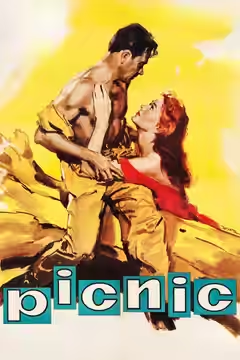
When a speech in Picnic (1955) runs long, Joshua Logan has the actor turn and deliver it to the horizon, and in CinemaScope Kansas there is a great deal of horizon. It is the habit that tells you where he came from. He had directed William Inge's play on Broadway, where a long speech to the back wall is the job, and he brought the same instinct to a camera standing a few feet from the actor's face. Lines that carried across a theatre come out sounding recited, and George Duning's music swells under every confession until we stopped believing the confessions.
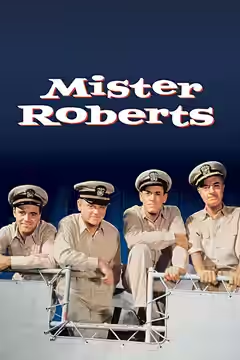
He was a stage man first and for longest. He co-founded the University Players at Princeton with Henry Fonda and James Stewart, studied with Stanislavsky in Moscow, and by the late 1940s had directed Annie Get Your Gun (1946) and co-written and directed Mister Roberts (1948) and South Pacific (1949). Films came in the 1950s, and nearly all of them were his own hits or someone else's: Mister Roberts (1955), on which he holds the screenplay credit and finished the direction after John Ford fell ill; Picnic; Bus Stop (1956); Sayonara (1957); South Pacific (1958). The 1960s brought Camelot (1967) and Paint Your Wagon, which we have not reviewed and which were widely thought ponderous.
What works is the actors, always. Holden's bruised swagger and Rosalind Russell's desperate schoolteacher are the reasons to sit through Picnic, and in Bus Stop he drew one of Marilyn Monroe's strongest performances. The slow dance on the lit pier in Picnic is the one scene where the music is exact and nobody is reciting, and we believed every second of it, because for once Logan let two people stand close and say nothing. Jo Mielziner's back yards, two frame houses and a shared fence, are where the film feels as small as the play, and that is where the good scenes are.
What does not work is everything larger. Every time Logan leaves the yard for a bigger view, the people shrink. In Mister Roberts the crew he and Thomas Heggen wrote as a chorus stay a chorus, and when the film goes ashore the comedy goes wide, with brawls and men carried back up the gangway, and a rueful play becomes a service farce any studio could have made. The complaint against Picnic was that he had inflated a modest play, and we agree with the diagnosis if not the sentence.
He said in 1953 that "Direction should be so clean and so modest and so invisible that it can't be noticed at all." On stage, by all accounts, it was. On film you notice it every time the frame widens. See Mister Roberts for Fonda and Picnic for the pier, and when the camera turns to the horizon, wait; it will come back to the porch eventually.
Biography
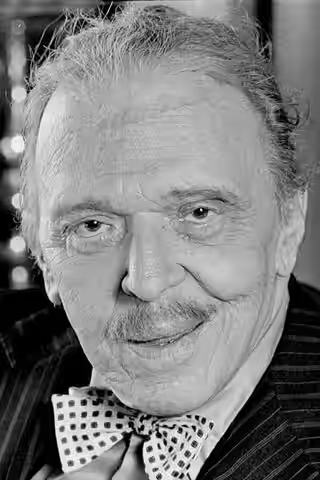
Joshua Logan (1908–1988) was an American stage and film director, writer and producer. Born Joshua Lockwood Logan III in Texarkana, Texas, he began his career in theatre, acting and directing with the University Players while at Princeton University.
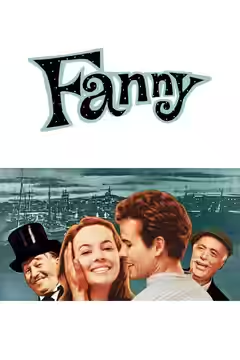
He achieved major success on Broadway, directing and often co-writing productions including Mister Roberts (1948), South Pacific (1949) and Picnic (1953). His film work included directing Picnic (1955), for which he received a Golden Globe, and contributing to the screenplay of Mister Roberts (1955); other credits include Bus Stop (1956), Sayonara (1957), South Pacific (1958), Fanny (1961), Camelot (1967) and Paint Your Wagon (1969). He received Tony Awards for his stage work and shared a Pulitzer Prize for Drama for South Pacific.