Joshua Logan’s version of Pagnol’s Marseilles story is handsome, slow and sentimental, and for long stretches we did not mind. Jack Cardiff makes the harbour look like a place worth staying in, and Charles Boyer and Maurice Chevalier carry everything the young leads cannot.
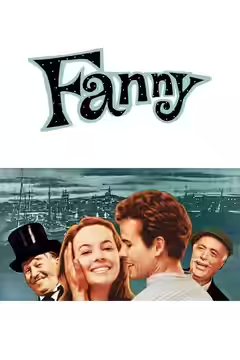
Marcel Pagnol told this story three times in the 1930s, in a trilogy of plays beginning with Marius and Fanny, and it has been told several times since. Joshua Logan’s version comes by way of the Broadway musical he staged in the 1950s with songs by Harold Rome. For the film he has cut the songs and kept the tunes, which play under the dialogue as if a band were rehearsing in the next room. Julius J. Epstein’s screenplay folds the three plays into 133 minutes, and it is a genial, unhurried piece of work that knows which of its characters are the interesting ones.
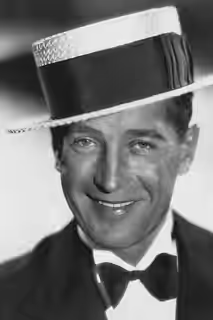
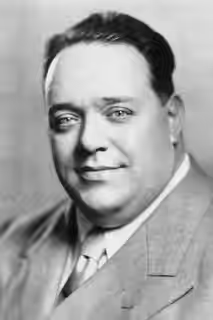
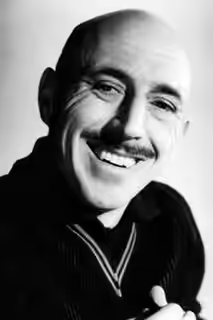
The interesting ones are the old men. Charles Boyer plays the father, who keeps the bar on the quay, shouts at everyone he loves and cannot understand why his son would want to be anywhere else. Maurice Chevalier plays Panisse, the well-off widower across the way who has decided that what his life lacks is a young wife and, in time, someone to leave the shop to. Chevalier does his familiar twinkle, and for the first half hour we resisted it. Then Boyer and Chevalier are put in a room together to argue about who owns whom, and both of them stop performing and start talking, and we gave in.
Boyer moved us more than we expected. The father is written as a comic bully, and Boyer plays the comedy, but in the scene where he understands that his son means to go he says almost nothing, and the film goes quiet with him. It is the best thing in it. Logan came from the stage and knows to leave a good actor alone in a wide shot, and he leaves Boyer alone.
Jack Cardiff shoots the harbour in the middle of the day, which is the hardest light to make attractive, and makes it attractive anyway: white boats, blue water, awnings, a fish market where every stall has a colour of its own. He goes close on faces when the story needs it and pulls back to the whole port when it does not, and the pulling back is where the film breathes. Anne-Marie Marchand dresses Fanny plainly and Panisse like a man who has never carried a fish in his life. The picture is a pleasure to look at even in the stretches where it is not much of a pleasure to listen to.
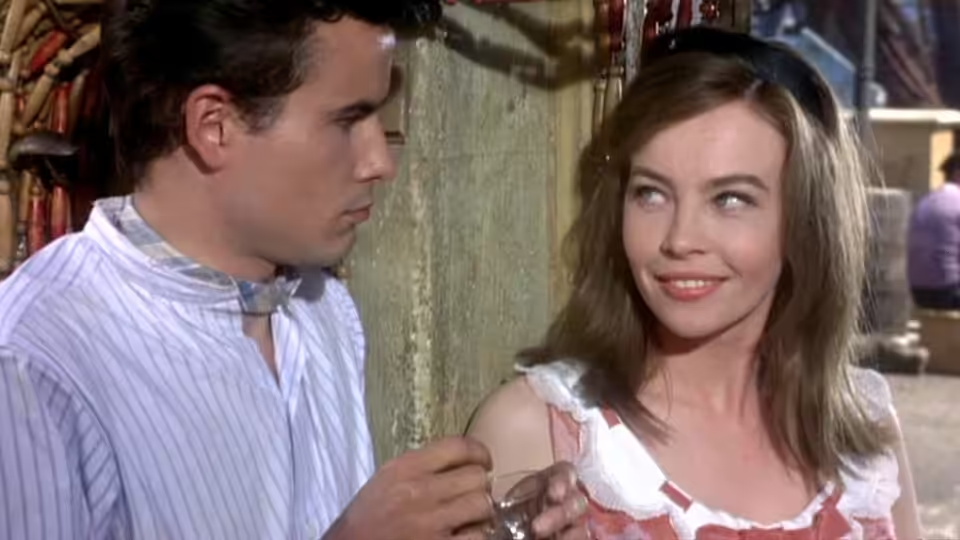
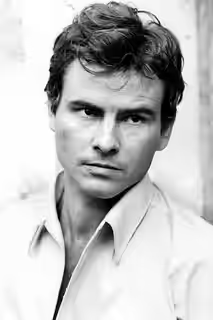
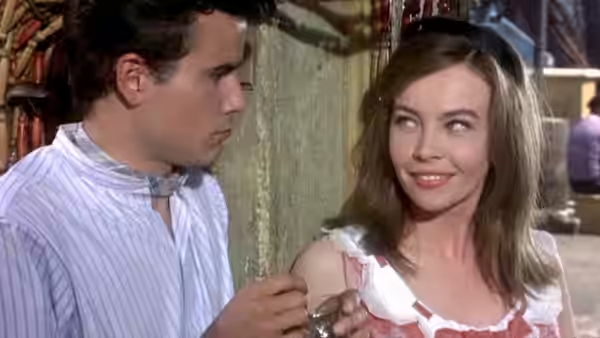
Those stretches belong to the young. Leslie Caron is good as Fanny and does a great deal with waiting, which is most of what the part asks; when she looks at Marius you believe she has been looking at him since childhood. Horst Buchholz is the problem. Marius is meant to be torn between a girl and the sea, and Buchholz plays a man who has already left and is being polite about staying for dinner. Their love scenes have no heat, and a film called Fanny that cannot make you mind whether Fanny gets her man has a hole in the middle of it. Our attention drifted in the middle hour, and we knew whose scenes we were waiting for.
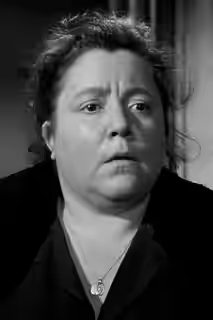
Around the edges the bar is well stocked. Georgette Anys is Honorine, Fanny’s mother, who can price a suitor faster than a fish. Salvatore Baccaloni’s ferryboat captain Escartifique and Lionel Jeffries’s Monsieur Brun sit at the same table for what feels like the whole film, arguing about nothing, and it is funnier whenever they are on. The second half turns on what becomes of Fanny after the ship has gone, and we will not describe the arrangement it reaches, except to say that it is about what a family is and who gets to decide, and that Chevalier plays it without a song to fall back on and is the better for it. William H. Reynolds cuts all of it at a walking pace. Some of that is Logan’s choice and some of it is just length; there is a quarter of an hour here that nobody would miss.
It is a film for a Sunday afternoon. Put it on when the light outside is going, let the harbour fill the screen, and forgive the young for being dull. The old men will see you through.