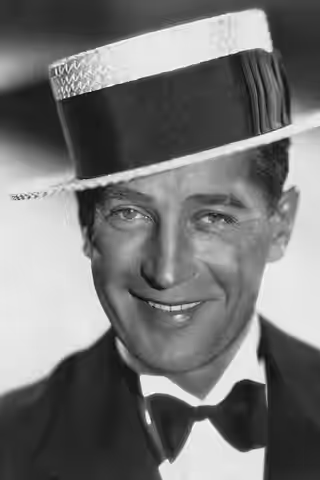
Chevalier played half of every scene to the stalls, boater tipped, accent thickened for export, singing as if he were talking. In The Love Parade it is the sharpest thing on the screen; over a decade it hardened into a routine.
Fi1m perspective
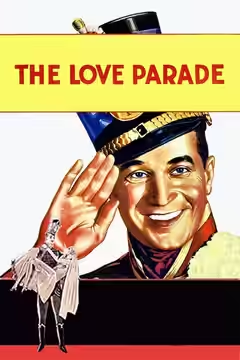
Early in The Love Parade (1929) a husband walks in on Chevalier's Count Alfred Renard and his wife, fires a pistol, and nobody falls, because it is loaded with blanks. Chevalier turns to the camera and shrugs at us. We laughed out loud, and it was the shrug that did it: a man in a 1929 talking picture assuming we are in on the joke, and being right. That is the whole act in one gesture. Part of him is always leaning over the footlights to see whether we are enjoying ourselves, and the surprise is how seldom it grates.
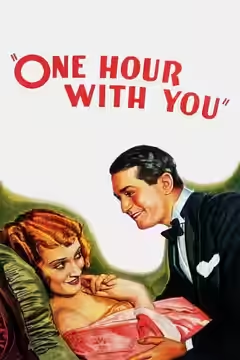
He came out of the Paris cafés and music halls, where he had been singing since 1901, and he never pretended otherwise. The boater, the dinner jacket and the accent, thickened once he was speaking English, came with him to Paramount in 1928 and stayed through six years of musicals, four for Ernst Lubitsch and four opposite Jeanette MacDonald. The Love Parade was the first, and he has never been more useful to a director. Lubitsch wanted a leading man who would treat sound as a toy, and Chevalier's half-spoken singing was exactly that: he did not so much sing a song as confide it. Love Me Tonight (1932) and The Merry Widow (1934) kept the Parisian in the same clothes.
The singing needs explaining, because it is why the rest works. He had almost no voice and knew it. "Thank God, it was my good luck not to have any voice… Since I had no voice, had to find something that would hold the interest of the public." What he found was delivery: the raised eyebrow, the pause before the rude half of a line, the sense that the lyric is a private remark he has decided to share. In The Love Parade the songs carry the story rather than halting it, which is rarer than it sounds. That is also where the limit is. The accent was always a little too perfect, a Frenchman doing a Frenchman for people who had never met one, and people were saying so in 1929. He found the part in that film and spent the following decade repeating it.
He went back to France in the mid-1930s, and Hollywood did not see him again for more than twenty years: Love in the Afternoon (1957) as Claude Chavasse, then Gigi (1958) as Honoré Lachaille, the boulevardier grown old and pleased about it, the part that made him popular all over again. What holds the late work up, so far as we can judge, is what held up the young man: he is glad to be watched and does not hide it.
Start with The Love Parade. If the shrug works on you, the rest of him will. If it does not, twenty minutes will tell you, and he will have enjoyed them more than you did.
Biography
Maurice Chevalier was a French actor, singer and entertainer. Born Maurice Auguste Chevalier in Paris on 12 September 1888, he began performing as a café singer and dancer in the early 1900s. He served in the French army during the First World War, was wounded and captured, and spent time as a prisoner of war where he learned English.
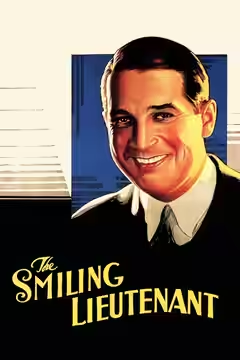
He achieved success on the French stage before moving to Hollywood in 1928. His first American film was Innocents of Paris (1929). He played Count Alfred Renard in Ernst Lubitsch’s The Love Parade (1929) opposite Jeanette MacDonald, and was nominated for the Academy Award for Best Actor for that film and The Big Pond (1930). He appeared in further musicals including The Smiling Lieutenant (1931), Love Me Tonight (1932) and The Merry Widow (1934). Later credits include Love in the Afternoon (1957) and Gigi (1958). Chevalier died in Paris on 1 January 1972.