Film review

Picnic

1955 · Directed by Joshua Logan · 1h 54m · MPA PG

In a sentenceA drifter takes his shirt off in Kansas and the entire state loses its composure

DramaRomance

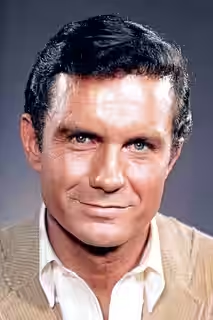
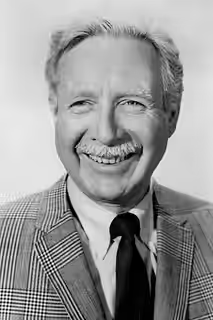
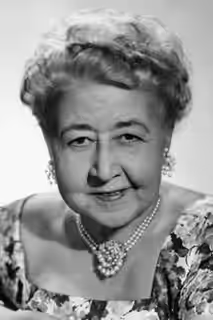
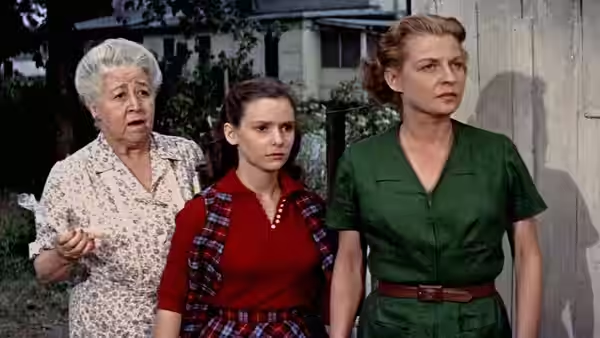
Labor Day morning in a small Kansas town. Hal Carter (William Holden), a drifter with no shirt worth the name, drops off a freight train looking for Alan Benson (Cliff Robertson), an old college friend whose father owns the grain elevators, in the hope of a job. He earns his breakfast doing yard work for Helen Potts (Verna Felton), and next door finds the Owens household: Flo (Betty Field), a mother with plans; Madge (Kim Novak), the town beauty Alan is courting; Millie (Susan Strasberg), the bookish younger sister; and Rosemary (Rosalind Russell), the schoolteacher who boards upstairs and is waiting for Howard Bevans (Arthur O’Connell) to propose. The whole town is getting ready for the picnic. Flo wants Madge married to money by autumn. Hal, in one morning, unsettles all of it.

Plays from YouTube when you press play; nothing loads from them until then.

Fi1m review

Joshua Logan blows William Inge’s small play up to the width of a county and much of it goes soft, but Holden’s bruised swagger, Rosalind Russell’s desperate schoolteacher and one slow dance on a lit pier are worth an evening. Novak is the hole in the middle.

Joshua Logan directed William Inge’s Picnic on the stage, and here he films it in CinemaScope at 114 minutes with Daniel Taradash on the screenplay. The idea underneath is a good one and a simple one: a handsome stranger walks into a town on a public holiday, and by nightfall every woman in it has said out loud what she wants. That works in a room with three walls. The question the film spends two hours answering is whether it survives being made the size of Kansas, and the answer is that about half of it does.

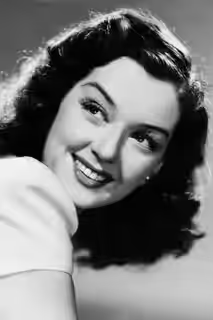
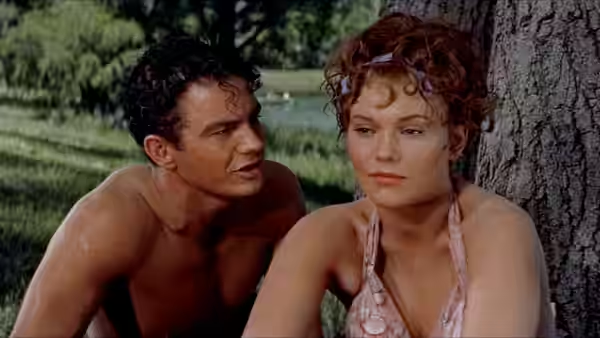
William Holden is the half that does. He is plainly a decade too old to be Alan Benson’s college friend, and rather than hide it he plays Hal as a man who knows the boasting stopped working some years ago and cannot think what to do instead. He talks too loudly, takes the shirt off too readily, and every so often the face goes still and you see how frightened he is. Rosalind Russell matches him from the other side of the fence. Her Rosemary begins as comic relief, the schoolteacher who has opinions on everyone, and turns, a drink at a time, into the most exposed person on screen. There is a scene at the picnic where she goes for his shirt that we found hard to sit through, and we mean that as praise. Susan Strasberg’s Millie, all elbows and library books, is the one person who seems to be enjoying the holiday.

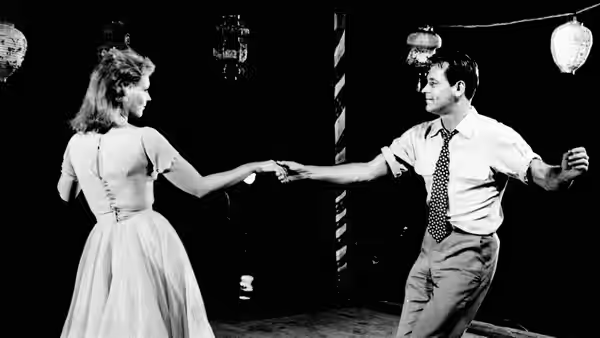
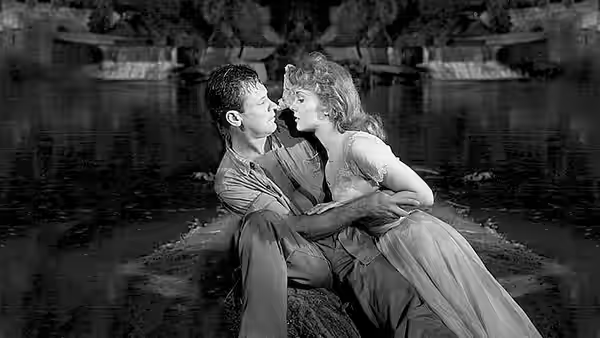
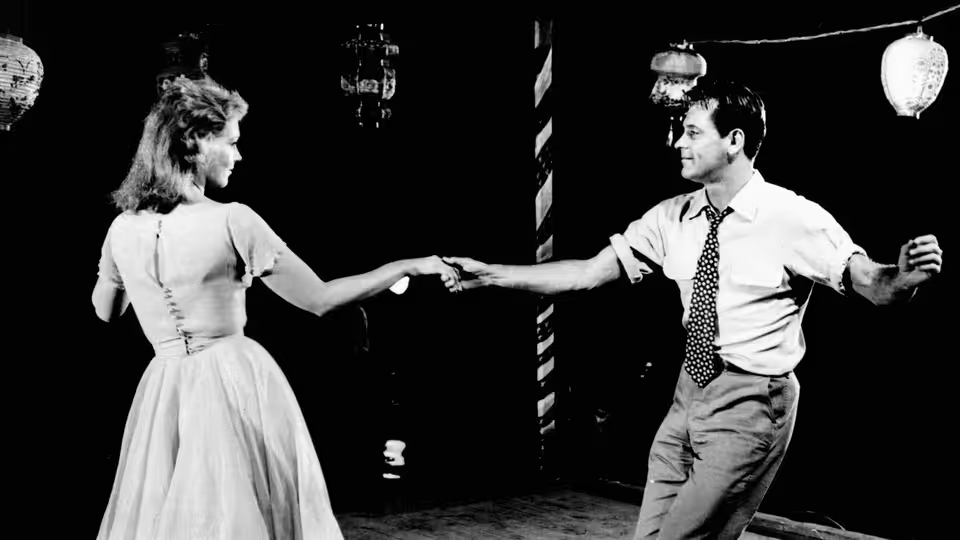
The picnic itself is where the widescreen pays for itself. James Wong Howe fills the frame with what looks like an entire county eating pie, racing three-legged and singing badly on a bandstand, and William Lyon and Charles Nelson cut it as a long afternoon rather than a montage, so that the light goes from white to gold to blue without anyone announcing it. Then Novak comes down the steps of the pier in a dress that was not made for a picnic, George Duning slides his main theme under the dance band, and Holden and Novak dance slowly under strings of coloured bulbs. We were got at by it, against every expectation, and the reason is that for four minutes nobody talks.

When they do talk, the trouble starts. Taradash has kept a good deal of Inge’s stage dialogue, and lines that carried across a theatre sound, in close-up and out of doors, like people reciting. Logan’s instinct when a speech runs long is to have the actor turn and deliver it to the horizon, and there is a great deal of horizon. Duning’s music, so exact in the dance, swells under every confession afterwards until we stopped believing the confessions.

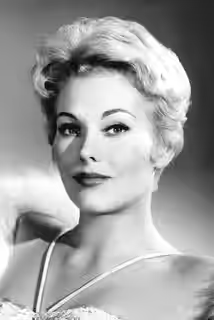
Kim Novak is the larger problem. Madge is a girl who has been told she is beautiful so often she has stopped hearing anything else, and the part needs an actress who can show us what is going on behind the compliment. Novak gives us the compliment. She is lit beautifully by Howe and dressed beautifully, and when she is asked to want something she looks at the ground. Opposite Holden, who is doing too much, she does too little, and the romance the film is built on never quite has two people in it.

Jo Mielziner’s design deserves a word, because the back yards are right: two frame houses, a shared fence, a porch swing, the grain elevators standing at the end of the street like a fact nobody mentions. It is the one place where the film feels as small as the play, and it is where the best scenes happen. Every time Logan leaves the yard for a bigger view, the people shrink.

The reviews so far lean against the film, and the complaint is the same one: that Logan has taken a modest play and inflated it. We agree with the diagnosis and not with the sentence. The inflation is real, but it did not reach Holden, or Russell, or the pier, and a film with three things in it that good is not a failure.

See it for the picnic sequence and for Russell, and forgive it the speeches. It suits a summer evening at home with the windows open, where the horizon shots matter less and the back porch matters more.
Critical consensus AI synthesised

40
Positive
2
Mixed
0
Negative
3

With only 5 reviews in so far, the critics lean against Picnic, and the complaint is the same each time: Joshua Logan’s CinemaScope treatment blows William Inge’s small play up into something loud and sprawling, with the New Yorker in particular objecting to choirs, portentous camerawork and music that drowns the story of a drifter unsettling a Kansas town. Where praise clusters it is on the cast, and above all on Rosalind Russell’s spinster schoolteacher, singled out by both Empire and Variety. William Holden is found forceful; Kim Novak divides them, effective for Variety and flat for Time Out. Empire, the warmest, still calls the dialogue dated.

Empire
13 March 2007 · Kim Newman
70*

The critic finds the film a charming but dated widescreen adaptation of the William Inge play, praising its sweet-and-sour entertainment and standout performances like Rosalind Russell's drunken spinster and Susan Strasberg's kid sister, while noting the poetic dialogue hasn't aged well.

Read the full review →
Variety
31 December 1954
70*

The film enlarges the stage play with new scope and style in its presentation while preserving the mood and substance of Inge's work. Holden gives a forceful performance as the drifter, Novak is effective as the awakening beauty, and Russell stands out as the spinster schoolteacher.

Read the full review →
The New York Times
19 February 1956 · Bosley Crowther
30*

The film expands the play into a sprawling CinemaScope spectacle of lust and community frenzy in a Kansas town, with the central romance often lost amid the big-picture excess. Logan, who also directed the stage version, leans fully into the wide screen's pictorial demands rather than approximating the intimate stage drama.

Read the full review →
Time Out
10 September 2012 · DP
20*

The critic finds the film an enormously tedious and overblown adaptation of the play, typical of histrionic small-town stories from the 1950s. Some performances are reasonable but Kim Novak is completely flat in a key role.

Read the full review →
The New Yorker
18 February 1956 · John McCarten
10*

Logan's CinemaScope adaptation inflates Inge's modest play into an overblown Middle Western extravaganza with massive choirs, portentous camerawork, and overpowering music that overwhelms the simple story of a drifter stirring up a Kansas town's women. The result is a garish, inflated spectacle far removed from the play's quiet emotional core.

Read the full review →

Cast

Awards

Academy Awards, 1956

Nominated
Best Director
Nominated
Best Original Dramatic or Comedy Score
Nominated
Best Picture
Nominated
Best Supporting Actor
Won
Best Art Direction, Color
Won
Best Film Editing

If you liked this, try…

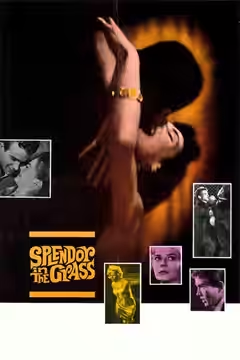
Splendor in the Grass poster

Splendor in the Grass

1961 · Inge again, on Kansas and wanting, with the anguish this time earned.

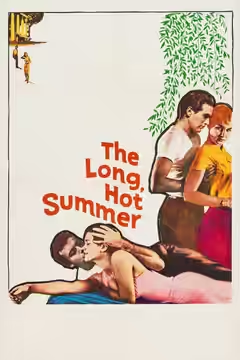
The Long, Hot Summer poster

The Long, Hot Summer

1958 · Another drifter unsettles a small town; Newman and Woodward do the smouldering properly.

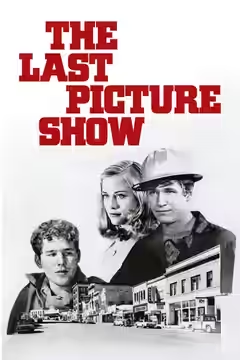
The Last Picture Show poster89

The Last Picture Show

1971 · The same small-town desperation, shot flat and quiet, with nobody declaiming at the horizon.

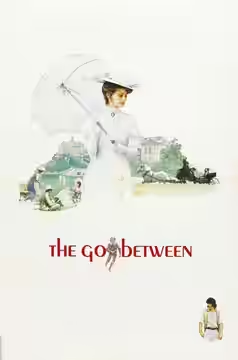
The Go-Between poster

The Go-Between

1971 · An English summer, class and a boy carrying letters he does not understand.

All That Heaven Allows poster

All That Heaven Allows

1955 · The same year, the same disapproving neighbours, and Sirk knows exactly what he is doing.