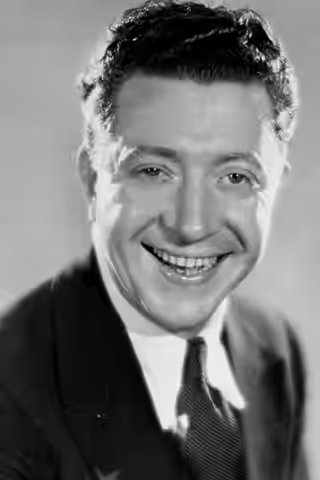
Frank McHugh spent the 1930s at Warner Bros as the friend: the hangdog face at James Cagney's elbow, the nervous laugh, the sidekick who never wanted to be here. Seldom given much to do, he did it well, and the films are thinner without him.
Fi1m perspective
Watch the man standing slightly behind the star. In a Warner Bros picture of the 1930s that is usually Frank McHugh, and his face is doing the work before he has a line: eyes down, mouth pulled in, the look of someone who has just heard the plan and does not think much of it. Then the laugh, high and nervous, which tells you he will go along with the plan anyway. He put it himself, later: "Mostly I wound up as the friend—dumb but loyal. I guess my dumb look was convincing." It was.
He came out of vaudeville and stock companies as a child, reached Broadway in The Fall Guy in 1925, and went to Warner Bros under contract in 1930. He then made more than 90 films in a dozen years, nearly all of them in support: the jittery reporter McCue in The Front Page (1931), comic relief in Footlight Parade (1933), Danny Green at Cagney's side in The Roaring Twenties (1939). He and Cagney made eleven films together, he and Allen Jenkins twelve, and Pat O'Brien was often in the frame as well. The studio kept a stock company and McHugh was its reliable drunk, its Irish-American pal, its mechanic and its buddy, whichever the week required.
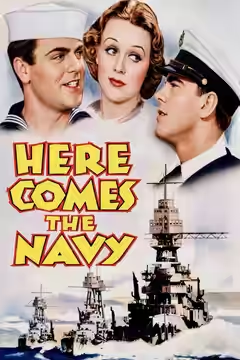
Here Comes the Navy (1934) shows the job at its most typical. Cagney needles, O'Brien bellows, and McHugh's Droopy Mullins is the sidekick who did not want to be here and says so with his shoulders. We liked him more than the film seems to, because in a picture that treats the Navy as a great lark his reluctance is the only reaction that looks like a person's. The film gives its best supporting minutes to Maude Eburne as his mother, and he takes that in his stride too; it is what friends are for.
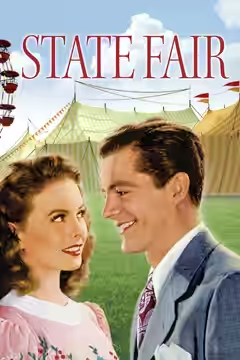
By State Fair (1945) he was the song plugger McGee, working hard around the edges of a Walter Lang musical that did not give him or Harry Morgan much to work with. That is the risk of the trade. A supporting player depends on the writing coming to him, and when it does not, all he can do is be present and alert, which McHugh always was. Going My Way (1944), as Father Timothy O'Dowd alongside Bing Crosby, asked him for the comedy and something quieter as well; we have not reviewed it and will not judge it here.
The parts got smaller in the 1950s, though The Last Hurrah (1958) gave him Festus Garvey in a serious political drama, and after that came radio and television, including The Bing Crosby Show in 1964 and 1965. His last film was Easy Come, Easy Go in 1967. Nobody ever built a film around Frank McHugh, and he seems not to have expected one. Look for him in the Cagney pictures, a step to the left of the star, and notice that the scene is funnier for having him in it.
Biography
Frank McHugh was an American film and television actor. Born in Homestead, Pennsylvania, he came from a theatrical family and began performing on stage as a child. He made his Broadway debut in 1925 and was signed by Warner Bros. as a contract player in 1930.
McHugh appeared in more than 150 films, often in supporting roles or providing comic relief, and worked with many of the studio's stars. He was a close friend of James Cagney and appeared with him in eleven films between 1932 and 1953. Among his notable roles are McGee in State Fair (1945), Droopy Mullins in Here Comes the Navy (1934), and parts in The Roaring Twenties (1939), Going My Way (1944) and There's No Business Like Show Business (1954). In the 1960s he had a recurring role on the sitcom The Bing Crosby Show.