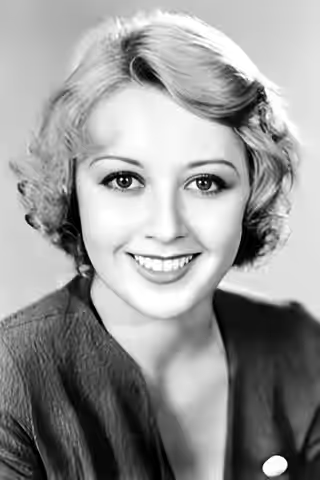
Joan Blondell delivers a wisecrack without making a fuss of it, and keeps cynical characters likeable. We rate her unforced comedy, though the films too often settle for giving her another version of the same supporting part.
Fi1m perspective
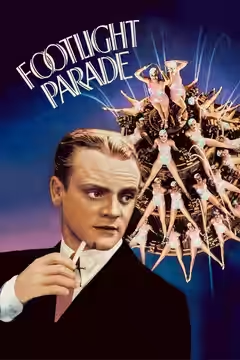
In Footlight Parade (1933), Joan Blondell’s Nan supplies dry comedy beside James Cagney’s alert, restless Chester Kent. She does not make a production of being funny, which matters in a film that spends too long postponing its musical numbers. We were glad of her company during that slow first hour: she makes the comedy feel easy when the plotting is anything but. She and Cagney give us people worth watching before Busby Berkeley’s numbers take over.
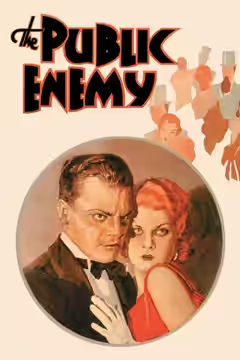
The Public Enemy (1931) gives her a smaller share of our attention, but her Mamie helps show why William A. Wellman’s brisk film works. Its short exchanges need actors who can make the words count without slowing things down. Blondell and Mae Clarke have that assurance; Jean Harlow’s less certain delivery makes their skill easier to hear. Cagney dominates, and this is not a film to approach chiefly for Blondell, but her supporting work belongs to its strengths.
Those parts came during a Warner Bros. run of roughly 50 films in the 1930s, often as wisecracking supporting women or second leads. Cagney was a recurring partner, as was Glenda Farrell in the gold-digging comedies. Blondell brings enough warmth to these cynical parts to keep the women from becoming a succession of sharp replies. The studio’s reliance on that familiar type was a limitation: being good at a particular job meant being asked to do it rather too often.
After leaving Warners in 1938–39, she moved into freelance work and character parts. Aunt Sissy in Elia Kazan’s A Tree Grows in Brooklyn (1945) gave that warmth more room in a dramatic role. Later, John Cassavetes cast her as the cynical playwright Sarah Goode in Opening Night (1977). The worldly women remained, but she had more to do than find the next wisecrack.
We would start with The Public Enemy, accepting that Cagney gets most of the attention. For her comic partnership with him, try Footlight Parade. Allow some patience for the stretches when neither of them can make the story move.
Biography
Joan Blondell was an American actress who performed in film, television and on stage for more than fifty years. Born Rose Joan Blondell in New York City, she began her career in vaudeville with her parents before winning the Miss Dallas beauty contest in 1926. She made her Broadway debut in the Ziegfeld Follies and appeared in several stage productions, including the 1929 play Penny Arcade with James Cagney.
Warner Bros. signed her after the play was filmed as Sinners' Holiday (1930). Blondell became a contract player at the studio and appeared in numerous pre-Code films, often in supporting roles as a wisecracking blonde. She played Mamie in The Public Enemy (1931) and co-starred with Glenda Farrell in nine films. She received an Academy Award nomination for Best Supporting Actress for The Blue Veil (1951).
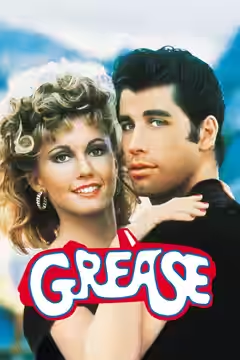
Blondell continued working into the late 1970s, with later film roles including Vi in Grease (1978) and Dolly Kenyon in The Champ (1979). She also appeared in television series such as The Twilight Zone and Bonanza, and received a Tony Award nomination for her stage work.