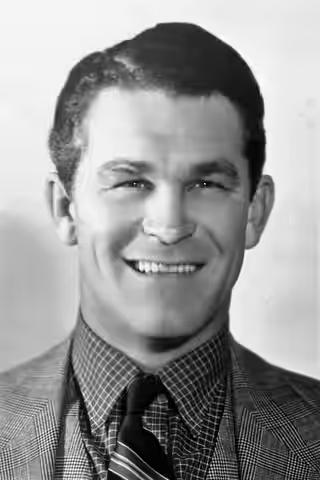
For four decades Guinn 'Big Boy' Williams was the large, amiable man standing just behind the star, usually in a western, often with Alan Hale on the other side of him. Our two encounters with him are small ones, and the better of them earned a laugh.
Fi1m perspective
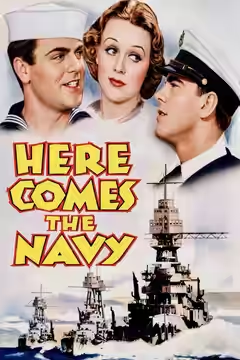
In Here Comes the Navy (1934) he runs a dance hall, and James Cagney walks into it looking for trouble. Williams's job, for a minute or two, is to keep the peace between two men who have plainly come for a fight, and he goes about it with the patience of a man who has broken up this fight before. We laughed out loud, because the fight arrives exactly on schedule and he never for a moment believed it would not. It is a bit part. It is also the whole of what he did, in miniature: the big, reasonable fellow whom nobody listens to.
He came to films in 1919, after the army and a spell playing baseball, and it was Will Rogers who got him through the door; the two of them made fifteen pictures together. He was a lead in silent westerns through the 1920s, though by his own account he began lower down. "I found out that in the old-fashioned, cheap Westerns they had a good-looking guy for the lead, and had somebody who could ride to double for him. I got to be the double." Sound did not trouble him. He led B-westerns for a while, then settled from the early 1930s into supporting work, much of it at Warner Bros.
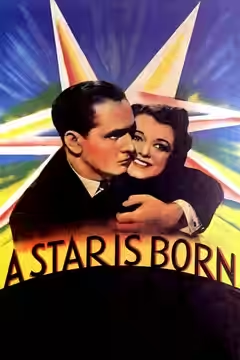
That is where the parts people remember come from. He is Tex Baird in Dodge City (1939) and Windy Brody in Santa Fe Trail (1940), both times beside Errol Flynn and Alan Hale, a trio the studio liked enough to reassemble: four films with Flynn, five with Hale. The type hardly varied. He was the good-hearted sidekick who was either slow on the uptake or quick to anger, with a squint that suggested the plot had got ahead of him. The one complaint anyone has ever made of him is that he was rarely asked to be anything else, in Nevada (1944) or anywhere. The occasional detour, a posture coach in A Star Is Born (1937), only shows how firmly he was fixed in the saddle.
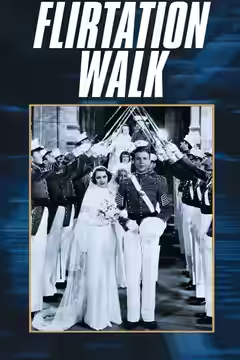
Our own record is thinner. In Flirtation Walk (1934), which we scored 57, he is Sleepy, one of the dopes and heavies filling out the barracks while Ross Alexander takes the good lines, and we barely noticed him; nor, on the evidence, did Frank Borzage. The dance hall is the better showing, and it lasts about as long as it takes to read this.
He kept working to the end, as Lieutenant Finn in The Alamo (1960) and, uncredited, as a gunrunner in The Comancheros (1961), his last film, both with his friend John Wayne. If you want to see what he was for, our two reviews will not tell you. Go to Dodge City, where he has a name, a few lines of his own and Flynn to stand beside.
Biography
Guinn Terrell Williams Jr., known professionally as Guinn 'Big Boy' Williams, was an American actor born in Decatur, Texas. He appeared in films from 1919 to 1961, often in Westerns and supporting roles.
Williams made his screen debut in the 1919 comedy Almost a Husband. He played Sleepy in Flirtation Walk (1934) and the Dance-Floor Manager in Here Comes the Navy (1934). He appeared in Dodge City (1939), Santa Fe Trail (1940), You Only Live Once (1937), A Star Is Born (1937), The Alamo (1960) and The Comancheros (1961). He was frequently cast as a sidekick, including alongside Alan Hale in several Errol Flynn films.