Film review

A Star Is Born

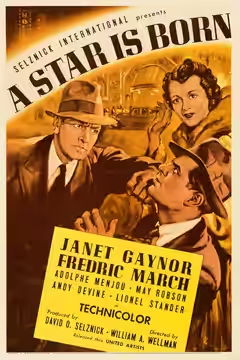
1937 · Directed by William A. Wellman · 1h 51m · MPA NR

In a sentenceHollywood tells her the odds are one in a hundred thousand, then shows her exactly what happens to the one

DramaRomance

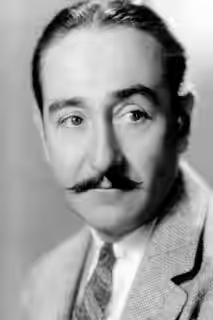
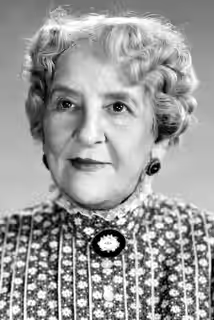
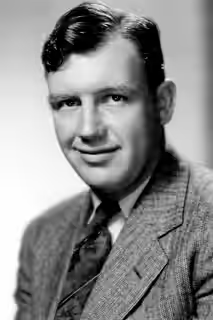
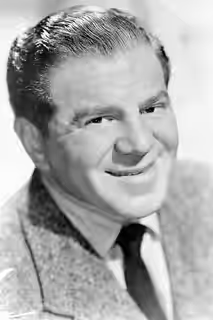
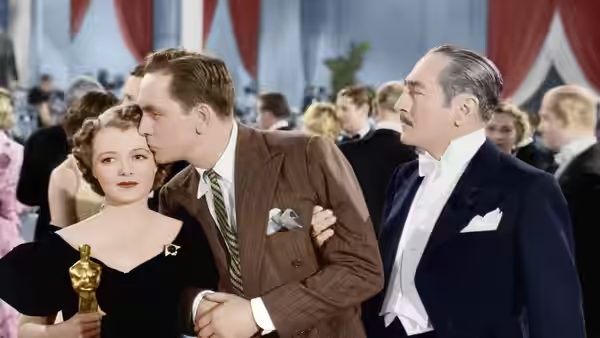
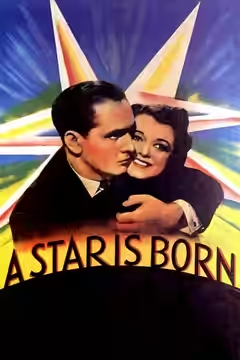
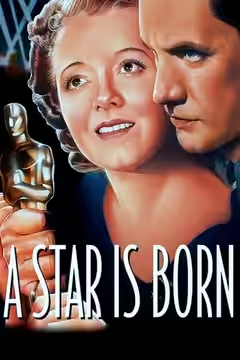
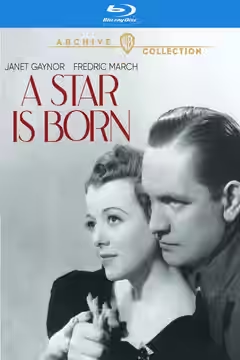
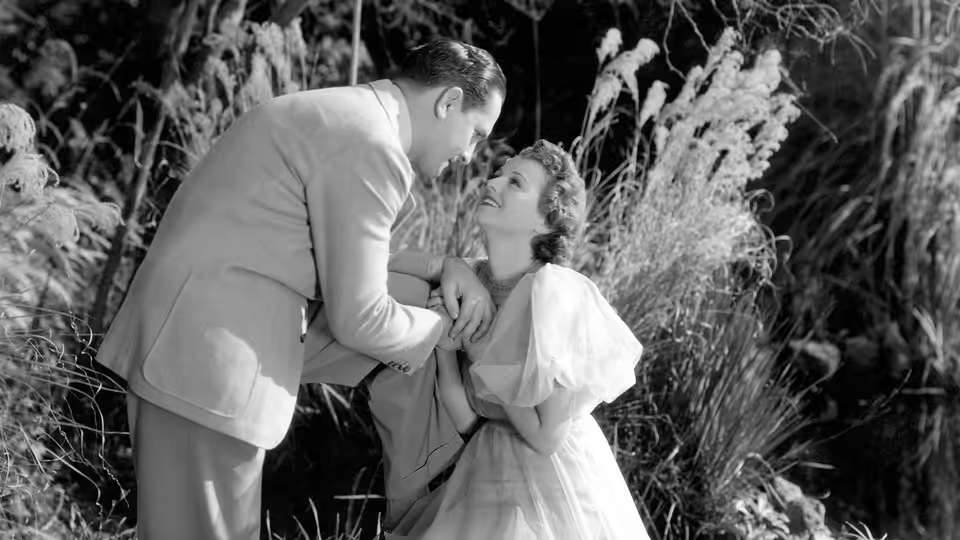
On a farm in North Dakota, Esther Blodgett (Janet Gaynor) reads the fan magazines and wants to be in pictures. Her father (J. C. Nugent) laughs at her; her grandmother Lettie (May Robson) hands over the money she has saved and tells her to go. In Hollywood the casting office turns her away and the boarding-house rent comes due, until an out-of-work assistant director, Danny McGuire (Andy Devine), finds her a night’s work serving at a party. There she meets Norman Maine (Fredric March), a leading man who drinks, and who persuades studio head Oliver Niles (Adolphe Menjou) to give her a screen test. Press agent Matt Libby (Lionel Stander) has spent years cleaning up after Norman and is not pleased to see him take an interest in a waitress.

Fi1m review

The first version of the story everyone knows, and a good one: Fredric March’s charming drunk and Janet Gaynor’s farm girl still hold, and the studio scenes are sharper about Hollywood than any of the remakes. The farmhouse opening is soft, and the middle hurries.

Esther Blodgett wants to be in pictures, and the film’s first job is to explain why a sensible person would want that. William A. Wellman’s A Star Is Born has been remade three times, most famously in 1954 with Judy Garland, and its shape is now so familiar that it is easy to forget somebody had to build it. This is the original, and it is good, with two lead performances that still hold and a harder eye on the studio system than its remakes managed. We would give it an evening without hesitation.

It begins a long way from Hollywood, on a farm in North Dakota, where Esther (Janet Gaynor) reads the fan magazines and her family tells her to grow up. The first twenty minutes are the softest in the film, and we fidgeted through the family supper. Then May Robson’s Grandmother Lettie takes Esther aside, hands over money she has been keeping back, and tells her that every Blodgett who ever amounted to anything got up and went. Robson plays it without a tremor, and we stopped fidgeting. From there the film moves fast: the bus, a boarding house, a casting office where a woman behind a desk explains the odds and means it.

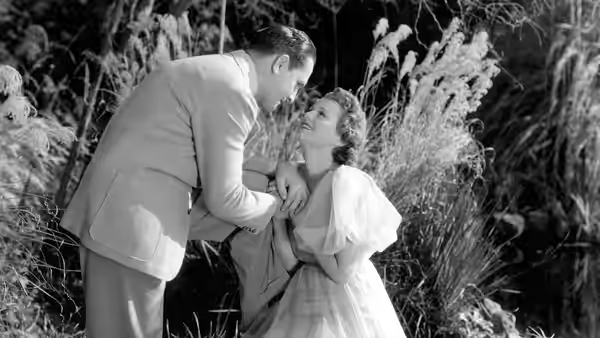
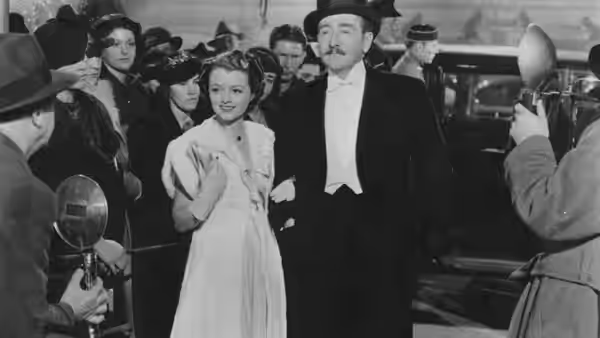
The centre of the film is Fredric March’s Norman Maine, the star Esther marries and then outgrows. March plays a drunk as a man who is funny and knows it, who can switch on the charm the moment he sees a camera and cannot switch it off afterwards. The scene that won us comes at a party, where Esther is serving canapés and Norman, three sheets to the wind, decides to be gallant. We liked him and we dreaded him at once, because March lets us see that Norman has done this before and that it has never ended well. Gaynor’s Esther is quieter, sometimes too quiet, but she has one gift, which is that she never seems to be watching herself. When Norman tells her she has something, we believe him because she plainly has no idea what he means.

W. Howard Greene shoots it in Technicolor, and the surprise is how little he shows off. Most colour films of the period were costume pictures; this one is set in the present, and Greene keeps to daylight, tan stucco, dark suits and the odd red dress. Lansing C. Holden’s studio lot is all plywood and bustle, and Omar Kiam’s costumes for Esther chart her rise better than the dialogue does: a cotton print on the farm, a maid’s black and white at the party, and then the gowns, each a little more expensive and a little less hers. Max Steiner’s score does more work than it needs to in the early scenes and then, sensibly, gets out of the way.

The screenplay is credited to Dorothy Parker, Alan Campbell and Robert Carson, from a story by Wellman and Carson, with Ben Hecht and producer David O. Selznick also among the writers, and you can hear the different hands. The farm is one writer; the studio is another. The studio scenes are the better ones. Adolphe Menjou’s Oliver Niles runs the place as a decent man who has made his peace with being ruthless, and Lionel Stander’s press agent Matt Libby is the film’s sharpest creation, a man who has spent years covering for Norman and hates him for every hour of it. Stander gets the best lines and delivers them as if he resents having to.

It is not perfect. The middle stretch, in which Esther becomes Vicki Lester and the montages take over, is cut by James E. Newcom with more efficiency than feeling, and a marriage that ought to take time to sour does so in about four minutes of screen time. Andy Devine’s Danny McGuire, the assistant director who befriends Esther early on, is given less to do than his first scenes promise. And the second half goes somewhere we will not describe, except to say that Wellman does not flinch from it.

It runs 111 minutes and did not reach British cinemas until 17 December 1939. Watch it before the 1954 version if you can. Garland’s is the bigger film; this is the one made by people who had worked in the town and kept notes.

Critical consensus AI synthesised

77
Positive
6
Mixed
0
Negative
0

All six reviews are positive, and the praise gathers in the same places. Most critics find the story of a young actress on the way up, married to a star on the way down, honest and human, and a convincing picture of Hollywood rather than a burlesque of it. Janet Gaynor and Fredric March are singled out again and again, March in particular for the husband’s decline. William A. Wellman’s direction is called expert and spirited, and the 1937 reviews note approvingly that Technicolor proves its worth in a modern story.

The spread is narrow: two reviews are enthusiastic, four are warm but plainer. The reservations are mild. Time Out finds the opening sentimental before the film sharpens into something more caustic about the studio system. Slant Magazine notes it is usually ranked behind the 1954 remake, while arguing for Wellman’s version. Nobody thinks it fails; the gap is between those calling it a triumph and those calling it good entertainment.

The Hollywood Reporter
5 October 2018 · THR Staff
90*

The review praises the film as a triumphant entertainment that authentically portrays Hollywood while weaving a poignant love story between a rising star and a declining one. It highlights the strong performances by Janet Gaynor and Fredric March, effective use of Technicolor, and William A. Wellman's direction.

Read the full review →
Variety
1 January 1937
90*

Unquestionably the most effective film yet made capitalizing on Hollywood's international reputation. The story of a young girl rising to fame while her husband descends is honest and moving, with love as heroine and alcohol as villain; Janet Gaynor and Fredric March give sustained lovely and finely drawn performances.

Read the full review →
Slant Magazine
12 February 2012 · Jaime N. Christley
70*

The critic views the 1937 film as typically regarded as second-best to the 1954 remake but commends Wellman's spirited direction, the balanced mix of comedy and tragedy, and the compelling performances of Janet Gaynor and Fredric March that give the familiar story emotional weight.

Read the full review →
The New Yorker
24 April 1937 · John C. Mosher
70*

A pleasant movie about Hollywood that is quite human, presenting the lives of film actors with reserve and sense rather than burlesque or lunatic drama. It is a romantic sketch of success in Hollywood, with the marriage of two stars—one rising, one sinking—handled effectively, especially by Fredric March.

Read the full review →
The New York Times
23 April 1937 · Frank S. Nugent
70*

The film is good entertainment by any standards, including the artistic, with a convincing Hollywood story full of drama in its own backyard. The script is bright, inventive and forceful, Mr. Wellman's direction is expert, and the color proves Technicolor's value in a modern story.

Read the full review →
Time Out
10 September 2012 · TM
70*

The 1937 Wellman version starts sentimentally but develops a much more caustic edge, maintaining a bitterly critical distance from the Hollywood dream factory. This is because the real-life tragedies inspiring the script were closer in time than for the 1954 remake, making for a fascinating comparison between the two films.

Read the full review →

Cast

Awards

Academy Awards, 1938

Nominated
Best Actor
Nominated
Best Actress
Nominated
Best Director
Nominated
Best Picture
Nominated
Best Writing, Adapted Screenplay
Won
Best Story

If you liked this, try…

What Price Hollywood? poster

What Price Hollywood?

1932 · The Cukor film this one borrowed its bones from; brisker, nastier, shorter.

A Star Is Born poster

A Star Is Born

1954 · Garland and Mason make it bigger and sadder; see the original first.

Sunset Boulevard poster93

Sunset Boulevard

1950 · The star who did not accept the decline, and the screenwriter who moved in.

Veronika Voss poster

Veronika Voss

1982 · Fassbinder’s fading actress in post-war Munich; the same story, colder and stranger.

Opening Night poster

Opening Night

1977 · Gena Rowlands as an actress drinking her way towards a first night, unflinching.