Wellman flew in the First World War and spent the next thirty-five years putting the camera where the danger was. His best films are fast, plain and physical. The rest were made quickly, and it shows.
Fi1m perspective
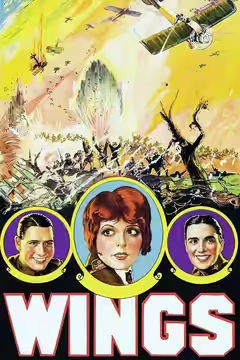
The faces in the cockpits of Wings (1927) belong to the actors, and the wind is flattening their cheeks. That is the shot to start with. William A. Wellman had flown for the French in the First World War before he came anywhere near a film set, and when Paramount gave him two American boys and a war in the air, he put the cameras up with the aircraft and did not fake a frame of it. Nearly a century later the dogfights still hold. The love story on the ground does not, and the film is 144 minutes long.
He had started as an actor in 1919 and got his first credits directing westerns at Fox in 1923, and after Wings he went on to Warner Bros and then freelanced, making more than eighty films across the silent and sound eras. The list is not tidy. The Public Enemy (1931) is the gangster film that launched James Cagney. A Star Is Born (1937) is a melodrama. Beau Geste (1939) is an adventure with Gary Cooper. The Ox-Bow Incident (1943) is a western about a lynching and The Story of G.I. Joe (1945) is a war film with a considerable reputation. His last film, Lafayette Escadrille (1958), went back to the aviators, which tells you where his heart had stayed.
What runs through all of it is a taste for people under pressure and a refusal to dress it up. He worked fast, often satisfied with one or two takes, and it gives the action a documentary flatness that has aged better than most of what his contemporaries were doing. It also made him impatient. In Wings the ground scenes only wake up when he gets restless, and the camera glides forward through a Paris nightclub over the tables and bottles as if it had been drinking too. The moment we still feel is smaller: Cooper walks into a tent as Cadet White, bites a chocolate bar, shrugs off a question about luck and walks out to his aeroplane. He is on screen for perhaps two minutes and the camp goes cold around him. We knew what was coming, and Wellman was right not to show it.
That instinct for a man rather than a performance is the whole of his method, and he said as much in 1952: "Movie stardom isn't about acting ability, it's personality and temperament." It got him Cooper twice and John Wayne three times, and it got him a run of 1930s and 1940s pictures that were competent and no more. The criticism that he was workmanlike is fair for a good part of the list. He did not linger, and some films needed him to.
Start with Wings, for the air, and skip nothing. Then follow him down to the ground, where he was more interested in what a frightened man does than in what an actor can do, and see how often that turned out to be enough.
Biography
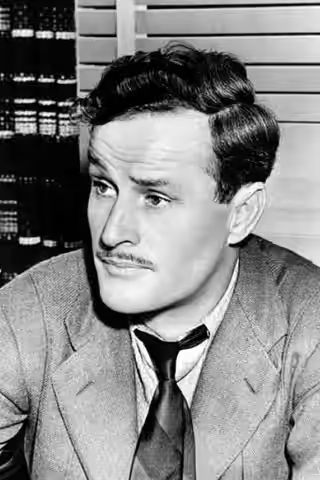
William Augustus Wellman (29 February 1896 – 9 December 1975) was an American film director, producer, screenwriter and actor. A former World War I fighter pilot with the Lafayette Escadrille, he began his film career as an actor before directing his first credited features in 1923. He went on to direct more than 80 films from the silent era through the 1950s.
Wellman is best known for Wings (1927), the first film to win the Academy Award for Best Picture, and for directing The Public Enemy (1931), A Star Is Born (1937), for which he won an Academy Award for Best Original Story, Nothing Sacred (1937), Beau Geste (1939) and The Ox-Bow Incident (1943). He received three further Academy Award nominations for Best Director.