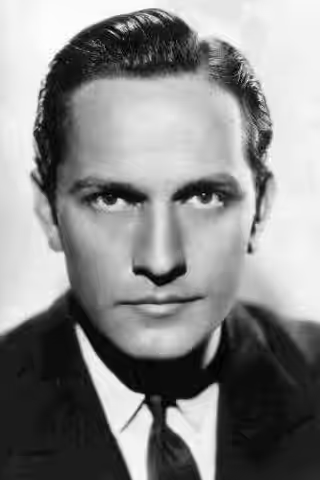
Fredric March had two settings. As a young romantic lead he declares things at people and keeps declaring them; as a man at odds with himself, drunk, ashamed or holding something in, he is a different actor and a far better one.
Fi1m perspective
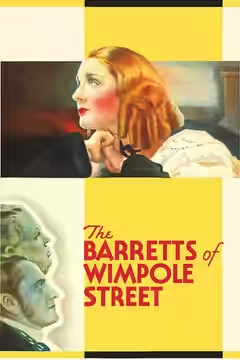
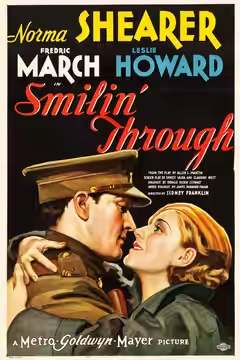
Watch Fredric March come through the door in The Barretts of Wimpole Street (1934). He arrives as Robert Browning with his arms open and his voice up, and he keeps both there for the rest of the film, courting an invalid at the volume of a proposal. Two years earlier, in Smilin' Through (1932), the same director, Sidney Franklin, gave him a dull young hero and a drunk in a flashback, and March did something with the drunk, a thing to do with wounded pride, that was more alive than anything in his love scenes. That is the whole of him in miniature. Give him a good coat and a woman to win and he declares; give him something to be ashamed of and he acts.
He came to films late, after a spell as a bank teller and years as an extra in New York, and Paramount used him first as a leading man. The film that changed things was Dr. Jekyll and Mr. Hyde (1931), two men in one body, and it showed what he could do when the part had a second man inside it. He went freelance in 1933, moved between the stage and the screen for the rest of his life, and his best decade was the 1940s, ending with Al Stephenson, the soldier who comes home in The Best Years of Our Lives (1946). The parts got smaller and stranger after that, and he kept taking them, into his seventies and The Iceman Cometh (1973).
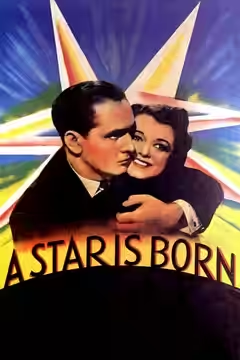
The pattern holds across the career. He has been called stolid in his early Paramount leads, and we found the same in both Franklin films: a fine actor with a poor part, asserting a romance the script had not bothered to write. Norman Maine in A Star Is Born (1937), the actor drinking his way out of his own career, is the Jeremy flashback stretched to feature length. He prepared coldly, learning his lines fast so he could spend the rehearsal on what sat underneath them, and he had no time for the method. It shows: you can see the decisions, and in the good parts they are good ones. Even when he is loud on purpose, as Brady thundering at Spencer Tracy in Inherit the Wind (1960), the volume belongs to the character rather than to the actor.
We will own the irritation. For a long stretch of The Barretts of Wimpole Street we wanted him to sit down, and the reason is plain: a man who never lowers his voice gives Norma Shearer's invalid nothing to lean towards, and gives us nothing to wonder about. The 1950s and 1960s brought him fewer parts worth the trouble, and he knew as well as anyone that the top of the profession is a poor place to stand still. "Stardom is just an uneasy seat on top of a tricky toboggan," he said. Start with the drunks and the men who cannot say what is wrong. The lovers can wait.
Biography
Fredric March was an American actor. Born Ernest Frederick McIntyre Bickel on 31 August 1897 in Racine, Wisconsin, he died on 14 April 1975 in Los Angeles, California.
He appeared as Kenneth Wayne / Jeremy in Smilin' Through (1932) and as Robert Browning in The Barretts of Wimpole Street (1934). March won Academy Awards for Best Actor for Dr. Jekyll and Mr. Hyde (1931) and The Best Years of Our Lives (1946). He also received Tony Awards for Best Actor in a Play for Years Ago (1947) and Long Day's Journey into Night (1956). He is one of only two actors, alongside Helen Hayes, to have won both the Academy Award and the Tony Award twice.
March studied at the University of Wisconsin–Madison and began his career in banking before turning to acting in the 1920s. He worked in New York theatre and films, later becoming a leading Hollywood performer known for roles in A Star Is Born (1937), Inherit the Wind (1960) and Seven Days in May (1964).