Irving Rapper’s film about a Methodist minister’s working life is mild, episodic and slow to get going, and Fredric March holds it together with a performance that never once asks to be admired. The last forty minutes pay for the first sixty.
Irving Rapper’s film is taken from Hartzell Spence’s memoir of his father, a Methodist minister who spent his working life in small Iowa parishes, and it has the shape of a memoir rather than a plot. William Spence (Fredric March) gives up medicine in 1904 to preach, marries Hope Morris Spence (Martha Scott), and goes wherever the church sends him. The film follows them from one draughty parsonage to the next over some thirty years. Nothing is at stake beyond a roof, a salary and a congregation’s good opinion, and the film is content with that. So, for the most part, were we.
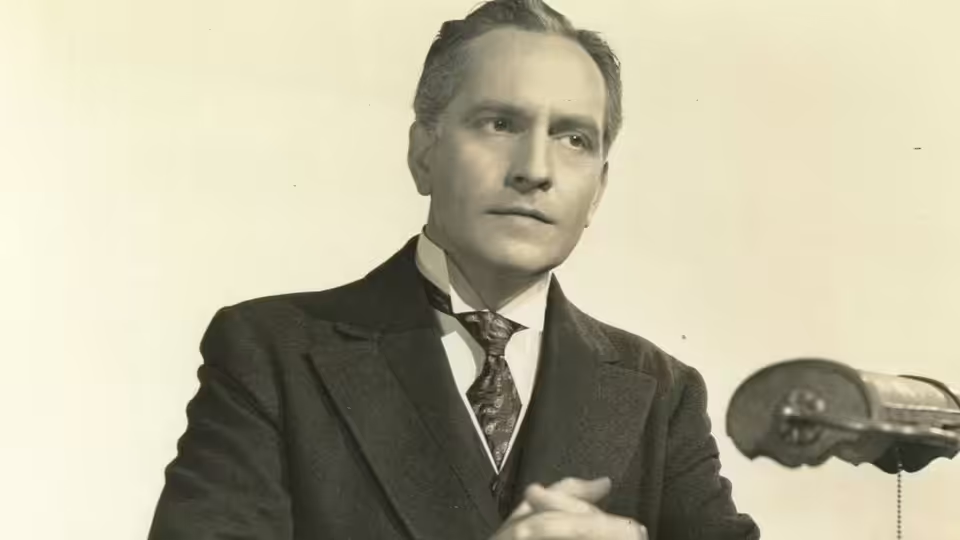
March plays Spence as a man who is certain of God and rather less certain of people, and who knows it. He is stubborn, vain about his sermons, quick to take offence and quicker to laugh at himself once he has calmed down. The performance is built out of small things: the way he bargains with a board of trustees, the way he pauses in a doorway before delivering bad news to his wife. He is never pious in the way film clergymen usually are. He is a working man whose work happens to be souls, and he complains about the pay like anyone else.
The scene most people remember, and rightly, has Spence learn that his son has been to the picture house, march down to see the William S. Hart western for himself so he can condemn it properly, and find a story about honour and sacrifice that he could have preached on a Sunday. We laughed at March leaning forward in his seat with his hat forgotten in his lap, and then something else caught. The film understands that a man can be surprised by his own pleasure and be improved by it, and it does not make a fuss about saying so.
Charles Rosher shoots the parsonages in flat interior light, kitchen tables and bare walls, so that each move looks like a demotion; the churches get the only soft light in the film. Max Steiner builds the score out of hymn tunes and keeps it under the dialogue for long stretches, which is not how Steiner usually behaved, and the restraint suits him. Milo Anderson tracks the decades in Hope’s dresses, from high collars to dropped waists, and it is often the only way you know time has moved. That is because Warren Low’s cutting carries the years by dissolve and caption, and here is the fault. The first half wanders. Whole stretches of the family’s life go by in a title card while a quarrel over a stove gets ten minutes it does not need.
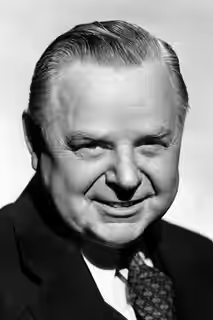
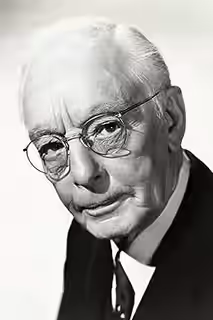
Martha Scott has the harder job. Hope is asked to give up a settled life and then to give up every home she makes, and Scott plays her without martyrdom, one sharp look at a new kitchen doing the work of a speech. Beulah Bondi, as Lydia Sandow, a widow who takes against the new minister on sight, is the film’s best evidence that not every parishioner is a saint. Gene Lockhart and Laura Hope Crews, as the Thurstons, are the moneyed couple whose approval a small church cannot do without, and Lockhart makes Preston Thurston’s smile carry a great deal. Harry Davenport, as Elias Samson, gets less time than we wanted.
The last forty minutes are where the film finds its purpose, in a fight over a new church building and a piece of gossip that puts the family in front of the whole town. We will not describe how either turns out. What we can say is that a passage near the end moved us more than we expected from a film this gentle, because by then we had lived in enough of those bare rooms to know what a proper church would cost, and who would pay.
It is a sermon, and it knows it. Everyone in it is fundamentally decent and even the gossips come round, so if you want your films about faith to have doubt in them, look elsewhere. But it is a sermon delivered by an actor who never raises his voice, and at 108 minutes it does not overstay. Watch it on a Sunday afternoon, which is the time of day it seems to have been made for. The first hour will test you a little and the last will pay you back.