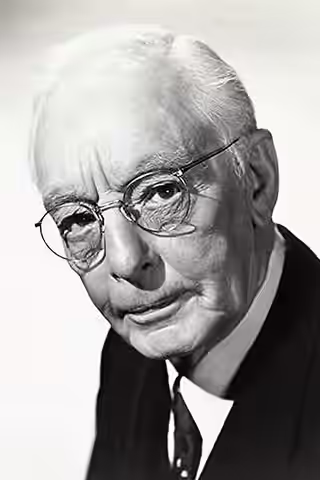
Davenport spent the last fifteen years of his life playing kind old men and stern old men, and made each of them seem to have been there long before the camera arrived. Small parts, done properly, more than a hundred times.
Fi1m perspective
A Harry Davenport character has usually been sitting there a long time before anyone thinks to speak to him. He listens. When he does talk it is in the voice of a man who has heard all this before and sees no cause for alarm, and the scene tends to settle around him. Hollywood cast him as grandfathers, judges, doctors and ministers, over and over, and he played each one as though nobody had told him the part was small.
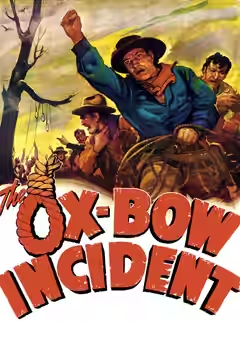
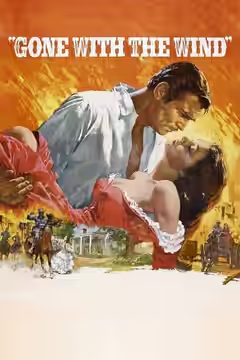
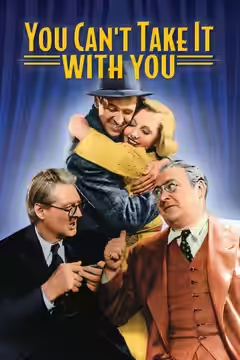
He came to films late for good. He had been on stage since 1871, when he was five, and on Broadway from 1894; he worked in and directed silent shorts from 1913, including the Mr. and Mrs. Jarr series. The sound-era career most people know began in the mid-1930s, when he was nearly seventy, and ran to more than a hundred films before his death in 1949. In that stretch he was the Judge in You Can't Take It with You (1938), Dr. Meade in Gone with the Wind (1939), Louis XI in The Hunchback of Notre Dame (1939), Arthur Davies, the one man against the mob, in The Ox-Bow Incident (1943), and Grandpa in Meet Me in St. Louis (1944).
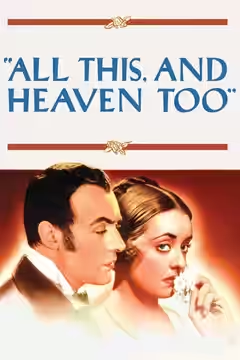
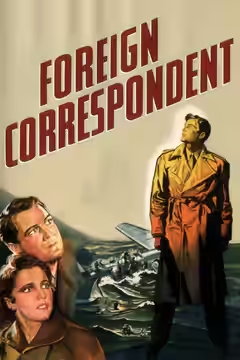
Of the two films of his we have reviewed, Foreign Correspondent (1940) uses him as Mr. Powers, the newspaper editor who sets Hitchcock's chase going, and then gets on with the chase; our review did not stop to notice him, which is roughly what the film does. All This, and Heaven Too (1940) gives him more. He is Pierre, a servant who takes to the governess at once, and our review called it his kind old man, which is accurate and slightly ungenerous. The film is 141 minutes and spends a third of them waiting. We were glad of him in those stretches: he does almost nothing except be sure of the young woman, and being sure, quietly, in a house full of people who are not, turned out to be the thing we held on to.
That is the trick, and it is also the limit. From seventy onward the parts were nearly all old men, and a lesser actor would have let the kindness turn to syrup. What kept Davenport out of it was authority. The Judge, the King, the lone voice of reason at a lynching: he could play the man who is right and disliked for it as easily as the man everyone loves, and the two were not far apart. Asked why he kept working into his seventies, he said, "A man should stand on his feet at any age."
If you find him in something tonight he will be the one who is not worried. Give it a scene and you will not be either.
Biography
Harry Davenport (born Harold George Bryant Davenport) was an American stage and film actor. He worked in show business from the age of six until his death, beginning with a long Broadway career before moving to Hollywood in the 1930s.
He appeared in numerous films, often in supporting roles as grandfathers, judges, doctors and ministers. Notable credits include Dr. Meade in Gone with the Wind (1939), Judge in You Can't Take It with You (1938), Mr. Powers in Foreign Correspondent (1940), Arthur Davies in The Ox-Bow Incident (1943) and Grandpa in Meet Me in St. Louis (1944). He also played Pierre in All This, and Heaven Too (1940).